Best Computer Cables with Pcie 4.0: 10 Spec-Based Picks
As an Amazon Associate we earn from qualifying purchases. Links on this page are affiliate links.
Choosing the right computer cable with PCIe 40 support ensures your graphics card maintains full signal integrity without bandwidth loss. The GLOTRENDS 200mm Right-Angle PCIe 4.0 Riser Cable leads our list because its 200mm reach and shielded 30AWG wiring deliver full 32GB/s bandwidth for mid-tower vertical setups.
This guide compares 10 products based strictly on the specifications published on their official listings. It helps you choose the correct cable length, connector orientation, and form factor for your vertical graphics card build.
Quick picks
The best fit for you
- You need vertical GPU mounting in mid-tower cases. GLOTRENDS 200mm Right-Angle PCIe 4.0 Riser Cable Its 200mm length, right-angle connector, and 30AWG shielded PCIe 4.0 wiring fit standard mid-tower layouts.
- You build inside compact sandwich ITX cases. LINKUP 22cm ITX Double Reverse Riser Cable The double-reverse routing design and 22cm length match small-form-factor ITX chassis requirements.
- You need long cable reach with angled plugs. Thermaltake Dual 90° PCIe 4.0 400mm Riser Cable A 400mm span and dual 90-degree connectors provide clean vertical GPU routing across larger spaces.
- You want to relocate PCIe x1 expansion cards. SinLoon 40cm PCIe 4.0 x1 90-Degree Riser Cable The 40cm length and 90-degree PCIe 4.0 x1 interface reposition secondary expansion cards reliably.
Our 10 picks

GLOTRENDS 200mm Right-Angle PCIe 4.0 Riser Cable
Best for: vertical GPU mounting in mid-tower cases
- Interface
- PCIe 4.0 (what this guide is about)
- Interface Standard
- PCIe 4.0
- Slot Configuration
- x16
- Cable Length
- 200mm
- Connector Angle
- 90 Degree Right Angle
- Maximum Bandwidth
- up to 32GB/s
View on Amazon: GLOTRENDS 200mm Right-Angle PCIe 4.0 Riser Cable
This GLOTRENDS riser cable connects your graphics card via a PCIe 4.0 x16 interface, delivering up to 32 GB/s bandwidth. It measures 200mm in length and features a 90-degree right-angle connector, giving you clearance in standard ATX and mid-tower cases. Built with foil-shielded 30AWG silver-plated copper lines, it prevents signal interference. It suits your build if you mount a modern GPU vertically without manual driver setup or external power.
Pros
- Delivers up to 32GB/s bandwidth on CPU-direct PCIe 4.0 x16 slots
- Individually foil-wrapped 30AWG silver-plated copper wiring for EMI protection
- Right-angle 90-degree connector provides clearance for vertical GPU mounts
- Requires no driver installation or BIOS adjustments
Cons
- Hot swapping is not supported
- Operates at PCIe 3.0 speeds on older hardware setups
Good fit if
- You need a 90-degree right-angle connector for a vertical GPU in a mid-tower case.
- You run PCIe 4.0 hardware and require full x16 bandwidth up to 32GB/s.
Skip if
- You require hot-swapping capability for your add-in cards.
- You need a straight 180-degree connector layout for your case.
Verdict: GLOTRENDS 200mm Right-Angle PCIe 4.0 Riser Cable delivers full 32GB/s Gen4 bandwidth with shielded 30AWG wiring for vertical graphics card installations. Its 200mm reach and right-angle plug make it a dependable fit for standard mid-tower setups.
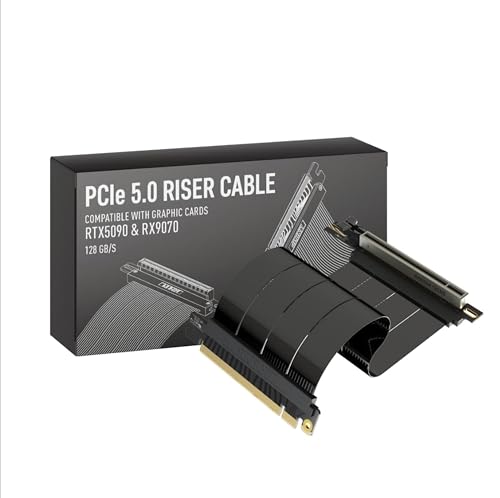
LINKUP 15cm PCIe 5.0 Right Angle Riser Cable
Best for: compact vertical GPU mounting in tight cases
- Interface
- PCIe 4.0 (what this guide is about)
- Interface Standard
- PCIe 5.0
- Slot Configuration
- x16
- Cable Length
- 15cm
- Connector Angle
- Right Angle
- Maximum Bandwidth
- 128GB/s
View on Amazon: LINKUP 15cm PCIe 5.0 Right Angle Riser Cable
This LINKUP riser cable connects your graphics card using a 15cm span with a right-angle connector. Built with multilayer shielding to suppress EMI and crosstalk, it supports full PCIe 5.0 bandwidth while maintaining backward compatibility with PCIe 4.0 setups. The flexible design allows custom folds to match tight chassis layouts. It suits you if you need a compact, low-profile cable for vertical GPU mounting in tight enclosures.
Pros
- Backward-compatible with PCIe 4.0 and supports PCIe 5.0 x16 speeds
- Multilayer shielding suppresses EMI and signal crosstalk
- Right-angle connector fits vertical GPU mounting brackets
- Flexible construction allows custom folding and routing
Cons
- Short 15cm length limits reach in larger PC cases
- Chassis mounting brackets and standoffs are not included
Good fit if
- You need a right-angle connector for a vertical GPU mount.
- You have a compact case with a short distance between slot and GPU.
- You run a PCIe 4.0 system and want bandwidth headroom for PCIe 5.0 upgrades.
Skip if
- You need a straight connector rather than a 90-degree right angle.
- You require a cable longer than 15cm to reach your motherboard slot.
Verdict: LINKUP 15cm Right Angle PCIe Riser Cable provides stable PCIe 4.0 signal transfer with added headroom for future PCIe 5.0 hardware. Its short reach and right-angle connector make it an efficient option for tight vertical setups.

LINKUP 22cm ITX Double Reverse Riser Cable
Best for: small-form-factor ITX sandwich chassis builds
- Interface
- PCIe 4.0 (what this guide is about)
- Interface Standard
- PCIe 5.0
- Slot Configuration
- x16
- Cable Length
- 22cm
- Connector Angle
- Double Reverse
- Maximum Bandwidth
- 128GB/s
This 22cm riser cable connects your graphics card in compact ITX and sandwich-style cases using an ITX double reverse connector layout. It supports PCIe 4.0 alongside PCIe 5.0 x16 bandwidth up to 128GB/s, protected by multilayer shielding against electromagnetic interference. You can fold and flex the cable along tight internal chassis paths. It fits builds that require a reversed connector orientation to fit tight small-form-factor case layouts.
Pros
- ITX double reverse connector orientation designed for sandwich cases
- Backward compatible with PCIe 4.0 and supports PCIe 5.0 up to 128GB/s
- Multilayer shielding and tuned impedance suppress EMI and crosstalk
- Flexible construction allows multi-angle folding in tight routes
Cons
- Double reverse connector configuration does not suit standard straight mounts
- Fixed 22cm length cannot accommodate layouts needing longer or shorter spans
Good fit if
- You build in an SFF or ITX sandwich case requiring a double reverse connector.
- You need a flexible 22cm cable compatible with PCIe 4.0 and PCIe 5.0 speeds.
Skip if
- You need a standard straight or simple 90-degree right-angle riser connector.
- You require a cable length significantly different from 22cm.
Verdict: LINKUP 22cm ITX Double Reverse Riser Cable delivers dedicated double-reverse routing and high-bandwidth shielding for compact small-form-factor builds. It provides full PCIe 4.0 backward compatibility with flexible cabling tailored to tight sandwich chassis.

LINKUP 15cm Straight PCIe 5.0 Riser Cable
Best for: future-proof PCIe 4.0 vertical GPU builds
- Interface
- PCIe 4.0 (what this guide is about)
- Interface Standard
- PCIe 5.0
- Slot Configuration
- x16
- Cable Length
- 15cm
- Connector Angle
- Straight
- Maximum Bandwidth
- 128GB/s
This LINKUP riser cable is a 15cm straight GPU extension built for vertical card mounting. While engineered for PCIe 5.0 x16 bandwidth up to 128GB/s, it provides full backward compatibility with PCIe 4.0 motherboards and graphics cards. Its multilayer shielding suppresses crosstalk and electromagnetic interference. You will find it suitable if you want a premium straight connection for compact layouts with extra bandwidth headroom for future hardware.
Pros
- Supports PCIe 5.0 speeds up to 128GB/s with PCIe 4.0 backward compatibility
- Multilayer shielding suppresses electromagnetic interference and signal crosstalk
- Flexible construction allows folding and bending to suit tight chassis paths
- Straight connector design fits standard direct-slot alignments
Cons
- Straight connector does not provide a 90-degree angle for specific vertical mounts
- 15cm length is insufficient for distant motherboard slots in larger cases
Good fit if
- You need a straight 15cm riser cable that works seamlessly on PCIe 4.0 hardware.
- You want multilayer shielding to maintain signal integrity under heavy graphics loads.
- You plan to keep your riser cable ready for future PCIe 5.0 graphics cards.
Skip if
- You require a right-angle or reverse-angle connector to clear your case floor.
- You need a cable run longer than 15cm to reach the primary PCIe slot.
Verdict: LINKUP 15cm Straight PCIe 5.0 Riser Cable pairs PCIe 4.0 backward compatibility with next-generation bandwidth headroom and multilayer shielding. It is a solid choice for straight-run vertical GPU layouts requiring reliable signal protection.

Thermaltake Dual 90° PCIe 4.0 400mm Riser Cable
Best for: vertical GPU mounting needing dual 90-degree connectors
- Interface
- PCIe 4.0 (what this guide is about)
- Interface Standard
- PCIe 4.0
- Cable Length
- 400mm
- Connector Angle
- Dual 90-degree
- Maximum Bandwidth
- 16Gbps
- Shielding Type
- EMI Shielding
View on Amazon: Thermaltake Dual 90° PCIe 4.0 400mm Riser Cable
The Thermaltake PCIe 4.0 Dual 90-Degree Riser Cable is a 400mm ribbon cable designed for vertical graphics card mounting. It features dual 90-degree connectors that keep wiring flat against your components, along with built-in EMI shielding to protect signal integrity. This cable suits you if your PC case requires a longer run between the motherboard and GPU while maintaining a clean, low-profile bend at both connection points.
Pros
- 400mm length provides extended reach inside larger enclosures
- Dual 90-degree connectors enable flat, space-efficient routing
- Integrated EMI shielding prevents electromagnetic interference
- Compatible with both AMD and Intel motherboard platforms
Cons
- Data transmission is listed at up to 16Gbps
- Single 400mm size may create excess slack in compact builds
Good fit if
- You need a 400mm cable length to connect your vertically mounted GPU.
- You want dual right-angle plugs for a flush layout against your hardware.
Skip if
- You need straight connectors or a standard single right-angle orientation.
- You have a small-form-factor case where a 400mm cable creates cable clutter.
Verdict: Thermaltake PCIe 4.0 Dual 90-Degree Riser Cable delivers a 400mm span with dual right-angle plugs for clean vertical GPU placement. It gives you stable signal delivery with integrated EMI shielding across AMD and Intel builds.

LINKUP Ultra PCIe 4.0 x16 Riser Cable 10cm
Best for: compact GeForce RTX 4090 vertical installations
- Interface
- PCIe 4.0 (what this guide is about)
- Interface Standard
- PCIe 4.0
- Slot Configuration
- X16
- Cable Length
- 10cm
- Connector Angle
- Universal 90 Degree
- Maximum Bandwidth
- Over 64GB/s
This 10cm PCIe 4.0 x16 riser cable connects your graphics card vertically inside tight PC chassis. It delivers bidirectional speeds over 64GB/s and features dedicated power lines with individual laneway shielding against electromagnetic interference. The design includes gold-plated contacts and sectional venting to maintain airflow. It suits you if you need a short, direct link for a GeForce RTX 4090 or Radeon RX 6950XT in a compatible motherboard setup.
Pros
- Delivers over 64GB/s bidirectional PCIe 4.0 bandwidth
- Individual laneway shielding blocks EMI and RFI interference
- Sectional cable layout allows air ventilation between wires
- Hand-soldered gold-plated contacts preserve signal integrity
Cons
- Short 10cm length restricts GPU placement distance
- Mounting screws are not recommended due to case alignment risks
Good fit if
- You run high-draw GPUs like the GeForce RTX 4090 on PCIe 4.0 motherboards.
- You need a compact 10cm link for vertical mounting close to the slot.
- You want individual EMI shielding with dedicated power lines.
Skip if
- You require a cable run longer than 10cm to position your graphics card.
- You plan to secure the riser using chassis screws in a Thermaltake P8 case.
Verdict: LINKUP Ultra PCIe 4.0 x16 Riser Cable 10cm provides dedicated shielding and high bandwidth for GeForce RTX 4090 setups. Its short reach makes it a specialized fit for compact vertical card orientations.

GIGA-MEGA 16cm PCIe 5.0 Riser Cable with Vertical Bracket
Best for: Radeon RX 7900 XT vertical mounting setups
- Interface
- PCIe 4.0 (what this guide is about)
- Interface Standard
- PCIe 5.0
- Slot Configuration
- x16
- Cable Length
- 16cm
- Connector Angle
- Right Angle
- Shielding Type
- Aluminum shielded
View on Amazon: GIGA-MEGA 16cm PCIe 5.0 Riser Cable with Vertical Bracket
This kit includes a flexible PCIe x16 right-angle riser cable and a steel vertical mount bracket. It operates at PCIe 4.0 and PCIe 5.0 speeds without requiring BIOS adjustments. The aluminum-shielded, dual-layer Twinax ribbon cable routes signals to cards like the Radeon RX 7900 XT. You need a case with at least six expansion slots to accommodate the steel frame. It suits builders seeking vertical GPU mounting without PCIe generation manual locks.
Pros
- Includes L-shape steel vertical mounting bracket
- Dual-layer Twinax ribbon cable with aluminum shielding
- PCIe 4.0 and PCIe 5.0 support without BIOS down-stepping
- Compatible with AMD, Nvidia, and Intel GPUs
Cons
- Requires at least six expansion slots in the PC case
- Chassis rear slot divider ribs can obstruct display output cables
- May conflict with large CPU air coolers
Good fit if
- You mount a Radeon RX 7900 XT or similar heavy graphics card vertically.
- You have a PC case with at least six unoccupied expansion slots.
- You want automatic PCIe 4.0 and PCIe 5.0 signal compatibility without adjusting BIOS settings.
Skip if
- You use a compact case that has fewer than six expansion slots.
- You run a large CPU air cooler that occupies vertical GPU space.
- You are unwilling to cut chassis divider ribs if they block display cables.
Verdict: GIGA-MEGA PCIe Riser Cable with Vertical Mount Bracket provides rigid steel support and PCIe 4.0 bandwidth for cards like the Radeon RX 7900 XT. Verify that your chassis has six expansion slots and clearance around the CPU cooler before installation.

SinLoon 40cm PCIe 4.0 x1 90-Degree Riser Cable
Best for: relocating PCIe x1 expansion and capture cards
- Interface
- PCIe 4.0 (what this guide is about)
- Interface Standard
- PCIe 4.0
- Slot Configuration
- X1
- Cable Length
- 40CM
- Connector Angle
- 90 Degree
- Maximum Bandwidth
- 16Gbps
View on Amazon: SinLoon 40cm PCIe 4.0 x1 90-Degree Riser Cable
This SinLoon riser cable provides a 40cm extension for PCIe 4.0 x1 connections at up to 16Gbps transfer speeds. It features a 90-degree right-angle female slot with 3U gold-plated contacts and a flexible TPE jacket. While the open-ended x1 connector accepts x4, x8, or x16 add-in cards, bandwidth remains restricted to single-lane throughput. It suits you if you need to reposition low-bandwidth cards like capture or network adapters.
Pros
- Delivers PCIe 4.0 x1 bandwidth up to 16Gbps
- Female socket accepts x1, x4, x8, and x16 cards
- 90-degree angled female connector with 40cm TPE cable
- 3U gold-plated contacts for enhanced signal transmission
Cons
- Bandwidth capped at x1 speeds even with x16 cards
- Does not support hot-plugging
- Delicate internal magnetic core requires careful handling
Good fit if
- You need a 40cm 90-degree extension for a PCIe x1 slot.
- You want to mount capture, network, or switch cards away from the motherboard.
Skip if
- You need full x16 bandwidth for a high-performance graphics card.
- You require hot-plug support during system operation.
Verdict: SinLoon 40cm PCIe 4.0 x1 90-Degree Riser Cable is a practical solution for relocating low-bandwidth expansion cards. Its angled connector and flexible 40cm lead suit compact or custom PC builds.

SinLoon 30cm PCIe 4.0 x1 180-Degree Riser Cable
Best for: relocating PCIe x1 add-in cards
- Interface
- PCIe 4.0 (what this guide is about)
- Interface Standard
- PCIe 4.0
- Slot Configuration
- X1
- Cable Length
- 30CM
- Connector Angle
- 180 Degree
- Maximum Bandwidth
- 16Gbps
View on Amazon: SinLoon 30cm PCIe 4.0 x1 180-Degree Riser Cable
This is a 30-centimeter PCIe 4.0 x1 extension cable with a straight 180-degree male-to-female design. It delivers up to 16Gbps of transfer speed and features a flexible TPE cable body with 3U gold-plated contacts. You can connect x1, x4, x8, or x16 expansion cards to the female slot. It suits you if you need to relocate add-in boards like network, capture, or switch cards within your custom build.
Pros
- PCIe 4.0 x1 interface provides up to 16Gbps bandwidth
- Female socket fits x1, x4, x8, and x16 cards
- 3U gold-dipped finger contacts with TPE cable body
- Backwards compatible with PCIe 3.0, 2.0, and 1.0
Cons
- Caps connected x4, x8, and x16 cards at x1 bandwidth
- Does not support hot-plugging
- Internal magnetic core requires careful handling by the PCB
Good fit if
- You need a 30cm PCIe 4.0 extension for an x1 expansion card.
- You want to mount capture cards, switch cards, or boot cards away from the slot.
Skip if
- You need full x16 lane bandwidth for a high-performance graphics card.
- You need a 90-degree right-angle connector instead of a straight 180-degree orientation.
Verdict: SinLoon 30cm PCIe 4.0 x1 180-Degree Riser Cable provides reliable 16Gbps extension for secondary expansion cards without demanding full x16 lane width. It offers flexible positioning for network or capture hardware while maintaining PCIe 4.0 transfer rates.
ELECNEXUS 200mm PCIe 4.0 x16 Riser Cable
Best for: vertical GPU mounting with PCIe 4.0 cards
- Interface
- PCIe 4.0 (what this guide is about)
- Interface Standard
- PCIe 4.0
- Slot Configuration
- x16
- Cable Length
- 200mm
- Maximum Bandwidth
- 64GB/s
- Shielding Type
- Triple-Layer EMI Shielding
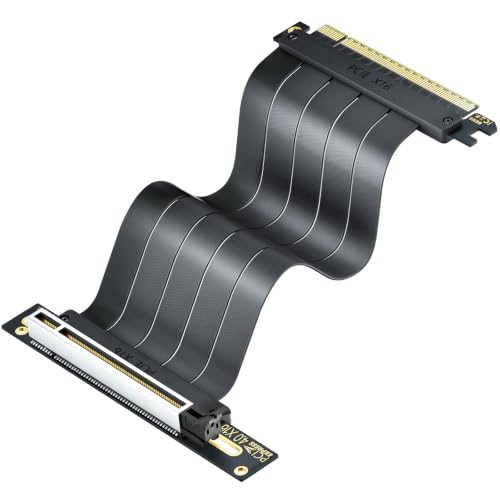
This ELECNEXUS 200mm PCIe 4.0 x16 extension cable mounts your graphics card vertically in your chassis. It supports 64GB/s bidirectional bandwidth and provides 75W power delivery across a reinforced 40-pin connector. The flat design incorporates triple-layer EMI shielding and a six-layer PCB to preserve signal transmission. This cable suits you if you run an RTX 40/30 or RX 7000/6000 series GPU and require a flexible 20-centimeter link.
Pros
- Supports up to 64GB/s bidirectional PCIe 4.0 bandwidth
- Triple-layer EMI shielding with metal, aluminum, and copper
- Standard 75W power delivery with reinforced 40-pin connector
- Six-layer PCB construction with gold-plated contacts
Cons
- Limited to PCIe 4.0 speeds rather than PCIe 5.0
- Fixed 20cm length may require careful chassis measurement
- Straight connector design without angled mounting brackets
Good fit if
- You need a 200mm flexible cable for a vertical GPU mount.
- You run a PCIe 4.0 or PCIe 3.0 graphics card.
- You want triple-layer EMI shielding to prevent signal interference.
Skip if
- You require native PCIe 5.0 bandwidth for your build.
- You need a dedicated 90-degree right-angle connector.
Verdict: ELECNEXUS 200mm PCIe 4.0 x16 Riser Cable delivers full 64GB/s bandwidth and 75W power delivery for vertical GPU builds. Its triple-layer shielding and flexible flat construction make it a dependable option for standard vertical graphics installations.
Specifications side by side
| Spec | GLOTRENDS 200mm Right-Angle PCIe 4.0 Riser Cable | LINKUP 15cm PCIe 5.0 Right Angle Riser Cable | LINKUP 22cm ITX Double Reverse Riser Cable | LINKUP 15cm Straight PCIe 5.0 Riser Cable | Thermaltake Dual 90° PCIe 4.0 400mm Riser Cable | LINKUP Ultra PCIe 4.0 x16 Riser Cable 10cm | GIGA-MEGA 16cm PCIe 5.0 Riser Cable with Vertical Bracket | SinLoon 40cm PCIe 4.0 x1 90-Degree Riser Cable | SinLoon 30cm PCIe 4.0 x1 180-Degree Riser Cable | ELECNEXUS 200mm PCIe 4.0 x16 Riser Cable |
|---|---|---|---|---|---|---|---|---|---|---|
| Interface Standard | PCIe 4.0 | PCIe 5.0 | PCIe 5.0 | PCIe 5.0 | PCIe 4.0 | PCIe 4.0 | PCIe 5.0 | PCIe 4.0 | PCIe 4.0 | PCIe 4.0 |
| Slot Configuration | x16 | x16 | x16 | x16 | not specified | X16 | x16 | X1 | X1 | x16 |
| Cable Length | 200mm | 15cm | 22cm | 15cm | 400mm | 10cm | 16cm | 40CM | 30CM | 200mm |
| Connector Angle | 90 Degree Right Angle | Right Angle | Double Reverse | Straight | Dual 90-degree | Universal 90 Degree | Right Angle | 90 Degree | 180 Degree | not specified |
| Maximum Bandwidth | up to 32GB/s | 128GB/s | 128GB/s | 128GB/s | 16Gbps | Over 64GB/s | not specified | 16Gbps | 16Gbps | 64GB/s |
| Shielding Type | individually foil-wrapped | multilayer shielding | multilayer shielding | multilayer shielding | EMI Shielding | Individual laneway shielding | Aluminum shielded | not specified | not specified | Triple-Layer EMI Shielding |
| GPU | not specified | not specified | not specified | not specified | not specified | GeForce RTX 4090 | Radeon RX 7900 XT | not specified | not specified | not specified |
| Interface | PCIe 4.0 | PCIe 4.0 | PCIe 4.0 | PCIe 4.0 | PCIe 4.0 | PCIe 4.0 | PCIe 4.0 | PCIe 4.0 | PCIe 4.0 | PCIe 4.0 |
| Form Factor | not specified | not specified | ITX | not specified | not specified | not specified | not specified | not specified | not specified | not specified |
| Use | not specified | not specified | not specified | not specified | not specified | Gaming | not specified | not specified | not specified | not specified |
| Dimensions | 9.84 × 4.72 × 4.72 inches | not specified | not specified | not specified | not specified | not specified | not specified | not specified | not specified | not specified |
| Weight | 4.97 ounces | 4.23 ounces | not specified | 3.88 ounces | 9.52 ounces | not specified | not specified | not specified | not specified | 3.17 ounces |
| Size | 200mm | 15cm - v4 | 22cm - v2 | 15cm - v2 | Compact | 10cm (open box) | not specified | 40CM | 30CM | 20cm |
| Color | Black | All Black | Black | Black | Black | Black | 16cm GEN5 Black Bracket V3 | not specified | not specified | Black |
| Model | PCIE40-X16-200MM-0090D | AG-P5-33SR-015BK | AG-P5-33VV-022BK | AVA5 | AC-077-CO1OTN-C1 | not specified | not specified | not specified | not specified | PCIE4.0-200-H |
To ensure your setup supports full bandwidth, compare the best motherboards with pcie 4 0 for compatible slot configurations.
Key Specs for PCIe 4.0 Riser Cables
-
Lane Width Requirements
Check whether your add-in card requires a full x16 connection or a smaller x1 slot. Graphics cards require full x16 lane bandwidth to avoid bottlenecks, whereas capture cards, sound cards, and basic network adapters function over an x1 lane. Using an x1 riser for dedicated graphics cards drops transfer rates significantly. For secondary peripheral hardware, a dedicated interface like the SinLoon 30cm PCIe 4.0 x1 180-Degree Riser Cable supplies 16Gbps transfer speeds without occupying a physical x16 slot space on your motherboard.
-
Slot Power Delivery
Review the electrical delivery specifications of the cable before installing power-demanding cards. PCIe x16 slots provide board power alongside data lanes, so your riser must support standard motherboard power limits. A cable with certified power delivery guarantees your graphics card draws the necessary baseline wattage safely through the slot without triggering hardware instability. The ELECNEXUS 200mm PCIe 4.0 x16 Riser Cable explicitly provides 75W power delivery alongside 64GB/s bandwidth, ensuring standard slot-powered graphics hardware receives proper power together with high-frequency Gen4 signaling.
-
Chassis Slot Clearance
Inspect your case layout to verify mounting bracket clearance before choosing an integrated mounting solution. Adding vertical mounting hardware requires dedicated expansion slot openings and physical space between the card and surrounding components. You must ensure the frame does not block rear chassis ports or collide with motherboard heatsinks and CPU coolers. The GIGA-MEGA 16cm PCIe 5.0 Riser Cable with Vertical Bracket requires six rear expansion slots alongside sufficient clearance around your CPU cooler, making it essential to measure your case interior before installation.
-
Flagship GPU Matching
Confirm that the riser explicitly matches the signal integrity requirements of high-demand graphics cards. Massive, top-tier GPUs place intense electrical and bandwidth demands across the interface, which exposes any shielding flaws or weak contact pins. Look for models built with heavy shielding that are designed to handle demanding gaming loads without dropped frames or PCIe bus errors. The LINKUP Ultra PCIe 4.0 x16 Riser Cable 10cm lists explicit compatibility for the GeForce RTX 4090, confirming it satisfies the strict signal stability standards required for top-tier modern gaming GPUs.
-
PCIe Generation Headroom
Evaluate whether your system plans require next-generation PCIe bandwidth headroom. A riser rated for PCIe 5.0 maintains backward compatibility with PCIe 4.0 devices while supporting faster transfer thresholds if you swap in newer motherboards and cards later. This higher specification often includes enhanced physical build standards, such as multilayer shielding, to control electromagnetic noise at elevated frequencies. The LINKUP 15cm Straight PCIe 5.0 Riser Cable delivers this backward-compatible PCIe 4.0 operation with multilayer shielding, protecting your data lanes against signal interference across present and future component upgrades.
Frequently asked questions
Can you use a PCIe 5.0 riser cable with a PCIe 4.0 graphics card?
Yes, PCIe specifications maintain backward compatibility across generations. A PCIe 5.0 riser cable operates reliably at PCIe 4.0 data transfer rates when connected to a Gen4 GPU and motherboard. For example, options like the LINKUP 15cm Straight PCIe 5.0 Riser Cable and LINKUP 15cm Right Angle model support PCIe 4.0 signaling while providing bandwidth headroom for hardware upgrades.
How much power does a PCIe 4.0 riser cable supply to a graphics card?
A standard PCIe 4.0 x16 riser cable delivers up to 75 watts directly through the slot interface. This specification matches standard motherboard slot power limits. The ELECNEXUS 200mm PCIe 4.0 x16 Riser Cable explicitly lists this 75W slot delivery alongside 64GB/s bandwidth. Graphics cards that need additional power draw it via auxiliary power cables from your power supply.
What chassis clearance is needed for a vertical GPU bracket kit?
You must check the number of expansion slots and internal clearances inside your chassis. Some mounting assemblies require specific chassis layouts to install properly. For instance, the GIGA-MEGA 16cm PCIe Riser Cable with Vertical Mount Bracket specifies that your case needs six expansion slots, and you must verify clearance around your CPU cooler before mounting.
What is the purpose of a PCIe 4.0 x1 riser cable?
A PCIe 4.0 x1 riser cable repositions secondary add-in cards that do not require full x16 lane bandwidth. These single-lane cables provide sufficient throughput for hardware such as audio boards, network cards, and video capture devices. For instance, the SinLoon 30cm PCIe 4.0 x1 180-Degree Riser Cable delivers 16Gbps transfer rates, letting you position smaller peripheral cards away from blocked primary slots.
Can a high-end card like the GeForce RTX 4090 work with a short riser cable?
Yes, high-end graphics cards can run effectively on short risers designed for tight chassis orientations. Compact layouts minimize signal travel distance while maintaining necessary Gen4 throughput. The LINKUP Ultra PCIe 4.0 x16 Riser Cable in a 10cm length features dedicated shielding engineered to handle high bandwidth demands for hardware like the GeForce RTX 4090 in restricted gaming enclosures.
Why is shielding important on a PCIe 4.0 riser cable?
Shielding prevents electromagnetic interference from degrading high-speed data transmission between the motherboard and expansion card. PCIe 4.0 operates at high frequencies where unshielded signals risk dropped packets and system instability. Models such as the ELECNEXUS 200mm cable feature triple-layer shielding, while the Thermaltake Dual 90° uses integrated EMI shielding to ensure clean signal delivery across Intel and AMD motherboards.
What does a double-reverse connector layout do on an ITX riser cable?
A double-reverse connector layout routes the cable closely around motherboard trays in compact small-form-factor builds. This design reverses connector alignments at both ends to enable clean 180-degree folding. The LINKUP 22cm ITX Double Reverse Riser Cable uses this specific geometry to route behind the motherboard tray in sandwich-style mini-ITX cases without putting severe strain on the PCB connectors.