Best Graphics Cards with Pcie 5.0: 15 Spec-Based Picks
As an Amazon Associate we earn from qualifying purchases. Links on this page are affiliate links.
Choosing the best graphics cards with pcie 5 0 requires balancing interface bandwidth against chassis clearance and memory capacity. We compared 15 products using the specifications published on their listings to identify the top options. The MSI GeForce RTX 5060 Ventus 2X OC leads the list because its compact 7.76-inch length and 8GB of GDDR7 memory fit easily into smaller builds.
These comparisons help you decide which card matches your case dimensions, motherboard slots, and display requirements.
Quick picks
The best fit for you
- You want a compact PCIe 5.0 graphics card. MSI GeForce RTX 5060 Ventus 2X OC Its short 7.76-inch length and 8GB memory fit easily into space-constrained cases.
- You need high-end PCIe 5.0 performance with fast memory. MSI GeForce RTX 5080 Ventus 3X White It features 16GB of GDDR7 memory across a 256-bit bus.
- You want a dual-slot card with 12GB memory. GIGABYTE RTX 5070 Windforce OC SFF 12GB It combines 12GB of memory with a compact height of 1.97 inches.
- You have a large chassis built for heavy cooling. ASUS TUF Gaming Radeon RX 9070 XT 16GB This card measures 13 inches long and occupies a thick 3.125-slot profile.
Our 15 picks
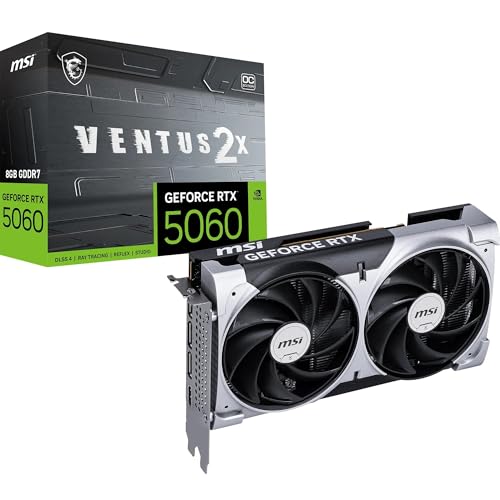
MSI GeForce RTX 5060 Ventus 2X OC
Best for: compact 1080p PCIe 5.0 PC builds
- Interface
- PCIe 5.0 (what this guide is about)
- Graphics Processor
- GeForce RTX 5060
- Memory Size
- 8GB
- Memory Type
- GDDR7
- Memory Bus Width
- 128-bit
- PCIe Interface
- PCIe 5.0
The MSI GeForce RTX 5060 Ventus 2X OC is a compact graphics card built on PCIe 5.0 x8 connectivity with 8GB of GDDR7 memory. Its 197mm length fits smaller PC cases easily, while the 145W power draw requires only a 550W power supply and a single 8-pin cable. If you want a modern Gen5 card for 1080p gaming with DisplayPort 2.1b support, this dual-fan model gives you updated architecture without demanding a chassis overhaul.
Pros
- PCIe 5.0 x8 interface with 8GB 28 Gbps GDDR7 memory
- Compact 197mm 2-slot footprint suitable for smaller cases
- Modest 145W power consumption with a 550W recommended PSU
- Triple DisplayPort 2.1b outputs plus one HDMI 2.1b port
- Zero RPM mode halts fans during low-load operation
Cons
- PCIe connection is wired for 8 lanes rather than a full 16-lane interface
- Memory interface width is limited to 128-bit with 8GB capacity
Good fit if
- You need a compact PCIe 5.0 card under 200mm for a space-constrained case.
- You want DisplayPort 2.1b connectivity without upgrading past a 550W power supply.
- You focus on 1080p gaming using GDDR7 memory and DLSS 4.0 support.
Skip if
- You require more than 8GB of video memory for high-resolution assets.
- You want a full x16 PCIe lane configuration or a wider memory bus.
Verdict: MSI GeForce RTX 5060 Ventus 2X OC 8GB delivers efficient PCIe 5.0 connectivity and fast GDDR7 memory in an easy-to-fit 197mm package. It is an optimal choice if you want modern display outputs and low power consumption without rebuilding your system.
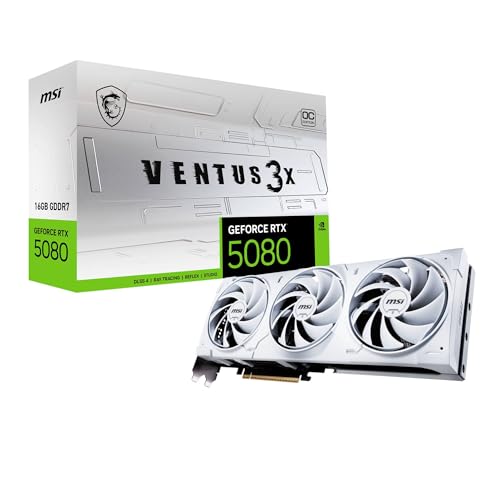
MSI GeForce RTX 5080 Ventus 3X White
Best for: high-end PCIe 5.0 builds needing GDDR7 memory
- Interface
- PCIe 5.0 (what this guide is about)
- Graphics Processor
- GeForce RTX 5080
- Memory Size
- 16 GB
- Memory Type
- GDDR7
- Memory Bus Width
- 256 Bits
- PCIe Interface
- PCIe 5.0
The card pairs an NVIDIA GeForce RTX 5080 graphics processor with 16 GB of GDDR7 memory on a 256-bit bus. It connects through a PCIe 5.0 interface. The physical dimensions measure 11.9 inches in length, 4.76 inches in width, and 3.31 pounds in weight. You get high-bandwidth memory throughput reaching 30 GB/s, making it suitable for builders seeking high-end PCIe 5.0 specifications.
Pros
- GeForce RTX 5080 GPU with 16 GB GDDR7 memory
- Fast 256-bit memory bus with 30 GB/s transfer rate
- PCIe 5.0 interface support
Cons
- Card length of 11.9 inches requires ample case clearance
- Total weight of 3.31 pounds requires sturdy mounting support
Good fit if
- You need high-bandwidth GDDR7 memory on a 256-bit bus.
- You have a PC chassis that fits an 11.9-inch graphics card.
- You want a PCIe 5.0 interface with the GeForce RTX 5080 processor.
Skip if
- You have a compact case with less than 11.9 inches of clearance.
- You prefer a lighter GPU that weighs less than 3.31 pounds.
Verdict: MSI RTX 5080 Ventus 3X OC White 16GB delivers top-tier PCIe 5.0 hardware backed by 16 GB of GDDR7 memory and a 256-bit bus. It provides robust performance specifications if your enclosure accommodates its 11.9-inch frame.

GIGABYTE Radeon RX 9070 XT Gaming OC 16GB
Best for: PCIe 5.0 gaming with 16GB VRAM
- Interface
- PCIe 5.0 (what this guide is about)
- Graphics Processor
- Radeon RX 9070 XT
- Memory Size
- 16GB
- Memory Type
- GDDR6
- PCIe Interface
- PCIe 5.0
- Use
- Gaming
This graphics card pairs AMD's Radeon RX 9070 XT processor with a modern PCIe 5.0 interface. You get 16GB of GDDR6 memory to handle demanding workloads and modern games. Its cooling setup uses a Windforce design, Hawk fans, and server-grade thermal gel within an 11.3-inch frame. If you want high-capacity memory on the newest PCIe 5.0 bus without moving to larger form factors, this model fits your setup.
Pros
- PCIe 5.0 interface for high-bandwidth motherboard slots
- 16GB GDDR6 memory capacity
- Windforce cooling with Hawk fans and server-grade thermal gel
- Integrated RGB lighting
Cons
- Uses GDDR6 memory rather than GDDR7
- Card thickness of 2.2 inches requires multiple expansion slots
- Overall weight of 3.92 pounds requires sturdy slot support
Good fit if
- You want a PCIe 5.0 card with 16GB of video memory.
- You have space for an 11.3-inch long and 2.2-inch thick card.
- You want built-in RGB lighting and Windforce cooling.
Skip if
- You prefer next-generation GDDR7 memory architecture.
- You need a slim graphics card for a compact PC case.
Verdict: Gigabyte Radeon RX 9070 XT 16GB delivers modern PCIe 5.0 connectivity alongside 16GB of GDDR6 VRAM. It is a capable choice if you need high memory capacity and Windforce cooling in a full-sized chassis.

ASUS Prime RTX 5070 Ti OC 16GB
Best for: SFF cases needing PCIe 5.0 performance
- Interface
- PCIe 5.0 (what this guide is about)
- Graphics Processor
- GeForce RTX 5070 Ti
- Memory Size
- 16GB
- Memory Type
- GDDR7
- Boost Clock
- 2527 MHz
- PCIe Interface
- PCIe 5.0
The ASUS Prime RTX 5070 Ti 16GB OC pairs NVIDIA Blackwell architecture with a PCIe 5.0 interface and 16GB of fast GDDR7 memory. It operates at an overclocked boost clock of 2527 MHz. Designed to meet SFF-Ready dimensions, this card measures 306 mm in length and occupies 2.5 slots. It suits you if you need high bandwidth and strong processing power inside a compact computer case.
Pros
- PCIe 5.0 interface paired with 16GB GDDR7 memory
- Boost clock reaches up to 2527 MHz in OC mode
- SFF-Ready 2.5-slot design at 306mm length
- Dual BIOS switch for Quiet and Performance profiles
- Axial-tech fans with dual-ball bearings and 0dB mode
Cons
- Requires a 750W power supply with a 16-pin 12V-2x6 cable
- Measures 306mm (12 inches) long, which limits very tight cases
Good fit if
- You want a PCIe 5.0 card with 16GB of GDDR7 memory for high-bandwidth tasks.
- You have an SFF chassis that supports a 306mm, 2.5-slot card.
- You possess a 750W or greater power supply with a 16-pin 12V-2x6 connector.
Skip if
- You use a power supply rated below 750W or lack a 16-pin 12V-2x6 connector.
- You have a small case with clearance under 306mm.
Verdict: ASUS Prime RTX 5070 Ti 16GB OC delivers PCIe 5.0 connectivity, 16GB GDDR7 memory, and a 2527 MHz boost clock in an SFF-Ready 2.5-slot footprint. It is a capable choice if your case fits a 306mm card and your power supply meets the 750W requirement.

ASUS TUF Gaming Radeon RX 9070 XT 16GB
Best for: full-size desktop gaming rigs with ample clearance
- Interface
- PCIe 5.0 (what this guide is about)
- Graphics Processor
- AMD Radeon RX 9070 XT
- Memory Size
- 16 GB
- Memory Type
- GDDR6
- PCIe Interface
- PCIe 5.0
- Slot Width
- 3.125 Slot
The ASUS TUF Gaming Radeon RX 9070 XT 16GB delivers modern connectivity with its PCIe 5.0 interface and AMD Radeon RX 9070 XT processor. You get 16GB of GDDR6 memory, three axial-tech cooling fans, and a thick 3.125-slot profile measuring 13 inches long. This card suits you if you run heavy gaming workloads and have a spacious PC case that can accommodate an oversized, triple-slot graphics card.
Pros
- PCIe 5.0 interface for high-bandwidth system connectivity
- 16GB GDDR6 memory capacity
- Triple axial-tech fans with dual ball bearings
- Protective PCB coating shields against moisture and dust
Cons
- Thick 3.125-slot profile occupies extensive case expansion space
- 13-inch length restricts fit in compact chassis
- Uses GDDR6 memory rather than GDDR7
Good fit if
- You need a PCIe 5.0 graphics card equipped with 16GB of VRAM.
- You own a spacious PC case with at least 13 inches of GPU clearance.
- You value component durability features like dust-resistant PCB coatings.
Skip if
- You build inside a compact or small-form-factor enclosure.
- You need adjacent motherboard PCIe slots left clear for other add-in cards.
Verdict: ASUS TUF Gaming Radeon RX 9070 XT 16GB pairs PCIe 5.0 support and 16GB of GDDR6 memory with heavy-duty thermal construction. It is a solid match for large gaming setups that have the clearance for a 13-inch, 3.125-slot card.

GIGABYTE RTX 5070 Windforce OC SFF 12GB
Best for: compact PCIe 5.0 builds needing 12GB VRAM
- Interface
- PCIe 5.0 (what this guide is about)
- Graphics Processor
- GeForce RTX 5070
- Memory Size
- 12GB
- Memory Type
- GDDR7
- Memory Bus Width
- 192-bit
- PCIe Interface
- PCIe 5.0
The Gigabyte GeForce RTX 5070 Windforce 12GB is a graphics card built on NVIDIA Blackwell architecture with a PCIe 5.0 interface. It pairs 12GB of high-speed GDDR7 memory with a 192-bit bus width. Measuring 11.1 inches long and 1.97 inches high, it meets NVIDIA SFF-ready dimensions. This card suits you if you want modern PCIe 5.0 bandwidth and GDDR7 memory inside a compact computer case.
Pros
- PCIe 5.0 interface
- 12GB GDDR7 memory
- NVIDIA SFF-ready dimensions
- Windforce cooling design
Cons
- 12GB VRAM capacity is lower than 16GB models
- 192-bit memory bus width
- 11.1-inch length requires adequate case clearance
Good fit if
- You need a PCIe 5.0 graphics card equipped with 12GB of GDDR7 memory.
- You build in a small-form-factor chassis meeting NVIDIA SFF-ready specifications.
- You want NVIDIA Blackwell architecture features including DLSS 4 support.
Skip if
- You require 16GB or more VRAM for your graphics workloads.
- You want a wider 256-bit memory bus interface.
- You have an ultra-compact case unable to accommodate an 11.1-inch card.
Verdict: Gigabyte GeForce RTX 5070 Windforce 12GB balances PCIe 5.0 bandwidth and GDDR7 memory in an SFF-ready dual-slot form factor. It gives you modern GPU architecture without demanding full-tower chassis clearance.

Gigabyte GeForce RTX 5070 Ti Eagle OC 16GB
Best for: SFF-ready PCIe 5.0 gaming builds
- Interface
- PCIe 5.0 (what this guide is about)
- Graphics Processor
- GeForce RTX 5070 Ti
- Memory Size
- 16GB
- Memory Type
- GDDR7
- Memory Bus Width
- 256-bit
- PCIe Interface
- PCIe 5.0
The Gigabyte RTX 5070 Ti Eagle OC SFF 16GB is a graphics card built on NVIDIA Blackwell architecture with native PCIe 5.0 support. It features 16GB of GDDR7 memory on a 256-bit bus, paired with Windforce cooling in an NVIDIA SFF-ready profile. You get modern Gen 5 connectivity and high memory bandwidth in a card measuring 12 inches long and 1.97 inches high. It suits you if you build a compact rig.
Pros
- PCIe 5.0 interface support
- 16GB GDDR7 memory with 256-bit bus width
- NVIDIA SFF-ready design with 1.97-inch height
- Equipped with WINDFORCE cooling system
Cons
- Length of 12 inches requires substantial case clearance
- Card color is not specified in published data
Good fit if
- You need PCIe 5.0 support alongside 16GB of GDDR7 memory.
- You want an NVIDIA SFF-ready card under two inches in height.
Skip if
- You have a small PC chassis that cannot accommodate a 12-inch card.
- You need a specific verified color finish for your build.
Verdict: Gigabyte RTX 5070 Ti Eagle OC SFF 16GB delivers PCIe 5.0 bandwidth and 16GB GDDR7 VRAM in an SFF-ready dimensions profile. It gives you Blackwell architecture features if your enclosure supports its 12-inch length.

ASRock Radeon RX 9070 XT Steel Legend 16GB
Best for: high-resolution gaming in spacious PCIe 5.0 builds
- Interface
- PCIe 5.0 (what this guide is about)
- Graphics Processor
- AMD Radeon RX 9070 XT
- Memory Size
- 16GB
- Memory Type
- GDDR6
- Boost Clock
- 2970 MHz
- Memory Bus Width
- 256-bit
The ASRock Radeon RX 9070 XT Steel Legend 16GB provides a PCIe 5.0 interface paired with 16GB of GDDR6 memory on a 256-bit bus. It features AMD RDNA 4 architecture, reaching a 2970 MHz boost clock and 2400 MHz game clock. Its 2.9-slot profile and 800W power supply recommendation suit you if you run a large chassis and want high-bandwidth PCIe 5.0 throughput for 4K gaming or demanding compute workloads.
Pros
- PCIe 5.0 interface with 16GB GDDR6 on a 256-bit bus
- 2970 MHz factory boost clock and 2400 MHz game clock
- 64 RDNA 4 Compute Units with 20 Gbps memory bandwidth
- Uses standard dual 8-pin PCIe power connectors
Cons
- Thick 2.9-slot design measuring 58 mm deep
- Requires a high-capacity 800W power supply
- Card length of 298 mm restricts small-form-factor builds
Good fit if
- You have a PC chassis with clearance for a 298 mm long, 2.9-slot card.
- You run an 800W or higher power supply with two 8-pin PCIe cables.
- You want PCIe 5.0 bandwidth paired with a 2970 MHz boost clock for 4K workloads.
Skip if
- You build inside a compact case with strictly dual-slot clearance.
- You have a power supply rated below the recommended 800W.
Verdict: ASRock RX 9070 XT Steel Legend 16GB delivers PCIe 5.0 connectivity and high clock speeds for demanding setups. Its 2.9-slot thickness and 800W power supply requirement demand ample room and adequate system power.

MSI GeForce RTX 5060 Ti Ventus 2X 8GB
Best for: compact PCIe 5.0 desktop builds
- Interface
- PCIe 5.0 (what this guide is about)
- Graphics Processor
- GeForce RTX 5060 Ti
- Memory Size
- 8GB
- Memory Type
- GDDR7
- Memory Bus Width
- 128-bit
- PCIe Interface
- PCIe 5.0
The MSI RTX 5060 Ti Ventus 2X 8GB is a graphics card built around the modern PCIe 5.0 standard. It pairs NVIDIA's GeForce RTX 5060 Ti processor with 8GB of fast GDDR7 memory across a 128-bit bus. At 8.94 inches long and 1.26 pounds, it fits easily into tighter builds. It suits you if you want current-generation PCIe 5.0 connectivity and high memory bandwidth without taking up excess chassis space.
Pros
- Supports high-bandwidth PCIe 5.0 interface
- Uses fast 28Gbps GDDR7 memory technology
- Compact 8.94-inch length fits standard cases
- Lightweight 1.26-pound build
Cons
- Limited to an 8GB memory capacity
- Narrow 128-bit memory bus width
Good fit if
- You have a PCIe 5.0 motherboard ready for modern cards.
- You need a dual-fan graphics card under 9 inches in length.
- You want the throughput benefits of GDDR7 memory.
Skip if
- You require more than 8GB of video memory.
- You prefer a wider memory interface than 128 bits.
Verdict: MSI RTX 5060 Ti Ventus 2X 8GB brings PCIe 5.0 communication and GDDR7 memory speeds to a space-saving card design. Its 8GB capacity and 128-bit bus establish clear operating boundaries for memory-heavy tasks.

GIGABYTE RTX 5060 Ti Windforce OC 8GB
Best for: Compact builds requiring PCIe 5.0 and GDDR7
- Interface
- PCIe 5.0 (what this guide is about)
- Graphics Processor
- GeForce RTX 5060 Ti
- Memory Size
- 8GB
- Memory Type
- GDDR7
- Memory Bus Width
- 128-bit
- PCIe Interface
- PCIe 5.0
The GIGABYTE RTX 5060 Ti Windforce OC 8GB delivers modern PCIe 5.0 connectivity on NVIDIA's Blackwell architecture. You get 8GB of high-speed GDDR7 memory running across a 128-bit bus width. At 8.19 inches long and 1.57 inches tall, this card fits compact builds more easily than bulkier alternatives. It suits you if you want current-generation bus speeds in a modest chassis.
Pros
- PCIe 5.0 interface support
- Fast GDDR7 memory type
- Compact 8.19-inch overall length
- NVIDIA Blackwell architecture with DLSS 4 support
Cons
- 8GB VRAM capacity limits memory-heavy tasks
- Narrow 128-bit memory bus width
Good fit if
- You need a PCIe 5.0 graphics card under 9 inches in length.
- You want GDDR7 memory paired with NVIDIA Blackwell architecture.
- You target workloads that fit comfortably within an 8GB memory limit.
Skip if
- You require more than 8GB of VRAM for intensive assets.
- You prefer a wider memory bus than 128 bits for higher memory throughput.
Verdict: GIGABYTE RTX 5060 Ti Windforce OC 8GB pairs modern PCIe 5.0 support and GDDR7 memory with a compact 8.19-inch footprint. It provides an efficient entry point to current-generation architecture if 8GB of VRAM meets your requirements.

Gigabyte GeForce RTX 5060 Ti Gaming OC 16GB
Best for: PCIe 5.0 gaming builds needing 16GB GDDR7
- Interface
- PCIe 5.0 (what this guide is about)
- Graphics Processor
- GeForce RTX 5060 Ti
- Memory Size
- 16GB
- Memory Type
- GDDR7
- Memory Bus Width
- 128-bit
- PCIe Interface
- PCIe 5.0
This Gigabyte graphics card pairs an NVIDIA GeForce RTX 5060 Ti graphics processor with a PCIe 5.0 interface. You get 16GB of GDDR7 memory running across a 128-bit bus width, built on the NVIDIA Blackwell architecture with DLSS 4 support. At 11.1 inches long and 1.57 inches tall, it suits you if your PC case has room for a longer card and you want high-capacity Gen5 graphics memory.
Pros
- PCIe 5.0 interface
- 16GB GDDR7 memory
- NVIDIA Blackwell architecture with DLSS 4 support
- Slim 1.57-inch profile height
Cons
- Narrow 128-bit memory bus width
- 11.1-inch card length requires sufficient case clearance
Good fit if
- You need a PCIe 5.0 card with 16GB of GDDR7 memory.
- You have a PC chassis that fits an 11.1-inch long graphics card.
Skip if
- You require a wider memory bus width than 128-bit.
- You have a compact case that cannot clear 11.1 inches of length.
Verdict: Gigabyte GeForce RTX 5060 Ti Gaming 16GB delivers modern PCIe 5.0 connectivity and 16GB of GDDR7 memory in an 11.1-inch form factor. It provides a solid Blackwell-architecture option if your chassis can accommodate its length.

ASUS Dual GeForce RTX 5060 OC 8GB
Best for: Compact PCIe 5.0 small-form-factor PC builds
- Interface
- PCIe 5.0 (what this guide is about)
- Graphics Processor
- GeForce RTX 5060
- Memory Size
- 8GB
- Memory Type
- GDDR7
- Boost Clock
- 2565 MHz
- PCIe Interface
- PCIe 5.0
The ASUS Dual GeForce RTX 5060 8GB pairs NVIDIA Blackwell architecture with a PCIe 5.0 interface and 8GB of GDDR7 memory. Its dual Axial-tech fans keep the 9-inch card compact, while a factory boost clock reaches 2565 MHz in OC mode. Measuring 2 inches thick across a 2.5-slot profile, it delivers 623 AI TOPS for modern workloads. It suits you if you need a compact PCIe 5.0 GPU for small-form-factor builds.
Pros
- PCIe 5.0 interface paired with GDDR7 memory
- Compact 9-inch length with SFF-Ready compatibility
- Boost clock reaches 2565 MHz in OC mode
- Delivers up to 623 AI TOPS compute performance
Cons
- Occupies a 2.5-slot width rather than a true dual-slot profile
- Limited to 8GB of video memory
Good fit if
- You need an SFF-Ready graphics card measuring 9 inches or less.
- You want PCIe 5.0 connectivity paired with fast GDDR7 memory.
- You run workloads that take advantage of DLSS 4 support.
Skip if
- You require more than 8GB of VRAM for memory-intensive applications.
- You have a strict dual-slot enclosure clearance limit.
Verdict: ASUS Dual GeForce RTX 5060 8GB provides PCIe 5.0 connectivity and GDDR7 memory in a manageable 9-inch, SFF-Ready footprint. Its 2.5-slot profile and 8GB memory limit suitability for tighter cases or memory-heavy setups, but it delivers 2565 MHz speeds for compact gaming systems.

GIGABYTE Radeon RX 9060 XT 8GB
Best for: Mainstream PCIe 5.0 gaming builds
- Interface
- PCIe 5.0 (what this guide is about)
- Graphics Processor
- Radeon RX 9060 XT
- Memory Size
- 8GB
- Memory Type
- GDDR6
- PCIe Interface
- PCIe 5.0
- Use
- Gaming
The Gigabyte Radeon RX 9060 XT 8GB brings PCIe 5.0 connectivity to mid-range gaming builds. It pairs an AMD Radeon RX 9060 XT graphics processor with 8GB of GDDR6 memory. Cooling relies on the Windforce system with Hawk fans and server-grade thermal gel within an 11.1-inch frame. If you want a PCIe 5.0 graphics card for standard gaming setups and have case clearance for an 11.1-inch chassis, this fits your needs.
Pros
- Modern PCIe 5.0 bus interface
- Windforce cooling with Hawk fans and thermal gel
- Integrated RGB lighting
- Slim 1.57-inch height profile
Cons
- Limited to 8GB of GDDR6 video memory
- 11.1-inch length requires checking chassis clearance
Good fit if
- You want a PCIe 5.0 card driven by the Radeon RX 9060 XT GPU.
- You have a PC case with at least 11.1 inches of clearance.
- You want integrated RGB lighting alongside Windforce cooling.
Skip if
- You need more than 8GB of VRAM for memory-heavy tasks.
- You require newer GDDR7 memory architecture.
Verdict: Gigabyte Radeon RX 9060 XT 8GB provides PCIe 5.0 support, robust Windforce cooling, and 8GB GDDR6 memory for gaming rigs. It serves as a balanced mainstream choice if your chassis accommodates its 11.1-inch length.

EZDIY-FAB 30cm PCIe 5.0 Right Angle Riser Cable
Best for: full-tower vertical PCIe 5.0 GPU mounting
- Interface
- PCIe 5.0 (what this guide is about)
- Weight
- 6.7 ounces
View on Amazon: EZDIY-FAB 30cm PCIe 5.0 Right Angle Riser Cable
This EZDIY-FAB accessory is a 30cm PCIe 5.0 x16 riser cable designed for vertically mounting graphics cards. It delivers up to 128 GB/s bidirectional bandwidth to support PCIe 5.0 throughput without lane bottlenecks. The cable features a right-angle connector, a 6-layer shielded PCB, and a flexible TPE jacket. It suits you if you are building inside a full-tower enclosure and need reliable Gen5 extension routing.
Pros
- Delivers PCIe 5.0 x16 bandwidth up to 128 GB/s bidirectional
- Six-layer PCB with individual lane shielding against EMI
- Reinforced metal slot with precision copper contacts
- Flexible TPE jacket designed for tight bends without kinking
Cons
- Is an extender cable rather than a standalone graphics card
- Fixed 30cm length is too long for compact mid-tower enclosures
- Right-angle 90-degree connector orientation restricts straight mounting layouts
Good fit if
- You need a 30cm PCIe 5.0 riser cable for a full-tower vertical GPU layout.
- You want full PCIe 5.0 x16 bandwidth with electromagnetic shielding.
Skip if
- You are shopping for a standalone graphics card instead of an accessory cable.
- You need a straight 180-degree connector or a shorter 20cm length for small cases.
Verdict: EZDIY-FAB 30cm Right Angle PCIe 5.0 Riser Cable provides full 128 GB/s Gen5 bandwidth and robust shielding for full-tower vertical GPU installations. It maintains PCIe 5.0 connection stability when mounting your card away from the motherboard.

EZDIY-FAB 20cm Straight PCIe 5.0 Riser Cable
Best for: vertical PCIe 5.0 GPU mounting in mid-towers
- Interface
- PCIe 5.0 (what this guide is about)
- Weight
- 5.29 ounces
View on Amazon: EZDIY-FAB 20cm Straight PCIe 5.0 Riser Cable
This accessory is a PCIe 5.0 x16 riser cable rather than a standalone graphics card. It delivers 128 GB/s bidirectional bandwidth across a 20cm length with a straight connector. The cable uses a 6-layer PCB, individual lane shielding, and a flexible TPE jacket. It suits you if you need to vertically mount or relocate a modern graphics card inside a mid-tower chassis.
Pros
- PCIe 5.0 x16 bandwidth up to 128 GB/s
- 6-layer PCB with individual lane shielding
- Reinforced metal slot with copper contacts
- Flexible TPE jacket for tight bends
Cons
- Riser cable accessory only with no GPU onboard
- Fixed 20cm length restricts full-tower placement
- Straight connector rather than right-angle design
Good fit if
- You need a PCIe 5.0 x16 extension cable for a vertical GPU mount.
- You build inside a mid-tower case requiring a 20cm straight connector.
Skip if
- You need an actual graphics card rather than an extension cable.
- You require a 90-degree angled connector or 30cm length for a full-tower.
Verdict: EZDIY-FAB 20cm Straight PCIe 5.0 Riser Cable provides full 128 GB/s bandwidth with reinforced shielding for vertical GPU mounting. It serves as an essential interconnect rather than a standalone graphics card.
Specifications side by side
| Spec | MSI GeForce RTX 5060 Ventus 2X OC | MSI GeForce RTX 5080 Ventus 3X White | GIGABYTE Radeon RX 9070 XT Gaming OC 16GB | ASUS Prime RTX 5070 Ti OC 16GB | ASUS TUF Gaming Radeon RX 9070 XT 16GB | GIGABYTE RTX 5070 Windforce OC SFF 12GB | Gigabyte GeForce RTX 5070 Ti Eagle OC 16GB | ASRock Radeon RX 9070 XT Steel Legend 16GB | MSI GeForce RTX 5060 Ti Ventus 2X 8GB | GIGABYTE RTX 5060 Ti Windforce OC 8GB | Gigabyte GeForce RTX 5060 Ti Gaming OC 16GB | ASUS Dual GeForce RTX 5060 OC 8GB | GIGABYTE Radeon RX 9060 XT 8GB | EZDIY-FAB 30cm PCIe 5.0 Right Angle Riser Cable | EZDIY-FAB 20cm Straight PCIe 5.0 Riser Cable |
|---|---|---|---|---|---|---|---|---|---|---|---|---|---|---|---|
| Graphics Processor | GeForce RTX 5060 | GeForce RTX 5080 | Radeon RX 9070 XT | GeForce RTX 5070 Ti | AMD Radeon RX 9070 XT | GeForce RTX 5070 | GeForce RTX 5070 Ti | AMD Radeon RX 9070 XT | GeForce RTX 5060 Ti | GeForce RTX 5060 Ti | GeForce RTX 5060 Ti | GeForce RTX 5060 | Radeon RX 9060 XT | not specified | not specified |
| Memory Size | 8GB | 16 GB | 16GB | 16GB | 16 GB | 12GB | 16GB | 16GB | 8GB | 8GB | 16GB | 8GB | 8GB | not specified | not specified |
| Memory Type | GDDR7 | GDDR7 | GDDR6 | GDDR7 | GDDR6 | GDDR7 | GDDR7 | GDDR6 | GDDR7 | GDDR7 | GDDR7 | GDDR7 | GDDR6 | not specified | not specified |
| Boost Clock | not specified | not specified | not specified | 2527 MHz | not specified | not specified | not specified | 2970 MHz | not specified | not specified | not specified | 2565 MHz | not specified | not specified | not specified |
| Memory Bus Width | 128-bit | 256 Bits | not specified | not specified | not specified | 192-bit | 256-bit | 256-bit | 128-bit | 128-bit | 128-bit | not specified | not specified | not specified | not specified |
| PCIe Interface | PCIe 5.0 | PCIe 5.0 | PCIe 5.0 | PCIe 5.0 | PCIe 5.0 | PCIe 5.0 | PCIe 5.0 | PCIe 5.0 | PCIe 5.0 | PCIe 5.0 | PCIe 5.0 | PCIe 5.0 | PCIe 5.0 | not specified | not specified |
| Recommended PSU | 550W | not specified | not specified | 750W | not specified | not specified | not specified | 800W | not specified | not specified | not specified | not specified | not specified | not specified | not specified |
| Slot Width | 2-slot | not specified | not specified | 2.5-slot | 3.125 Slot | not specified | not specified | 2.9-slot | not specified | not specified | not specified | 2.5-slot | not specified | not specified | not specified |
| Memory | 8GB | 16GB | 16GB | 16GB | 16GB | 12GB | 16GB | 16GB | 8GB | 8GB | 16GB | 8GB | 8GB | not specified | not specified |
| Interface | PCIe 5.0 | PCIe 5.0 | PCIe 5.0 | PCIe 5.0 | PCIe 5.0 | PCIe 5.0 | PCIe 5.0 | PCIe 5.0 | PCIe 5.0 | PCIe 5.0 | PCIe 5.0 | PCIe 5.0 | PCIe 5.0 | PCIe 5.0 | PCIe 5.0 |
| Use | not specified | not specified | Gaming | not specified | Gaming | not specified | not specified | not specified | not specified | not specified | Gaming | not specified | Gaming | not specified | not specified |
| Length | 7.76 inches | 11.9 inches | not specified | not specified | 13 inches | not specified | not specified | not specified | 8.94 inches | not specified | not specified | not specified | not specified | not specified | not specified |
| Width | 4.72 inches | 4.76 inches | not specified | not specified | 5.51 inches | not specified | not specified | not specified | 4.96 inches | not specified | not specified | not specified | not specified | not specified | not specified |
| Weight | 1.13 pounds | 3.31 pounds | 3.92 pounds | 2.6 pounds | 2.43 pounds | not specified | 2.66 pounds | 3.46 pounds | 1.26 pounds | 1.42 pounds | not specified | 1.4 pounds | 2.6 pounds | 6.7 ounces | 5.29 ounces |
| Dimensions | not specified | not specified | 11.3 × 5.2 × 2.2 inches | 12 × 5 × 2 inches | not specified | 11.1 × 4.33 × 1.97 inches | 12 × 4.96 × 1.97 inches | 11.7 × 5.2 × 0.1 inches | not specified | 8.19 × 4.72 × 1.57 inches | 11.1 × 4.69 × 1.57 inches | 9 × 4.8 × 2 inches | 11.1 × 4.65 × 1.57 inches | not specified | not specified |
| Model | V537-002R | V531-062R | GV-R9070XTGAMING OC-16GD | PRIME-RTX5070TI-O16G | TUF-RX9070XT-O16G-GAMING | GV-N5070WF3OC-12GD | GV-N507TEAGLE OC-16GD | 90-GA5DZZ-00UANF | V536-001R | GV-N506TWF2OC-8GD | GV-N506TGAMING OC-16GD | DUAL-RTX5060-O8G | GV-R9060XTGAMING OC-8GD | EZDPC247-5 | EZDPC247-3 |
| Color | not specified | Multicolour | Black | BLACK | multicoloured | Information Not Available | Information Not Available | White/Grey | black | Information Not Available | Information Not Available | BLACK | Black | White | White |
| Size | not specified | not specified | RADEON9070XT | RTX5070Ti|OC | OC Edition | RTX5070 | RTX 5070 Ti OC | RX 9070 XT 16G | 8 GB | RTX 5060 Ti | RTX5060Ti|OC|16GB | RTX5060|8GB|OC | not specified | 30CM | 20CM |
Is a PCIe 5.0 graphics card worth it for your build?
PCIe 5.0 provides up to 128 GB/s of interface bandwidth between your graphics card and compatible motherboard. Listed options combine this connection with modern memory standards, offering 8GB to 16GB of GDDR6 or GDDR7 VRAM. In daily operation, the interface maintains fast communication channels and links directly to Gen5 expansion slots or specialized riser cables. However, having a PCIe 5.0 interface does not alter your physical requirements. You still need adequate chassis length and power supplies ranging up to 800W depending on the card model.
Worth it if
- You have a compatible motherboard designed to utilize 128 GB/s PCIe 5.0 transfer speeds.
- You want a modern graphics card configured with fast GDDR7 or high-capacity 16GB memory.
- You plan to mount your GPU vertically using a dedicated Gen5 128 GB/s riser cable.
Skip it if
- You have a compact case that cannot accommodate larger cards requiring up to 13 inches of length.
- You run a power supply below the 750W or 800W requirements specified for higher-tier models.
To take advantage of these bandwidth specifications, you can pair your card with the best motherboards with pcie 5 0 currently available.
How We Picked These Cards
To pick the 15 options for 2026, we identify Amazon listings with a PCIe 5.0 interface stated in the product title or feature list. We display only one size or variant for each product family. Every detail comes directly from published specifications and feature lists on the listings. We never physically handle the products.
This guide orders products in stock first. You can compare published dimensions, memory capacity, and memory type to determine which option fits your PC chassis. Live pricing and stock update automatically on the page at least daily, so they do not appear in this guide text.
How to Choose a PCIe 5.0 Card
-
Choose Between Memory Generations
Check the memory type specification when evaluating PCIe 5.0 hardware. Options in this category feature either GDDR6 or newer GDDR7 memory. GDDR6 provides reliable throughput for mainstream workloads. In contrast, GDDR7 memory delivers faster data transfer rates across modern architectures. If your applications demand high memory bandwidth, prioritize cards built with GDDR7. If you focus primarily on baseline gaming with standard texture buffers, GDDR6 models like the GIGABYTE Radeon RX 9070 XT Gaming OC 16GB provide dependable memory performance.
-
Match Power Supply Capacity
Verify your power supply wattage before selecting a high-tier PCIe 5.0 card. Demanding GPUs require dedicated wattage headroom to operate without stability issues. Entry-level PCIe 5.0 models work within standard desktop power envelopes. Higher-performance hardware requires robust power distribution. For instance, the ASRock Radeon RX 9070 XT Steel Legend 16GB specifies an 800W power supply requirement. Check your unit's continuous output wattage and ensure your enclosure has the necessary cabling before you commit to a card with higher power requirements.
-
Check Slot Thickness Clearance
Examine the card's expansion slot profile alongside its physical length. Card thickness determines how many adjacent motherboard expansion slots become blocked after installation. Standard dual-slot designs fit comfortably into compact and multi-card systems. Thick heatsinks provide substantial cooling volume but consume three or more slot spaces. The ASUS TUF Gaming Radeon RX 9070 XT 16GB features a 3.125-slot profile. You need to ensure your chassis rear bracket has enough physical openings and that the card will not choke airflow against lower case panels.
-
Evaluate Memory Bus Width
Look at the memory bus width specification to understand total data throughput. The bus width determines how much data moves between the graphics processor and VRAM each clock cycle. A 128-bit bus suits compact mainstream cards handling standard resolutions. Demanding visual tasks require wider communication channels. For example, the MSI GeForce RTX 5080 Ventus 3X White utilizes a 256-bit bus. If you plan to run high-resolution textures or bandwidth-intensive workloads, compare bus widths to ensure the memory channel matches your performance target.
-
Select Riser Connector Orientation
Determine the connector angle if you plan to install your PCIe 5.0 graphics card vertically. Vertical mounting accessories feature either straight or right-angle motherboard connections. A straight plug fits motherboards where clearance below the PCIe slot is unobstructed. A 90-degree right-angle plug routes the cable flush against the board, preventing stress against nearby connectors or lower fans. The EZDIY-FAB 30cm Right Angle Riser Cable provides a right-angle design. Check your motherboard layout and vertical bracket spacing to determine which connector orientation prevents sharp cable bends.
-
Measure Vertical Riser Length
Measure the distance between your primary PCIe slot and vertical mounting bracket before purchasing an interconnect. Riser cables commonly come in 20cm or 30cm lengths. A 20cm cable suits compact cases and mid-towers, eliminating excessive slack that could block interior airflow. A 30cm cable accommodates full-tower cases where the mounting tray sits further away. The EZDIY-FAB 20cm Straight PCIe 5.0 Riser Cable fits standard enclosures. You should mock up the routing path in your chassis to choose the shortest cable that reaches comfortably without excessive tension.
Frequently asked questions
What power supply wattage do you need for high-end PCIe 5.0 graphics cards?
Power supply requirements depend on the card, but demanding PCIe 5.0 models specify supplies between 750W and 800W. For example, the ASUS Prime RTX 5070 Ti OC 16GB lists a 750W power supply requirement. Stepping up to the ASRock Radeon RX 9070 XT Steel Legend 16GB raises the baseline requirement to an 800W power supply. Checking these manufacturer numbers prevents system instability under heavy graphical loads.
Can you mount a PCIe 5.0 graphics card vertically without losing bandwidth?
Yes, you can mount a card vertically if you use a certified PCIe 5.0 riser cable. Standard PCIe 4.0 risers limit your bandwidth to older interface speeds. Dedicated accessories like the EZDIY-FAB 20cm Straight or 30cm Right Angle riser cables support full 128 GB/s PCIe 5.0 transmission rates. These shielded interconnects ensure your GPU maintains complete Gen5 throughput when positioned away from the motherboard slot.
How many expansion slots do PCIe 5.0 graphics cards typically occupy?
PCIe 5.0 graphics cards range in thickness from standard dual-slot profiles to bulky triple-slot coolers. Compact choices like the GIGABYTE RTX 5070 Windforce OC feature a dual-slot design that leaves adjacent motherboard slots accessible. Meanwhile, larger alternatives require more clearance. The ASUS Prime RTX 5070 Ti OC occupies 2.5 slots, the ASRock Steel Legend takes 2.9 slots, and the ASUS TUF Gaming RX 9070 XT requires 3.125 slots.
Which PCIe 5.0 graphics card is best suited for small-form-factor cases?
The MSI GeForce RTX 5060 Ventus 2X OC offers the most compact footprint among the 15 picks. Measuring 7.76 inches long and 4.72 inches wide, this card fits easily into space-constrained enclosures. If you prefer alternative configurations, the GIGABYTE RTX 5060 Ti Windforce OC also targets smaller cases with an 8.19-inch length. Both options deliver full PCIe 5.0 motherboard connectivity without requiring expansive interior chassis space.
Does a 16GB PCIe 5.0 graphics card guarantee GDDR7 memory?
No, a 16GB capacity specification does not mean the card uses GDDR7 memory. Manufacturers pair the PCIe 5.0 interface with different memory technologies. Models like the MSI RTX 5080 Ventus 3X and ASUS Prime RTX 5070 Ti use 16GB of GDDR7 memory. In contrast, cards like the GIGABYTE Radeon RX 9070 XT Gaming OC and ASUS TUF Gaming RX 9070 XT feature 16GB of GDDR6 VRAM. You should verify both specs.
What clock speeds can you expect from an overclocked PCIe 5.0 GPU?
Factory overclocked PCIe 5.0 cards often feature boost clock ratings well above 2500 MHz. For instance, the ASUS Prime RTX 5070 Ti OC lists a 2527 MHz boost clock out of the box. Similarly, the ASUS Dual GeForce RTX 5060 OC specifies an operating clock of 2565 MHz. These factory settings establish the graphics processor core speed without requiring you to manually tune clock multipliers or system voltages.