15 Best Graphics Cards Under $150, Compared
As an Amazon Associate we earn from qualifying purchases. Links on this page are affiliate links.
Finding a capable graphics card under 150 requires balancing memory capacity, board dimensions, and video outputs. We evaluated 15 models based strictly on the specifications published on their listings. The Sapphire Nitro+ Radeon RX 580 8GB leads the rankings because it offers 8GB of GDDR5 memory and five display outputs for multi-monitor setups.
This guide helps you decide whether a full-size gaming card or a low-profile workstation card fits your PC case clearance, power supply headroom, and monitor setup.
Quick picks
The best fit for you
- You need maximum memory and five display outputs Sapphire Nitro+ Radeon RX 580 8GB It offers 8GB of GDDR5 memory and five display outputs for multi-monitor setups.
- You need dedicated graphics in a compact workstation PNY Quadro K1200 Low Profile Its low-profile form factor and 4GB of GDDR5 memory fit space-constrained desktop systems.
- You want fast GDDR6 memory in an ITX build ASRock Intel Arc A380 Challenger ITX 6GB It delivers 6GB of GDDR6 memory and PCIe 4.0 connectivity in an ITX form factor.
- You need four HDMI displays without auxiliary power Xynsviu GTX 750 4GB Low Profile GPU This low-profile card features four HDMI outputs and operates using PCIe slot power alone.
Our 15 picks

Sapphire Nitro+ Radeon RX 580 8GB
Best for: multi-monitor setups needing 8GB VRAM
- Graphics Processor
- Radeon RX 580
- Memory Size
- 8GB
- Memory Type
- GDDR5
- Memory Bus Width
- 256-bit
- Dimensions
- 12.8 × 2.75 × 8.5 inches
- Weight
- 3.5 pounds
The Sapphire Nitro+ Radeon RX 580 8GB is a desktop graphics card equipped with 8GB of GDDR5 memory and a 256-bit bus. You get five total display connections, including two HDMI ports, two DisplayPort outputs, and one DVI-D port. A dual-fan cooler manages heat across its 12.75-inch frame. This card suits you if you need multi-monitor support and substantial video memory for everyday desktop setups.
Pros
- 8GB GDDR5 memory with a 256-bit bus
- Five display outputs: two HDMI, two DisplayPort, and one DVI-D
- Dual-fan cooling hardware with an included backplate
Cons
- Large card footprint measuring 12.75 inches long
- Total weight reaches 3.5 pounds
Good fit if
- You run up to five monitors simultaneously from one card.
- You have a PC case that accommodates a 12.75-inch graphics card.
- You need 8GB of dedicated GDDR5 memory on a 256-bit bus.
Skip if
- You use a compact or small-form-factor computer case.
- You require a lightweight card under three pounds.
Verdict: Sapphire Nitro+ Radeon RX 580 8GB delivers ample memory bandwidth and five display outputs for multi-screen configurations. Its dual-fan thermal design requires substantial physical clearance inside your desktop chassis.

PNY Quadro K1200 Low Profile
Best for: compact low-profile workstation systems
- Graphics Processor
- Quadro K1200
- Memory Size
- 4 GB
- Memory Type
- GDDR5
- PCIe Interface
- PCIe 2.0
- Form Factor
- Low Profile
The PNY Quadro K1200 Low Profile is a dedicated graphics card designed for slim desktop computers. It provides 4 GB of GDDR5 memory to handle your display tasks. The card uses a PCIe 2.0 x16 bus interface and features a low-profile physical design. If you need a compact graphics board with dedicated GDDR5 memory that fits into small form factor chassis, this hardware meets your specific spatial requirements.
Pros
- Compact low-profile form factor
- 4 GB of dedicated GDDR5 memory
- PCIe 2.0 x16 connection
- DisplayPort connectivity
Cons
- Uses older PCIe 2.0 interface specification
- Memory capacity limited to 4 GB
Good fit if
- You need a low-profile card for a slim desktop case.
- You require 4 GB of GDDR5 memory for DisplayPort output.
Skip if
- You need more than 4 GB of video memory.
- You require a PCIe 3.0 or newer bus interface.
Verdict: PNY Quadro K1200 Low Profile provides 4 GB of GDDR5 memory in a slim card designed for compact desktop enclosures. Its PCIe 2.0 x16 connection delivers dedicated graphics capability without taking up standard full-height bracket space.

XFX Radeon RX 580 8GB OC
Best for: Full-size desktop gaming and VR builds
- Graphics Processor
- Radeon RX 580
- Memory Size
- 8GB
- Memory Type
- GDDR5
- Boost Clock
- 1386 MHz
- Recommended PSU
- 500 watts
- Dimensions
- 10.6 × 1.57 × 4.88 inches
The XFX Radeon RX 580 8GB OC delivers full Polaris architecture performance with an 8GB GDDR5 memory buffer. Running at a factory overclocked 1386 MHz boost clock and an 8.1 GHz effective memory clock, it provides ample throughput for modern gaming and VR setups. Its dual-fan Double Dissipation cooler measures 10.63 inches long, making it a dependable fit if you have a mid-tower case and at least a 500-watt power supply.
Pros
- Factory overclocked up to 1386 MHz boost clock
- 8GB GDDR5 memory with 8.1 GHz boost clock
- Double Dissipation cooling technology with dual fans
- Five display outputs including three DisplayPort, one HDMI, and one DVI
Cons
- Requires a power supply of at least 500 watts
- Long 10.63-inch footprint requires substantial case clearance
Good fit if
- You need 8GB of GDDR5 memory for graphics-intensive gaming or VR.
- You have a PC chassis that fits cards 10.63 inches or longer.
- You own a power supply rated at 500 watts or higher.
Skip if
- You have a compact chassis that cannot house a 10.63-inch card.
- You run a low-wattage system with a power supply under 500 watts.
Verdict: XFX Radeon RX 580 8GB OC provides high clock speeds, 8GB of GDDR5 memory, and robust cooling for builders with standard desktop enclosures. It is a capable choice if your system meets the 500-watt power requirement.

Sapphire Nitro+ Radeon RX 580 4GB
Best for: multi-monitor desktop setups needing flexible video outputs
- Graphics Processor
- Radeon RX 580
- Memory Size
- 4GB
- Memory Type
- GDDR5
- Dimensions
- 11.7 × 2.17 × 5.28 inches
- Weight
- 2.43 pounds
The Sapphire Nitro+ Radeon RX 580 4GB is a dedicated desktop graphics card powered by AMD silicon. It features 4GB of GDDR5 memory paired with a 1750 MHz clock speed that reaches a 7000 MHz effective rate. With two DisplayPort 1.4 connections, two HDMI ports, and a legacy DVI-D port, this model suits you if you need multi-display flexibility inside a standard desktop chassis.
Pros
- Five display outputs including two HDMI, two DisplayPort 1.4, and one DVI-D
- 7000 MHz effective GDDR5 memory clock speed
- AMD Radeon RX 580 GPU core architecture
- Dedicated 4GB GDDR5 video memory
Cons
- Substantial 11.73-inch length requires clearance in smaller cases
- Lower 4GB memory capacity than 8GB RX 580 variants
- Heavier build at 2.43 pounds
Good fit if
- You need multiple display outputs with two HDMI and two DisplayPort connections.
- You have a PC chassis that clears an 11.73-inch card length.
- You require 4GB of GDDR5 memory running at 7000 MHz effective speed.
Skip if
- You need more than 4GB of video memory for your applications.
- You build inside a compact chassis that cannot clear 11.73 inches.
Verdict: Sapphire Nitro+ Radeon RX 580 4GB delivers versatile display connectivity with five outputs and 7000 MHz effective GDDR5 memory. Its 11.73-inch length and 4GB memory capacity make it ideal for spacious setups with moderate VRAM requirements.

Sapphire Pulse Radeon RX 580 8GB GDDR5
Best for: systems needing 8GB GDDR5 memory capacity
- Graphics Processor
- Radeon RX 580
- Memory Size
- 8GB
- Memory Type
- GDDR5
- Dimensions
- 9.06 × 4.92 × 1.57 inches
- Weight
- 2.2 pounds
The Sapphire Pulse Radeon RX 580 8GB GDDR5 is a desktop graphics card built on PCI Express connectivity. You get 8GB of GDDR5 video memory and a physical footprint measuring 9.06 inches long, 4.92 inches wide, and 1.57 inches high. It weighs 2.2 pounds. This card suits you if your PC case has clearance for a nine-inch card and you require 8GB of dedicated video memory.
Pros
- 8GB GDDR5 video memory
- PCI Express connectivity
- Moderate 9.06-inch length fits mid-tower cases
Cons
- Specific display output types are not listed in the specs
- Card height of 1.57 inches requires dual-slot clearance
- Clock speeds and power connector requirements are unlisted
Good fit if
- You need 8GB of GDDR5 memory for your graphics setup.
- You have a PC case with at least 9.1 inches of horizontal clearance.
- You have an available PCI Express slot on your motherboard.
Skip if
- You require a low-profile card for an ultra-slim chassis.
- You need confirmed display outputs such as HDMI or DisplayPort before purchase.
Verdict: Sapphire Pulse Radeon RX 580 8GB GDDR5 provides 8GB of dedicated GDDR5 memory using a PCI Express interface. It offers substantial VRAM for compatible desktop systems that accommodate its 9.06-inch length.
HP Radeon Pro WX 3100 4GB Low Profile
Best for: compact workstation builds using DisplayPort monitors
- Graphics Processor
- Radeon Pro WX 3100
- Memory Size
- 4 GB
- Memory Type
- GDDR5
- Form Factor
- Low Profile
- Use
- Workstation
- Dimensions
- 7.48 × 9.45 × 2.36 inches
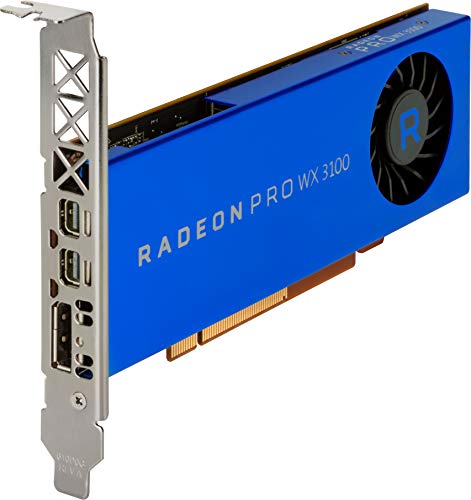
The HP Radeon Pro WX 3100 is a dedicated workstation graphics card built in a low profile form factor. It provides 4 GB of GDDR5 memory along with one standard DisplayPort and two Mini DisplayPort outputs. This setup suits you if you need reliable display outputs and dedicated video memory inside a compact workstation chassis without relying on integrated graphics.
Pros
- Low profile form factor for compact chassis fit
- 4 GB of dedicated GDDR5 memory
- Triple monitor support via one DisplayPort and two Mini DisplayPorts
Cons
- No standard HDMI or DVI video outputs included
- Memory capacity is limited to 4 GB
Good fit if
- You need a low profile workstation graphics card for a slim desktop.
- You connect monitors using DisplayPort or Mini DisplayPort cables.
Skip if
- You need native HDMI or DVI ports for your monitors.
- You require more than 4 GB of video memory for larger workloads.
Verdict: HP Radeon Pro WX 3100 4GB Low Profile delivers 4 GB of GDDR5 memory and triple DisplayPort connectivity in a space-saving workstation design. It gives you a practical hardware option for compact desktop setups requiring dedicated graphics capability.

AMD Radeon PRO WX 3200 4GB
Best for: lightweight 4GB dedicated AMD workstation setups
- Graphics Processor
- Radeon PRO WX 3200
- Memory Size
- 4GB
- Dimensions
- 9.84 × 2.6 × 8.27 inches
- Weight
- 12.7 ounces
The AMD Radeon PRO WX 3200 4GB is a dedicated graphics card built for systems that need standalone video hardware. It provides 4GB of video memory and weighs 0.79 pounds. With measurements of 9.84 inches long, 8.27 inches high, and 2.60 inches wide, it requires adequate chassis depth. This card suits you if you need 4GB of AMD graphics memory in a unit weighing under one pound.
Pros
- 4GB dedicated memory capacity
- Lightweight build at 0.79 pounds
- Width of 2.60 inches for standard slot spacing
Cons
- Length of 9.84 inches requires adequate case clearance
- Video output port types not listed in product data
- Memory type and clock speeds not specified
Good fit if
- You need an AMD card with 4GB of memory.
- You prefer a lightweight graphics card under one pound.
Skip if
- You need verified video output port types prior to purchase.
- You have a small case that cannot fit a 9.84-inch card.
Verdict: AMD Radeon PRO WX 3200 4GB delivers 4GB of memory in a lightweight sub-pound form factor. It is a practical fit if your chassis can accommodate its 9.84-inch length.

LINKUP Extreme4+ 50cm PCIe 4.0 Riser Cable
Best for: GeForce RTX 4090 vertical mounting setups
- GPU
- GeForce RTX 4090
- Interface
- PCIe 4.0
- Use
- Gaming
- Weight
- 8.47 ounces
This is a 50cm PCIe 4.0 x16 riser cable designed to connect your graphics card to a motherboard remotely. It delivers bidirectional bandwidth over 64GB/s with individual laneway shielding and gold-plated contacts. If you need to mount a GPU such as a GeForce RTX 4090 vertically or offset inside your chassis, this cable maintains full signal integrity while providing ventilation through its sectional layout.
Pros
- Delivers over 64GB/s bidirectional PCIe 4.0 x16 bandwidth
- Individual laneway shielding prevents EMI and RFI interference
- Sectional design allows air ventilation
- Gold-plated hand-soldered contacts for signal integrity
Cons
- Extension accessory rather than a standalone graphics card
- Mounting screws are not recommended due to possible case hole misalignment
Good fit if
- You need a 50cm PCIe 4.0 x16 riser to relocate your GPU
- You run high-bandwidth components like a GeForce RTX 4090 on a PCIe 4.0 setup
Skip if
- You need an actual graphics card rather than a connection cable
- You install your GPU directly into the motherboard PCIe slot
Verdict: LINKUP 50cm PCIe 4.0 Riser Cable delivers high-bandwidth PCIe 4.0 x16 connectivity for remote GPU placement. It gives you shielded transmission for components like the RTX 4090 without signal degradation.

Maxsun Radeon RX 550 4GB Low Profile
Best for: compact single-slot HTPC and SFF builds
- Graphics Processor
- AMD Radeon RX 550
- Memory Size
- 4GB
- Memory Type
- GDDR5
- Memory Bus Width
- 128-Bit
- PCIe Interface
- PCI Express X16 3.0
- Slot Width
- single slot
The Maxsun Radeon RX 550 4GB Low Profile is a compact graphics card designed for tight enclosures. It features 4GB of GDDR5 memory across a 128-bit bus, 512 stream processors, and a single-slot footprint measuring 6.61 inches long. If you need a dedicated GPU for a home theater PC or small form factor system that supports 8K DisplayPort output without taking multiple expansion slots, this card fits your build.
Pros
- Single-slot, low-profile design fits slim SFF and Mini-ITX cases
- 4GB GDDR5 memory with 128-bit bus width
- Supports up to 8K resolution DisplayPort output
- Compact length of 6.61 inches and width of 2.71 inches
Cons
- Limited to 512 stream processors
- Uses older PCIe 3.0 interface standard
Good fit if
- You need a single-slot, low-profile card for an HTPC or slim chassis.
- You want 8K display capability from a compact expansion card.
- You need 4GB of dedicated GDDR5 memory on a 128-bit bus.
Skip if
- You require the bandwidth of a newer PCIe 4.0 interface.
- You need a higher compute unit count than 512 stream processors.
Verdict: Maxsun Radeon RX 550 4GB Low Profile delivers 4GB GDDR5 memory and 8K DisplayPort support in an ultra-compact single-slot format. It provides an efficient solution when your computer case cannot accommodate full-height or dual-slot expansion cards.

ASRock Radeon RX 6400 Challenger ITX 4GB
Best for: compact systems without dedicated PCIe power cables
- Graphics Processor
- Radeon RX 6400
- Memory Size
- 4GB
- Memory Type
- GDDR6
- Boost Clock
- 2321 MHz
- PCIe Interface
- PCIe 4.0
- Form Factor
- Low Profile
The ASRock Radeon RX 6400 Challenger 4GB is a compact graphics card built on AMD RDNA 2 architecture. It features a 2321 MHz boost clock, 4GB of GDDR6 memory, and a PCIe 4.0 interface. Because it draws all power directly from the PCIe slot without external power connectors, you can install it in power-constrained builds. This card suits you if you need modern display outputs and silent low-load operation for compact desktop systems.
Pros
- Requires no external power connectors, drawing power from the PCIe slot
- Single-fan cooling includes 0dB silent operation during low-intensity tasks
- Outputs include DisplayPort 1.4 with DSC and HDMI 2.1 with VRR
- Boost clock reaches up to 2321 MHz with 4GB GDDR6 memory
Cons
- Limited to 4GB of GDDR6 memory capacity
- Provides only two display output ports
- Single-fan thermal setup rather than multi-fan cooling
Good fit if
- You need a compact card that runs without external PCIe power cables.
- You want modern display connectivity supporting HDMI 2.1 and DisplayPort 1.4.
- You prefer 0dB silent fan operation during light desktop tasks.
Skip if
- You require more than 4GB of video memory for your software.
- You need to connect more than two monitors simultaneously.
Verdict: ASRock Radeon RX 6400 Challenger 4GB delivers modern RDNA 2 architecture and slot-powered efficiency for compact ITX enclosures. Its 2321 MHz boost clock and modern video outputs make it a capable low-power option.

ASRock Intel Arc A380 Challenger ITX 6GB
Best for: compact Mini-ITX builds needing 6GB VRAM
- Graphics Processor
- Intel Arc A380
- Memory Size
- 6GB
- Memory Type
- GDDR6
- Boost Clock
- 2250MHz
- Memory Bus Width
- 96-bit
- PCIe Interface
- PCIe 4.0
The ASRock Intel Arc A380 Challenger ITX 6GB is a compact dual-slot graphics card built for small form factor systems. It features 6GB of GDDR6 memory across a 96-bit bus, a 2250MHz core clock, and PCIe 4.0 support. A single-fan cooler includes 0dB silent technology for quiet idling. It suits you if you need modern video memory for compact media rigs or esports gaming.
Pros
- 6GB GDDR6 memory on a 96-bit bus
- Compact ITX dual-slot form factor
- Factory overclocked 2250MHz core clock
- 0dB Silent fan stops spinning at low temperatures
- Supports up to 8K resolution video output
Cons
- Requires a dedicated 8-pin power connector
- Recommends a 500W power supply
- Narrow 96-bit memory bus width
Good fit if
- You build inside a compact Mini-ITX or small form factor case.
- You want 6GB of GDDR6 memory for esports gaming or media tasks.
- You need 8K display output support.
Skip if
- You run a power supply rated below 500W.
- You lack an 8-pin PCIe power cable.
- You need a low-profile single-slot expansion card.
Verdict: ASRock Intel Arc A380 Challenger ITX 6GB provides 6GB GDDR6 memory and 8K display capability in an ITX-friendly size. It is a solid match for compact desktop setups with an available 8-pin power lead.

SRhonyra GTX 1050 4GB Low Profile
Best for: low-profile PCs needing no auxiliary power cables
- Graphics Processor
- GTX 1050
- Memory Size
- 4GB
- Memory Type
- GDDR5
- Memory Bus Width
- 128-bit
- PCIe Interface
- PCI-e 3.0 x16
- Slot Width
- single slot
The SRhonyra GTX 1050 4GB Low Profile is a compact, single-slot graphics card built on the Pascal architecture. It features 4GB of GDDR5 memory on a 128-bit bus and draws a maximum of 60W directly from the PCIe 3.0 x16 slot without external power cables. With HDMI and DisplayPort outputs, it fits small form factor cases and suits you if you need a dual-monitor setup or a compact media center build.
Pros
- Max 60W power draw with no auxiliary power connectors needed
- Single-slot, low-profile design measuring 5.7 inches long
- Supports dual displays via DisplayPort up to 7680x4320 and HDMI up to 3840x2160
- Equipped with 4GB GDDR5 memory on a 128-bit bus
Cons
- Limited to two video display outputs
- Uses older PCIe 3.0 interface specification
- Cooling is limited to a single 50mm fan
Good fit if
- You need a single-slot, low-profile card for a small form factor PC or HTPC.
- You have a power supply lacking dedicated PCIe power cables.
- You want a dual-monitor setup using one DisplayPort and one HDMI connection.
Skip if
- You need to connect three or more monitors simultaneously.
- You require legacy video outputs like DVI or VGA.
Verdict: SRhonyra GTX 1050 4GB Low Profile delivers 4GB of GDDR5 memory and 60W plug-and-play efficiency in a true single-slot design. It is an effective option for slim systems that require dual-display output without extra power wiring.

Gigabyte GeForce GTX 1650 4GB GDDR6 Compact
Best for: compact builds needing GDDR6 GTX 1650 graphics
- Graphics Processor
- GeForce GTX 1650
- Memory Size
- 4GB
- Memory Type
- GDDR6
- Memory Bus Width
- 128-bit
- Dimensions
- 11.8 × 2.36 × 8.27 inches
- Weight
- 2.2 pounds
The GIGABYTE GeForce GTX 1650 4GB GDDR6 is a dedicated graphics card built on NVIDIA Turing architecture. It features 4GB of GDDR6 memory across a 128-bit memory bus interface and utilizes a single 90mm blade fan for cooling. With a 170 mm compact card size, this unit fits into builds where internal case space is limited, making it suitable if you need entry-level graphics processing without large physical clearance requirements.
Pros
- 4GB GDDR6 memory
- 128-bit memory bus width
- Compact 170 mm card length
- Single 90mm blade fan cooling
Cons
- Limited to 4GB memory capacity
- Single cooling fan design
Good fit if
- You need a compact 170 mm card to fit a tight PC case.
- You want NVIDIA Turing architecture with GDDR6 memory.
Skip if
- You need more than 4GB of video memory for your applications.
- You require a multi-fan cooling configuration.
Verdict: GIGABYTE GeForce GTX 1650 4GB GDDR6 provides 4GB of GDDR6 memory on a 128-bit bus inside a compact 170 mm card layout. It offers straightforward Turing architecture performance for systems with space constraints.

SAPLOS GTX 1050 4GB Dual-Slot Graphics Card
Best for: plug-and-play upgrades without auxiliary power
- Graphics Processor
- GTX 1050
- Memory Size
- 4GB
- Memory Type
- GDDR5
- Boost Clock
- 1354 MHz
- Memory Bus Width
- 128-bit
- PCIe Interface
- PCI Express 3.0x16
The SAPLOS GTX 1050 4GB provides a compact upgrade for standard desktop systems. It features 4GB of GDDR5 memory on a 128-bit bus, a 1354 MHz boost clock, and 640 stream processors. Because it draws power entirely through the PCIe 3.0 x16 slot without extra power cables, you can install it into ATX, M-ATX, or ITX cases without upgrading your power supply. It drives up to three displays.
Pros
- Requires no external power connectors, drawing power directly from the PCIe slot
- Semi-passive cooling turns fans off during low loads below approximately 60°C
- Supports up to three monitors using DisplayPort, HDMI, and DVI-D ports
- Compact 6.69-inch length fits ATX, Micro-ATX, and Mini-ITX cases
Cons
- Dual-slot thickness prevents installation in slim or small form factor (SFF) chassis
- Relies on older GDDR5 memory and PCIe 3.0 bus standards
Good fit if
- You need a dedicated graphics card that runs without auxiliary power supply cables.
- You want to connect up to three displays via DisplayPort, HDMI, and DVI-D.
- You have an ATX, Micro-ATX, or Mini-ITX case with two open expansion slots.
Skip if
- You have a slim or small form factor (SFF) PC that requires single-slot cards.
- You require faster GDDR6 memory or modern PCIe 4.0 connectivity.
Verdict: SAPLOS GTX 1050 4GB Dual-Slot Graphics Card delivers a simple plug-and-play setup for multi-monitor desktop computing without requiring additional power connectors.

Xynsviu GTX 750 4GB Low Profile GPU
Best for: four-monitor office and trading setups
- Graphics Processor
- GTX 750
- Memory Size
- 4GB
- Memory Type
- GDDR5
- Slot Width
- dual-slot
- Form Factor
- Low Profile
- Dimensions
- 7.09 × 4.72 × 0.1 inches
The Xynsviu GTX 750 4GB Low Profile GPU is a compact video card built for multi-display workstations. It features four HDMI ports that let you connect up to four monitors at once, along with 4GB of GDDR5 memory and a 60W power draw that runs entirely off the PCIe slot. If you need a low-profile card for stock trading, monitoring, or everyday office multitasking across several screens, this card fits your setup.
Pros
- Four HDMI outputs supporting up to four simultaneous monitors
- Low 60W power consumption powered directly by the PCIe slot
- Supports single-display resolutions up to 3840 x 2160 at 60Hz
- Compact 7.09-inch length fits small form factor desktop cases
Cons
- Occupies two expansion slots despite low-profile form factor
- Lacks native DisplayPort or DVI video outputs
- 4K at 60Hz output limited to single-display configurations
Good fit if
- You need to drive up to four HDMI displays from a single card.
- You have a compact desktop without supplemental PCIe power cables.
- You require multi-screen expansion for trading or office productivity.
Skip if
- You only have a single expansion slot available in your case.
- You need native DisplayPort connections for your monitors.
Verdict: Xynsviu GTX 750 4GB Low Profile GPU is a practical choice if you need four HDMI outputs and plug-and-play PCIe power for a multi-monitor office setup. Its dual-slot thickness requires checking case clearance, but it delivers reliable multi-screen expansion without extra power cables.
Specifications side by side
| Spec | Sapphire Nitro+ Radeon RX 580 8GB | PNY Quadro K1200 Low Profile | XFX Radeon RX 580 8GB OC | Sapphire Nitro+ Radeon RX 580 4GB | Sapphire Pulse Radeon RX 580 8GB GDDR5 | HP Radeon Pro WX 3100 4GB Low Profile | AMD Radeon PRO WX 3200 4GB | LINKUP Extreme4+ 50cm PCIe 4.0 Riser Cable | Maxsun Radeon RX 550 4GB Low Profile | ASRock Radeon RX 6400 Challenger ITX 4GB | ASRock Intel Arc A380 Challenger ITX 6GB | SRhonyra GTX 1050 4GB Low Profile | Gigabyte GeForce GTX 1650 4GB GDDR6 Compact | SAPLOS GTX 1050 4GB Dual-Slot Graphics Card | Xynsviu GTX 750 4GB Low Profile GPU |
|---|---|---|---|---|---|---|---|---|---|---|---|---|---|---|---|
| Graphics Processor | Radeon RX 580 | Quadro K1200 | Radeon RX 580 | Radeon RX 580 | Radeon RX 580 | Radeon Pro WX 3100 | Radeon PRO WX 3200 | not specified | AMD Radeon RX 550 | Radeon RX 6400 | Intel Arc A380 | GTX 1050 | GeForce GTX 1650 | GTX 1050 | GTX 750 |
| Memory Size | 8GB | 4 GB | 8GB | 4GB | 8GB | 4 GB | 4GB | not specified | 4GB | 4GB | 6GB | 4GB | 4GB | 4GB | 4GB |
| Memory Type | GDDR5 | GDDR5 | GDDR5 | GDDR5 | GDDR5 | GDDR5 | not specified | not specified | GDDR5 | GDDR6 | GDDR6 | GDDR5 | GDDR6 | GDDR5 | GDDR5 |
| Boost Clock | not specified | not specified | 1386 MHz | not specified | not specified | not specified | not specified | not specified | not specified | 2321 MHz | 2250MHz | not specified | not specified | 1354 MHz | not specified |
| Memory Bus Width | 256-bit | not specified | not specified | not specified | not specified | not specified | not specified | not specified | 128-Bit | not specified | 96-bit | 128-bit | 128-bit | 128-bit | not specified |
| PCIe Interface | not specified | PCIe 2.0 | not specified | not specified | not specified | not specified | not specified | not specified | PCI Express X16 3.0 | PCIe 4.0 | PCIe 4.0 | PCI-e 3.0 x16 | not specified | PCI Express 3.0x16 | not specified |
| Recommended PSU | not specified | not specified | 500 watts | not specified | not specified | not specified | not specified | not specified | not specified | not specified | 500W | not specified | not specified | not specified | not specified |
| Slot Width | not specified | not specified | not specified | not specified | not specified | not specified | not specified | not specified | single slot | not specified | 2-slot | single slot | not specified | Dual Slot | dual-slot |
| Memory | 8GB | 4GB | 8GB | 4GB | 8GB | 4GB | not specified | not specified | not specified | not specified | 6GB | not specified | 4GB | 4GB | 4GB |
| GPU | Radeon RX 580 | not specified | Radeon RX 580 | Radeon RX 580 | Radeon RX 580 | not specified | not specified | GeForce RTX 4090 | Radeon RX 550 | not specified | not specified | not specified | GeForce GTX 1650 | not specified | not specified |
| Interface | not specified | not specified | not specified | not specified | not specified | not specified | not specified | PCIe 4.0 | not specified | PCIe 4.0 | PCIe 4.0 | not specified | not specified | not specified | not specified |
| Form Factor | not specified | Low Profile | not specified | not specified | not specified | Low Profile | not specified | not specified | Low Profile | Low Profile | ITX | Low Profile | not specified | not specified | Low Profile |
| Use | not specified | not specified | not specified | not specified | not specified | Workstation | not specified | Gaming | Gaming | not specified | not specified | not specified | not specified | not specified | not specified |
| Dimensions | 12.8 × 2.75 × 8.5 inches | not specified | 10.6 × 1.57 × 4.88 inches | 11.7 × 2.17 × 5.28 inches | 9.06 × 4.92 × 1.57 inches | 7.48 × 9.45 × 2.36 inches | 9.84 × 2.6 × 8.27 inches | not specified | not specified | 9.89 × 8.55 × 2.52 inches | not specified | 5.7 × 2.7 × 0.1 inches | 11.8 × 2.36 × 8.27 inches | not specified | 7.09 × 4.72 × 0.1 inches |
| Weight | 3.5 pounds | not specified | 2.5 pounds | 2.43 pounds | 2.2 pounds | not specified | 12.7 ounces | 8.47 ounces | 1.81 pounds | 9.7 ounces | 1.32 pounds | 11 ounces | 2.2 pounds | 9.88 ounces | 14.1 ounces |
| Length | not specified | not specified | not specified | not specified | not specified | not specified | not specified | not specified | 6.61 inches | not specified | 1.1 inches | not specified | not specified | 6.69 inches | not specified |
| Width | not specified | not specified | not specified | not specified | not specified | not specified | not specified | not specified | 2.71 inches | not specified | 9.7 inches | not specified | not specified | 4.72 inches | not specified |
| Model | 11265-01-20G-cr | ZXC-VCQK1200DP-PB | RX-580P8DFD6 | M311331 | 11265-05-20G | 2TF08AA | 100-506115 | PCIE4PSR-050 | RX 550 | RX6400 CLI 4G | 90-GA3KZZ-00UANF | SR105D5LP4G1 | GV-N1656OC-4GD REV4.0 | not specified | GTX750 4G 4HDMI |
| Size | not specified | not specified | RX 580 | not specified | not specified | not specified | not specified | 50cm | not specified | RX 6400 4GB | 190 x 124 x 39 mm | low profile single slot | not specified | GTX 1050 | not specified |
| Color | not specified | not specified | not specified | not specified | not specified | not specified | various | Black | not specified | not specified | Matte Black | 1050 HDMI & DP | Black | not specified | GTX750 4G 4HDMI |
Hardware Specifications You Compromise On
Selecting graphics cards in this category means accepting specific hardware limits. Memory capacity caps at 8GB across every model, with several workstation options offering 4GB. All cards with documented memory types use GDDR5 rather than newer memory formats. If you choose an 8GB model for higher performance, you must accommodate up to 500-watt power requirements and chassis clearance reaching 12.75 inches. Smaller low-profile workstation cards fit tight enclosures but restrict you to 4GB capacity and interfaces like PCIe 2.0 x16.
- Memory type: Every listed card uses GDDR5 memory
- Memory capacity: Capped at 8GB, with compact workstation cards limited to 4GB
- Power requirement: Full-size 8GB options require 500 watts of system power
- PCIe interface: Select compact cards utilize PCIe 2.0 x16 connections
If your chassis needs supplementary airflow for these hardware specifications, you can install a fan under 150 to keep overall case temperatures regulated.
How We Picked These Cards
You see 15 graphics cards chosen from listings that qualify for Under $150. All details come directly from published specifications and feature lists on each listing. Products are not physically handled. To keep your comparison clear and practical, this page includes only one representative model from each product family.
The guide arranges selections with products in stock first, then by Amazon sales rank (better-selling products first). Availability updates daily directly on the page. Because catalog listings shift over time, individual graphics cards move into or out of this guide as qualifications change.
How to Choose the Right Graphics Card
-
Verify Power Supply Wattage
You must check your computer power supply rating before selecting a card. Certain performance cards require dedicated power delivery and substantial wattage to run safely. For example, the Gigabyte GeForce GTX 1070 8GB specifies a 500W system power requirement. If your desktop power supply provides less than this documented threshold, the card will fail to operate reliably under load. Match your power supply wattage to the manufacturer specification to prevent sudden shutdowns and hardware instability during intensive graphical computing tasks.
-
Check for ISV Certifications
You should determine whether your primary software relies on professional driver stability. Standard desktop GPUs target general computing, while dedicated workstation cards undergo testing for specific professional applications. The PNY Quadro P1000 4GB Low-Profile highlights ISV certification for specialized software stability. If you run computer-aided drafting or commercial design suites, selecting a card with documented workstation certifications ensures stable driver support. For standard productivity and multimedia tasks, cards lacking professional certifications operate normally while providing similar base display capabilities.
-
Inspect Display Output Types
You must evaluate the physical output connectors to ensure compatibility with your existing monitors and cabling. Some workstation hardware uses compact connector standards that require matching adapter hardware. The NVIDIA Quadro P1000 4GB Graphics Card provides four mini DisplayPort 1.4 connections rather than standard full-size ports. If your monitors use standard DisplayPort or HDMI cables, you will need compatible cables or adapters to connect your screens. Confirming output specifications in advance prevents connectivity problems when deploying multi-screen arrangements.
-
Select Memory Capacity Carefully
You need to balance memory capacity against your planned visual workloads. Cards in this category typically provide either 4GB or 8GB of dedicated GDDR5 memory. The Sapphire Nitro+ Radeon RX 580 4GB provides 4GB of VRAM, which functions well for basic desktop displays and standard multi-monitor office tasks. If you edit high-resolution assets or execute complex 3D rendering workflows, prioritize models with 8GB of memory. More VRAM allows your card to store larger visual assets locally without exhausting dedicated memory.
-
Review PCIe Interface Generations
You should verify the PCI Express generation supported by your motherboard slot and the card. Interface standards determine data throughput limits between your graphics hardware and the system processor. For instance, the PNY Quadro K1200 Low Profile utilizes a PCIe 2.0 x16 connection. While PCIe interfaces are backward and forward compatible, pairing a legacy interface with modern boards locks data transfer to the older standard. Check your motherboard documentation to understand how the card interface specification matches your available system bus.
Frequently asked questions
Can you run multiple monitors on these budget graphics cards?
Yes, several cards in this lineup support multi-monitor configurations right out of the box. For example, the Sapphire Nitro+ Radeon RX 580 provides five video outputs for expansive display arrays. If you need standard connections, the Xynsviu GTX 750 4GB includes four HDMI ports. The HP Radeon Pro WX 3100 offers triple DisplayPort jacks for compact workstations.
Do these graphics cards require dedicated power cables from the power supply?
Not all cards require auxiliary PCIe power cables from your power supply. Models such as the SRhonyra GTX 1050 4GB operate on 60W using motherboard slot power alone. The ASRock Radeon RX 6400 Challenger ITX also runs without auxiliary cables. However, options like the ASRock Intel Arc A380 require an 8-pin power lead, while the XFX RX 580 specifies a 500-watt power supply.
Which graphics cards fit inside small form factor or slim PC cases?
Low-profile and single-slot cards are built specifically to fit slim or small form factor computer cases. The SRhonyra GTX 1050 measures 5.7 inches long in a single-slot design. The Maxsun Radeon RX 550 also uses a low-profile single-slot layout measuring 6.61 inches. For workstation duties, the PNY Quadro K1200 and HP Radeon Pro WX 3100 fit compact chassis dimensions.
What is the difference between GDDR5 and GDDR6 graphics cards in this range?
GDDR6 memory delivers newer architecture and faster transfer bandwidth than older GDDR5 memory modules. Most models in this group, such as the Sapphire Pulse RX 580 and PNY Quadro K1200, utilize GDDR5. Meanwhile, cards like the Gigabyte GeForce GTX 1650, ASRock Radeon RX 6400 ITX, and ASRock Intel Arc A380 Challenger feature faster GDDR6 memory across modern PCI Express interfaces.
Can any of these graphics cards output 8K video resolution?
Yes, specific models in this group provide display interfaces capable of driving 8K resolution. The Maxsun Radeon RX 550 4GB Low Profile includes DisplayPort output engineered to support 8K displays. In addition, the ASRock Intel Arc A380 Challenger ITX 6GB specifies 8K display capability alongside its PCIe 4.0 interface, giving you support for high-resolution monitors in compact builds.
What should you know about PCIe riser cables when mounting a GPU?
PCIe riser cables allow you to mount your graphics card vertically or away from the motherboard expansion slot. The LINKUP Extreme4+ 50cm cable provides PCIe 4.0 x16 connectivity with shielded wiring to prevent signal degradation during transmission. It is specifically rated for vertical mounting configurations, including builds with hardware like the GeForce RTX 4090, as long as your chassis has space.