ZOTAC Gaming GeForce GTX 1650 Alternatives: 6 Similar Picks Compared
As an Amazon Associate we earn from qualifying purchases. Links on this page are affiliate links.
Finding suitable zotac gaming geforce gtx 1650 alternatives starts with evaluating what the base hardware provides. The original ZOTAC GeForce GTX 1650 4GB features a 128-bit memory bus width, 4GB of GDDR5 memory, and a compact frame measuring 5.94 inches long by 4.38 inches high. These physical dimensions and core memory specs suit space-constrained desktop builds that require dedicated gaming graphics without demanding large clearance space inside your computer case.
You might seek a different card if your setup demands alternate specifications, dimensions, connectivity, or brands. For instance, your system might benefit from faster GDDR6 memory, a low-profile form factor for slim cases, or distinct video outputs such as quad HDMI or legacy VGA and DVI ports. Other desktop configurations may align better with different graphics processors like the Radeon RX 550 or GeForce GTX 1050 Ti. The 6 alternatives compared here were selected because their technical specifications overlap with the original ZOTAC model, giving you balanced options for your build requirements.
How Each Alternative Compares
ASUS TUF Gaming GeForce GTX 1650 4GB
The ASUS TUF Gaming GeForce GTX 1650 upgrades the memory standard over the ZOTAC GeForce GTX 1650. It features 4GB of GDDR6 memory instead of GDDR5, along with a protective backplate for structural reinforcement. Both cards use the GeForce GTX 1650 graphics processor and provide 4GB of video memory for gaming. However, the ASUS model requires significantly more installation clearance. It measures 8.11 inches long, 4.92 inches wide, and 1.81 inches high, while weighing 1.39 pounds. The ZOTAC card is substantially more compact, measuring 5.94 inches wide and 1.53 inches long. You should choose the ASUS TUF card if your desktop enclosure accommodates an 8.11-inch card and you want GDDR6 memory.
Maxsun Radeon RX 550 4GB ITX
The Maxsun Radeon RX 550 ITX differs primarily in its graphics processing architecture. It runs on an AMD Radeon RX 550 GPU with 512 stream processors, rather than the GeForce GTX 1650 found in the ZOTAC card. Both cards provide 4GB of GDDR5 memory for gaming tasks. In terms of dimensions, the Maxsun card measures 7.28 inches long and 1.37 inches wide, weighing 6.98 ounces. This makes it longer than the 1.53-inch length of the compact ZOTAC unit. It adopts a dedicated ITX form factor designed for small builds. You should choose the Maxsun card if you are assembling an ITX system focused on basic 1080p gaming and multimedia work.
51RISC Radeon RX 550 4GB Low Profile
The 51RISC Radeon RX 550 Low Profile is built for spaces that cannot fit full-height hardware. It features a low-profile form factor measuring 6.61 inches long, 2.71 inches wide, and 0.7 inches high. In contrast, the ZOTAC GeForce GTX 1650 stands 4.38 inches high and 5.94 inches wide. The 51RISC card runs without supplemental power cables, drawing low power directly from the slot. However, you give up the GeForce GTX 1650 graphics processor, receiving a Radeon RX 550 core instead. Both units share 4GB of GDDR5 memory. You should pick the 51RISC card if you have a slim, low-profile chassis lacking dedicated power connectors.
Sanpyl 550Ti 4GB GDDR5 Graphics Card
The Sanpyl 550Ti targets older desktop architectures rather than modern gaming platforms. It offers legacy connectivity through VGA and DVI ports alongside an HDMI output, connecting directly to older monitor configurations. It also supports standard PCI Express 2.0 expansion slots. The ZOTAC card uses the newer GeForce GTX 1650 GPU with a 128-bit memory bus width. While both cards share 4GB of GDDR5 memory for gaming, the Sanpyl card relies on the older 550Ti architecture. You give up the newer GTX 1650 processing design in exchange for legacy display flexibility. Pick the Sanpyl card if you must maintain compatibility with legacy VGA displays and PCIe 2.0 motherboards.
Xynsviu GTX 1650 Quad HDMI Low Profile
The Xynsviu GTX 1650 Quad HDMI expands multi-display output capabilities compared to the ZOTAC GeForce GTX 1650. It provides four separate HDMI ports, allowing you to connect four displays simultaneously. It operates on 60 W of PCIe bus power without requiring external power connectors. Both models share the GeForce GTX 1650 graphics processor and 4GB of GDDR5 memory. For chassis fit, the Xynsviu measures 7.09 inches long, 4.72 inches wide, and 0.1 inches high, weighing 14.1 ounces, compared to the 1.53-inch length and 5.94-inch width of the ZOTAC. You should pick this card if you need to run a four-monitor array powered entirely from the motherboard slot.
Maxsun GeForce GTX 1050 Ti Low Profile
The Maxsun GeForce GTX 1050 Ti Low Profile is tailored specifically for slim computer cases. It features a narrow width of 0.71 inches and a length of 6.57 inches, weighing 7.27 ounces. It includes a dual-port layout and a boost clock of 1392 MHz. In contrast, the ZOTAC GeForce GTX 1650 measures 5.94 inches wide, 4.38 inches high, and 1.53 inches long. Both graphics cards provide 4GB of GDDR5 memory for gaming. By choosing the Maxsun card, you give up the newer GeForce GTX 1650 graphics architecture for the older GTX 1050 Ti core. You should pick this alternative if you need low-profile clearance in a very slim chassis.
Quick picks
Our 7 picks

ZOTAC GeForce GTX 1650 4GB
Best for: compact gaming PC builds
- Graphics Processor
- GeForce GTX 1650
- Memory Size
- 4GB
- Memory Type
- GDDR5
- Memory Bus Width
- 128-Bit
- Use
- Gaming
- Dimensions
- 1.53 × 5.94 × 4.38 inches
The ZOTAC GeForce GTX 1650 OC 4GB is a dedicated gaming graphics card using the GeForce GTX 1650 processor. It provides 4GB of GDDR5 memory across a 128-bit bus width. With physical dimensions of 5.94 inches by 4.38 inches by 1.53 inches, it fits smaller computer cases. It suits you if you require a gaming graphics card that fits within compact desktop enclosures.
Pros
- GeForce GTX 1650 graphics processor
- 4GB GDDR5 video memory
- 128-bit memory bus width
- Compact dimensions of 5.94 by 4.38 by 1.53 inches
Cons
- Uses GDDR5 memory rather than newer memory types
- Limited to a 4GB memory capacity
- Comes as renewed hardware
Good fit if
- You need a compact graphics card measuring under six inches in width.
- You want a GeForce GTX 1650 processor with a 128-bit memory bus.
Skip if
- You need more than 4GB of video memory for your system.
- You prefer factory-new hardware over renewed parts.
Verdict: ZOTAC GeForce GTX 1650 OC 4GB provides a 128-bit bus and 4GB GDDR5 memory inside a compact frame. It delivers essential hardware specifications for tight PC enclosures.
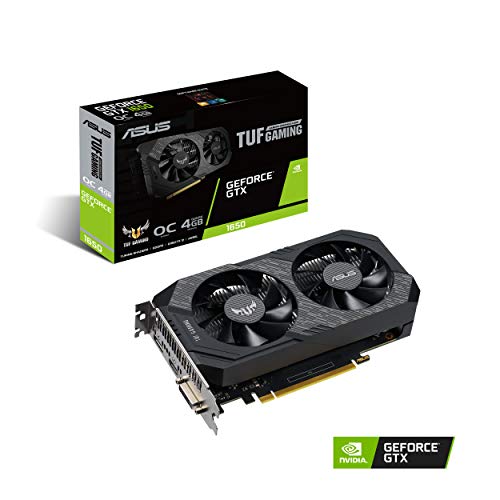
ASUS TUF Gaming GeForce GTX 1650 4GB
Best for: PCIe 3.0 systems needing GDDR6 memory
- Graphics Processor
- GeForce GTX 1650
- Memory Size
- 4GB
- Memory Type
- GDDR6
- PCIe Interface
- PCIe 3.0
- Use
- Gaming
- Dimensions
- 8.11 × 4.92 × 1.81 inches
The card is an NVIDIA Turing graphics card equipped with 4GB of GDDR6 memory across a PCIe 3.0 interface. It delivers a digital maximum resolution of 7680 x 4320 and includes a protective backplate on its 8.11-inch frame. With DisplayPort and HDMI outputs, it suits you if you need reliable display output for high-resolution screens and dedicated gaming hardware built with automated manufacturing.
Pros
- 4GB of GDDR6 memory
- Digital maximum resolution of 7680 x 4320
- Protective backplate for physical reinforcement
- DisplayPort and HDMI video outputs
Cons
- Length of 8.11 inches exceeds compact low-profile chassis limits
- PCIe 3.0 interface rather than newer bus standards
Good fit if
- You want a GeForce GTX 1650 card configured with GDDR6 memory.
- You need display connectivity supporting resolutions up to 7680 x 4320.
- You have space in your case for an 8.11-inch dual-slot card.
Skip if
- You need a low-profile card for a slim computer case.
- You require more than 4GB of video memory for your applications.
Verdict: ASUS TUF Gaming GeForce GTX 1650 GDDR6 delivers 4GB of GDDR6 memory and a protective backplate on an 8.11-inch frame. It provides a durable option for standard PCIe 3.0 desktop configurations.

Maxsun Radeon RX 550 4GB ITX
Best for: compact ITX systems and 1080p gaming
- Graphics Processor
- AMD Radeon RX 550
- Memory Size
- 4GB
- Memory Type
- GDDR5
- Boost Clock
- up to 1183 MHz
- Memory Bus Width
- 128-Bit
- PCIe Interface
- PCI Express X16 3.0
The Maxsun Radeon RX 550 ITX Graphics Card provides an alternative to the GTX 1650 for compact desktop builds. It features an AMD Radeon RX 550 graphics processor paired with 4GB of GDDR5 memory across a 128-bit bus. Running at boost clocks up to 1183 MHz with 512 stream processors, it handles 1080p gaming, 4K video decoding, and photo editing. You get a space-saving 7.28-inch design suited for small-form-factor setups.
Pros
- Compact ITX card measuring 7.28 inches long
- 4GB GDDR5 memory on a 128-bit bus
- Single 9 cm cooling fan
- Supports DirectX 12, OpenGL 4.6, and 4K video decoding
Cons
- Boost clock tops out at 1183 MHz
- Limited to 512 stream processors
Good fit if
- You need a 7.28-inch card designed for compact ITX computer cases.
- You want 4GB of GDDR5 memory for 1080p gaming or photo editing.
- You use applications requiring DirectX 12 or OpenGL 4.6 support.
Skip if
- You need more than 512 stream processors for heavy graphical workloads.
- You require boost clock frequencies beyond 1183 MHz.
Verdict: Maxsun Radeon RX 550 ITX Graphics Card is a compact 7.28-inch option with 4GB GDDR5 memory for basic 1080p gaming and multimedia tasks. Its 512 stream processors and ITX form factor make it an accessible entry-level alternative for small PC cases.

51RISC Radeon RX 550 4GB Low Profile
Best for: compact low-profile desktops and mini-ITX systems
- Graphics Processor
- Radeon RX 550
- Memory Size
- 4GB
- Memory Type
- GDDR5
- Memory Bus Width
- 128bit
- PCIe Interface
- PCIe 3.0*16
- Form Factor
- Low Profile
The 51RISC Radeon RX 550 Low Profile 4GB gives you a compact graphics card designed for small form factor setups. It features 4GB of GDDR5 memory across a 128-bit bus and runs on a 35W TDP directly from the PCIe 3.0 x16 slot. With DisplayPort and HDMI ports, it suits you well if you need an efficient card for a slim desktop or mini-ITX build without adding dedicated PCIe power cables.
Pros
- Low-profile design with mounted short bracket fits mini-ITX cases
- Low 35W TDP operates without external power connectors
- 4GB GDDR5 memory with a 128-bit bus width
- Provides both DisplayPort and HDMI video outputs
Cons
- Core clock tops out at 1183 MHz
- Offers only two display outputs
Good fit if
- You have a mini-ITX case or slim desktop that requires a low-profile bracket.
- You want a card that draws power strictly through the PCIe slot with a 300W power supply.
Skip if
- You need more than two simultaneous monitor connections.
- You require core clock speeds higher than 1183 MHz.
Verdict: 51RISC Radeon RX 550 Low Profile 4GB provides an ultra-compact solution for slim builds needing 4GB VRAM and low power draw. It operates without extra power cables, making it a straightforward fit for compact systems.

Sanpyl 550Ti 4GB GDDR5 Graphics Card
Best for: older systems needing legacy VGA and DVI ports
- Graphics Processor
- 550Ti
- Memory Size
- 4GB
- Memory Type
- GDDR5
- Memory Bus Width
- 128Bit
- PCIe Interface
- PCI Express2.0
- Use
- Gaming
This Sanpyl 550Ti graphics card provides 4GB of GDDR5 memory across a 128-bit bus width. It features a single cooling fan and runs on an older PCI Express 2.0 interface. For video output, you get HDMI, DVI, and legacy VGA ports to connect different display types. If you need a basic card with legacy display connections and dedicated memory for an older system, this model fits your setup.
Pros
- 4GB GDDR5 memory with a 128-bit bus width
- Includes HDMI, DVI, and legacy VGA video outputs
- Equipped with an integrated cooling fan
Cons
- Uses an older PCI Express 2.0 bus interface
- Product appearance varies between production batches
- No DisplayPort output provided
Good fit if
- You require legacy VGA or DVI display outputs alongside HDMI.
- You need a dedicated 4GB GDDR5 graphics card for a PCIe 2.0 slot.
Skip if
- You need modern DisplayPort connectivity for your monitor.
- You want a newer PCIe 3.0 or PCIe 4.0 interface specification.
Verdict: Sanpyl 550Ti 4GB GDDR5 Graphics Card delivers 4GB of GDDR5 video memory and versatile display outputs including VGA, DVI, and HDMI. It suits basic gaming setups and older systems that rely on a PCI Express 2.0 slot.

Xynsviu GTX 1650 Quad HDMI Low Profile
Best for: quad-monitor setups in compact, bus-powered PCs
- Graphics Processor
- GTX1650
- Memory Size
- 4GB
- Memory Type
- GDDR5
- Slot Width
- dual-slot
- GPU
- GeForce GTX 1650
- Dimensions
- 7.09 × 4.72 × 0.1 inches
The Xynsviu GTX 1650 4GB Quad HDMI Graphics Card brings GeForce GTX 1650 processing power into a low-profile, dual-slot format. Built with 4GB of GDDR5 memory and a 60 W power draw handled entirely through the PCIe bus, it requires no external power cables. This card suits you if you need to run up to four displays through dedicated HDMI ports in a compact PC or multi-monitor workstation.
Pros
- Four HDMI output ports supporting up to four simultaneous displays
- Low-profile, half-height card design for compact ITX builds
- Runs on PCIe bus power with a 60 W maximum power consumption
- Supports 4K at 60Hz across two screens or 8K 2x2 display stitching
Cons
- Lacks DisplayPort or DVI display outputs
- Dual-slot width occupies two expansion slots despite half-height profile
Good fit if
- You need to drive up to four HDMI monitors from a single graphics card.
- You have a power supply without dedicated PCIe supplementary power cables.
- You are assembling a small-form-factor or ITX PC that fits half-height cards.
Skip if
- You rely on DisplayPort monitors without using separate adapters.
- You have a slim case restricted strictly to single-slot expansion cards.
Verdict: Xynsviu GTX 1650 4GB Quad HDMI Graphics Card delivers multi-screen productivity with four HDMI outputs and low 60 W PCIe bus power. It provides reliable multi-monitor support for compact builds without requiring external power connectors.

Maxsun GeForce GTX 1050 Ti Low Profile
Best for: small-form-factor desktop PC builds
- Graphics Processor
- GeForce GTX 1050 Ti
- Memory Size
- 4GB
- Memory Type
- GDDR5
- Boost Clock
- 1392 MHz
- Memory Bus Width
- 128 Bit
- PCIe Interface
- PCIe 3.0 x16
This card features an NVIDIA GeForce GTX 1050 Ti graphics processor paired with 4GB of GDDR5 memory on a 128-bit bus. You get a boost clock reaching 1392 MHz, a PCIe 3.0 x16 interface, and video outputs covering DisplayPort and HDMI up to 7680x4320 resolution. At 6.57 inches long, its low-profile design fits compact small-form-factor desktop cases where standard-height graphics hardware cannot fit.
Pros
- Low-profile form factor measuring 6.57 inches long
- Boost clock speed up to 1392 MHz
- Supports up to 7680x4320 resolution via HDMI and DisplayPort
- 4GB 128-bit GDDR5 memory with 7000 MHz speed
Cons
- Only two display outputs available (HDMI and DP)
- Uses older PCIe 3.0 bus interface standard
Good fit if
- You need a low-profile card under 7 inches for a small-form-factor desktop.
- You want 4GB of dedicated GDDR5 memory for high-resolution displays up to 8K.
Skip if
- You require more than two video outputs for your display setup.
- You need a card built on architectures newer than NVIDIA Pascal.
Verdict: Maxsun GeForce GTX 1050 Ti 4GB Low Profile provides a compact, dual-port GPU designed specifically for slim small-form-factor PC enclosures. Its 1392 MHz boost clock and 4GB GDDR5 configuration handle display demands within tight chassis clearances.
Specifications side by side
| Spec | ZOTAC GeForce GTX 1650 4GB | ASUS TUF Gaming GeForce GTX 1650 4GB | Maxsun Radeon RX 550 4GB ITX | 51RISC Radeon RX 550 4GB Low Profile | Sanpyl 550Ti 4GB GDDR5 Graphics Card | Xynsviu GTX 1650 Quad HDMI Low Profile | Maxsun GeForce GTX 1050 Ti Low Profile |
|---|---|---|---|---|---|---|---|
| Graphics Processor | GeForce GTX 1650 | GeForce GTX 1650 | AMD Radeon RX 550 | Radeon RX 550 | 550Ti | GTX1650 | GeForce GTX 1050 Ti |
| Memory Size | 4GB | 4GB | 4GB | 4GB | 4GB | 4GB | 4GB |
| Memory Type | GDDR5 | GDDR6 | GDDR5 | GDDR5 | GDDR5 | GDDR5 | GDDR5 |
| Boost Clock | not specified | not specified | up to 1183 MHz | not specified | not specified | not specified | 1392 MHz |
| Memory Bus Width | 128-Bit | not specified | 128-Bit | 128bit | 128Bit | not specified | 128 Bit |
| PCIe Interface | not specified | PCIe 3.0 | PCI Express X16 3.0 | PCIe 3.0*16 | PCI Express2.0 | not specified | PCIe 3.0 x16 |
| Slot Width | not specified | not specified | not specified | not specified | not specified | dual-slot | not specified |
| Memory | 4GB | 4GB | 4GB | 4GB | 4GB | 4GB | 4GB |
| GPU | GeForce GTX 1650 | GeForce GTX 1650 | Radeon RX 550 | Radeon RX 550 | not specified | GeForce GTX 1650 | not specified |
| Interface | not specified | PCIe 3.0 | not specified | not specified | not specified | not specified | not specified |
| Form Factor | not specified | not specified | ITX | Low Profile | not specified | not specified | Low Profile |
| Use | Gaming | Gaming | Gaming | Gaming | Gaming | not specified | Gaming |
| Dimensions | 1.53 × 5.94 × 4.38 inches | 8.11 × 4.92 × 1.81 inches | not specified | 6.61 × 2.71 × 0.7 inches | not specified | 7.09 × 4.72 × 0.1 inches | not specified |
| Weight | not specified | 1.39 pounds | 6.98 ounces | not specified | not specified | 14.1 ounces | 7.27 ounces |
| Length | not specified | not specified | 7.28 inches | not specified | not specified | not specified | 6.57 inches |
| Width | not specified | not specified | 1.37 inches | not specified | not specified | not specified | 0.71 inches |
| Model | ZT-T16500F-10L-cr | TUF-GTX1650-O4GD6-P-GAMING | RX 550 | RX 550 Low Profile | Sanpylgzcoud5w34 | GTX1650 4G 4HDMI | MS-GTX1050Ti LP 4G |
| Size | not specified | not specified | not specified | RX 550 4GB Low Profile | not specified | not specified | not specified |
| Color | not specified | not specified | not specified | not specified | not specified | GTX1650 4G 4HDMI | not specified |
For those comparing seating options, explore the gtplayer gaming chair alternatives page for similar picks.
Frequently asked questions
Which alternative is best for multi-monitor display setups?
The Xynsviu GTX 1650 Quad HDMI is built specifically for driving several screens at once. It provides four native HDMI outputs, letting you run a multi-display workstation or monitoring setup from a single low-profile graphics card. In addition, it draws 60 W directly from the PCIe bus, meaning you do not need auxiliary power cables from your power supply unit to operate it.
Are there low-profile graphics card alternatives that fit in slim desktop cases?
Yes, several alternatives offer low-profile dimensions designed specifically for slim PC enclosures. The 51RISC Radeon RX 550 measures 6.61 inches long and 0.7 inches high, while the Maxsun GeForce GTX 1050 Ti Low Profile measures 6.57 inches long and 0.71 inches wide. Both fit narrow chassis slots and provide 4GB of dedicated video memory, making them suitable replacements when chassis clearance is constrained.
Can you run these graphics card alternatives without dedicated PCIe power cables?
Yes, multiple options on this list operate without requiring auxiliary PCIe power connectors from your power supply. Models like the 51RISC Radeon RX 550 Low Profile and the Xynsviu GTX 1650 Quad HDMI run entirely on power supplied through the motherboard expansion slot. The Xynsviu card requires only 60 W of PCIe bus power, simplifying cable management in compact desktop towers with modest power supplies.
Which graphics card works best with legacy monitors that require VGA or DVI ports?
The Sanpyl 550Ti 4GB GDDR5 is the best option for older display connections. While most modern cards only feature HDMI or DisplayPort, this model includes built-in VGA, DVI, and HDMI outputs. It connects directly to older analog or legacy digital screens without requiring active signal adapters. It also operates on older PCI Express 2.0 motherboard slots while providing 4GB of GDDR5 memory.
What is the core hardware difference between the Radeon RX 550 and GTX 1650?
The primary hardware difference lies in the underlying GPU architecture and stream processor count. The Maxsun Radeon RX 550 uses an AMD graphics processor with 512 stream processors paired with 4GB GDDR5 memory. In contrast, GeForce GTX 1650 cards use NVIDIA graphics processing units designed for higher graphics workloads. Both card types feature 4GB of VRAM, but their execution architectures cater to different performance tiers.
How do card dimensions affect your choice of a GTX 1650 replacement?
Dimensions determine whether a graphics card will clear your PC case boundaries and adjacent expansion slots. The ASUS TUF Gaming GeForce GTX 1650 measures 8.11 inches in length, requiring a standard desktop case. If you have an ITX enclosure, the Maxsun Radeon RX 550 ITX measures 7.28 inches long and weighs 6.98 ounces, offering a smaller footprint that accommodates restricted interior computer layouts.
What clock speed specification does the Maxsun GTX 1050 Ti offer?
The Maxsun GeForce GTX 1050 Ti Low Profile specifies a boost clock frequency of 1392 MHz. This clock frequency regulates core computing speed across gaming and display tasks. The card combines that boost speed with 4GB of GDDR5 memory in a slim frame measuring 6.57 inches long and 0.71 inches wide, providing dedicated processing capability for small-form-factor builds where space is restricted.