Pcie 5.0 or Pcie 3.0 Computer Cables? Compared by Specs
As an Amazon Associate we earn from qualifying purchases. Links on this page are affiliate links.
You are looking at the pcie 50 vs pcie 30 computer cable debate. Both items are x16 riser cables designed for vertical GPU mounting. They share a right-angle connector and shielded construction to protect signal integrity. The main difference lies in their interface generation. One supports the latest PCIe 5.0 standard for higher bandwidth, while the other uses the established PCIe 3.0 protocol. This choice affects maximum data transfer speeds and future compatibility.
Key differences
| Aspect | LINKUP 25cm Right Angle PCIe 5.0 Riser Cable | GLOTRENDS 250mm PCIe 3.0 x16 90-Degree Riser Cable |
|---|---|---|
| Interface Standard | PCIe 5.0 | PCIe 3.0 |
| Maximum Bandwidth | 128GB/s | up to 16GB/s |
| Cable Length | 25cm | 250mm |
| Shielding Type | multilayer shielding | shielded ribbon |
Which one should you choose?
Choose LINKUP 25cm Right Angle PCIe 5.0 Riser Cable if
- You need maximum bandwidth for next-generation graphics cards like RTX 5090.
- You want a cable that supports PCIe 4.0 and 5.0 devices without bottlenecking.
- You prefer a shorter 25cm run for compact or specific case layouts.
Choose GLOTRENDS 250mm PCIe 3.0 x16 90-Degree Riser Cable if
- You are using older GPUs such as RTX 20 series or GTX 16 series.
- You require a longer 250mm cable to reach slots in full-tower cases.
- You need backward compatibility with PCIe 2.0 and 1.0 slots.
Verdict: Choose the LINKUP PCIe 5.0 riser if you plan to use modern high-bandwidth GPUs or want future-proofing. Pick the GLOTRENDS PCIe 3.0 option if you have older graphics cards or need a longer cable reach for full-tower chassis. Both provide stable signal shielding for vertical mounting.
PCIe 5.0 vs 3.0 Riser Specs
Interface Standard
The LINKUP cable supports the PCIe 5.0 standard, which is the latest generation for consumer graphics cards. This interface allows for significantly higher data transfer rates compared to older standards. The GLOTRENDS cable uses the PCIe 3.0 standard, which is an older but still widely supported generation. If you have a modern GPU that supports PCIe 5.0 or 4.0, the LINKUP cable provides the necessary bandwidth to utilize those speeds fully. The GLOTRENDS cable is limited to PCIe 3.0 speeds, meaning it will not support the higher bandwidth of newer cards unless you manually downgrade the slot settings in your motherboard BIOS.
Maximum Bandwidth
Bandwidth determines how much data can move between your GPU and the motherboard per second. The LINKUP PCIe 5.0 riser cable offers a maximum bandwidth of 128GB/s. This high throughput is essential for next-generation cards and high-FPS gaming. The GLOTRENDS PCIe 3.0 cable provides up to 16GB/s of bandwidth. While this is sufficient for many current and previous generation graphics cards, it is significantly lower than the LINKUP option. If you plan to use high-end GPUs that require more than 16GB/s, the GLOTRENDS cable will become a bottleneck. The LINKUP cable ensures you have plenty of headroom for future upgrades.
Cable Length
Length is critical for vertical GPU mounts, as you need enough slack to route the cable cleanly without strain. The LINKUP cable is 25cm long, which is equivalent to 250mm. The GLOTRENDS cable is also 250mm long. Both products offer the exact same physical length for your build. This means they will fit similarly in full-tower cases or setups where the GPU bracket is positioned a specific distance from the motherboard slot. Since the lengths are identical, you will not gain or lose any routing flexibility by choosing one over the other based on distance alone.
Connector Angle
Both cables feature a right-angle connector design, which is standard for vertical GPU mounting. The LINKUP cable specifies a Right Angle connector, while the GLOTRENDS cable describes its connector as a 90 Degree Right Angle. These are functionally the same orientation, allowing the cable to exit the GPU slot at a perpendicular angle for cleaner cable management. This design helps reduce stress on the PCIe slot and keeps the cable away from other components. Since both products utilize this same right-angle configuration, there is no practical difference in how they will sit inside your case or how they connect to the graphics card.
Shielding Type
Shielding protects the data signal from interference, which is vital for stable frame rates and 4K output. The LINKUP cable uses multilayer shielding to suppress crosstalk and EMI, aiming for clean eye margins under load. The GLOTRENDS cable uses a shielded ribbon design to block interference along the entire run. Both products prioritize signal integrity through shielding, though the specific construction methods differ slightly. The LINKUP option emphasizes tuned impedance and premium conductors for Gen5 performance, while the GLOTRENDS option focuses on stable signal delivery for Gen3 GPUs. Both approaches are designed to keep your display output stable during gaming or workstation use.
Which pcie riser cable suits your build
Users with latest gen 5 graphics cards
The LINKUP cable supports PCIe 5.0 x16, delivering up to 128GB/s bandwidth. This ensures full speed for next-gen GPUs like RTX 5090. Its multilayer shielding maintains signal integrity under heavy loads. If you plan to upgrade your graphics card soon, this higher interface standard provides the necessary headroom for future performance demands.
Owners of older generation graphics cards
The GLOTRENDS cable uses the PCIe 3.0 standard, offering up to 16GB/s bandwidth. This matches the capabilities of older GPUs like RTX 20 series or RX 5000. It is backward compatible with PCIe 2.0 and 1.0 slots. You get stable signal performance without needing to adjust BIOS settings or worry about compatibility issues with legacy hardware.
Builders needing extra length for full towers
The GLOTRENDS option comes in a 250mm length, providing extra reach for full-tower cases. This distance accommodates vertical GPU brackets situated far from the motherboard slot. It leaves ample routing space for thick air coolers, radiators, and cable combs. The shielded ribbon design blocks interference along this longer run, keeping output stable in spacious chassis layouts.
Quick picks
| # | Product | Best for | Price |
|---|---|---|---|
| 1 | LINKUP 25cm Right Angle PCIe 5.0 Riser Cable | Vertical GPU mounts requiring PCIe 5.0 | Check price of LINKUP 25cm Right Angle PCIe 5.0 Riser Cable on Amazon |
| 2 | GLOTRENDS 250mm PCIe 3.0 x16 90-Degree Riser Cable | full-tower cases with PCIe 3.0 GPUs | Check price of GLOTRENDS 250mm PCIe 3.0 x16 90-Degree Riser Cable on Amazon |
The products compared
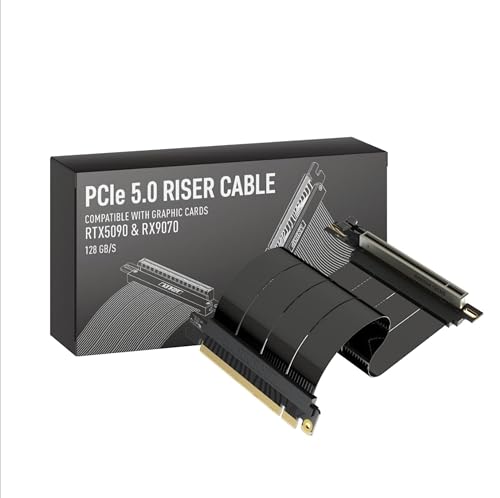
LINKUP 25cm Right Angle PCIe 5.0 Riser Cable
Best for: Vertical GPU mounts requiring PCIe 5.0
- Interface Standard
- PCIe 5.0
- Slot Configuration
- x16
- Cable Length
- 25cm
- Connector Angle
- Right Angle
- Maximum Bandwidth
- 128GB/s
- Shielding Type
- multilayer shielding
View on Amazon: LINKUP 25cm Right Angle PCIe 5.0 Riser Cable Affiliate link
This LINKUP cable provides PCIe 5.0 x16 connectivity with a 128GB/s bandwidth limit. It features a right-angle connector and multilayer shielding for signal integrity. The 25cm length suits vertical GPU mounts in towers or SFF cases. It supports backward compatibility with PCIe 4.0 and 3.0 devices. You get a clean build layout without sacrificing data transfer speeds for next-generation hardware.
Pros
- PCIe 5.0 x16 interface standard
- 128GB/s maximum bandwidth
- Right angle connector design
- Multilayer shielding for EMI suppression
Cons
- 25cm length may not fit all case layouts
- Right angle only limits routing options
- Requires separate support bracket for stability
Good fit if
- You need PCIe 5.0 bandwidth for future GPUs
- You are building a vertical GPU mount
- You want a right-angle connection for tight spaces
Skip if
- You require a straight connector
- You need a cable longer than 25cm
- You are using older PCIe 3.0 only systems
Verdict: LINKUP 25cm PCIe 5.0 Right Angle Riser delivers full Gen5 speeds for vertical builds. It fits users who prioritize bandwidth and specific connector angles. It is not ideal for those needing longer spans or straight connections.

GLOTRENDS 250mm PCIe 3.0 x16 90-Degree Riser Cable
Best for: full-tower cases with PCIe 3.0 GPUs
- Interface
- PCIe 3.0 (what this guide is about)
- Interface Standard
- PCIe 3.0
- Slot Configuration
- x16
- Cable Length
- 250mm
- Connector Angle
- 90 Degree Right Angle
- Maximum Bandwidth
- 16GB/s
View on Amazon: GLOTRENDS 250mm PCIe 3.0 x16 90-Degree Riser Cable Affiliate link
This GLOTRENDS riser cable offers a 250mm length with a 90-degree right-angle connector. It supports PCIe 3.0 x16 interfaces, delivering up to 16GB/s bandwidth. The shielded ribbon design helps maintain signal stability. It works with GeForce RTX 20 and Radeon RX 5000 series GPUs. You need a full-tower case to use the extra length effectively. This cable is designed for vertical GPU mounting setups.
Pros
- 250mm length for full-tower cases
- 90-degree right-angle connector
- PCIe 3.0 x16 up to 16GB/s
- EMI-shielded ribbon design
Cons
- PCIe 3.0 limits bandwidth compared to Gen 5
- 90-degree angle may not fit all cases
- Hot swapping not supported
Good fit if
- You have a full-tower case
- You use PCIe 3.0 compatible GPUs
- You need vertical GPU mounting
Skip if
- You require PCIe 5.0 bandwidth
- You have a small form-factor case
- You need hot swapping support
Verdict: GLOTRENDS 250mm PCIe 3.0 Riser is a solid choice for users with full-tower cases and PCIe 3.0 GPUs who need vertical mounting. It provides stable signal transmission through its shielded design. Buyers needing higher bandwidth should look elsewhere.
Specifications side by side
| Spec | LINKUP 25cm Right Angle PCIe 5.0 Riser Cable | GLOTRENDS 250mm PCIe 3.0 x16 90-Degree Riser Cable |
|---|---|---|
| Interface Standard | PCIe 5.0 | PCIe 3.0 |
| Slot Configuration | x16 | x16 |
| Cable Length | 25cm | 250mm |
| Connector Angle | Right Angle | 90 Degree Right Angle |
| Maximum Bandwidth | 128GB/s | 16GB/s |
| Shielding Type | multilayer shielding | EMI Shielded |
| Interface | PCIe 4.0 | PCIe 3.0 |
| Weight | 5.29 ounces | not stated |
| Size | 25cm - v4 | 250mm |
| Color | All Black | Black |
| Model | AG-P5-33SR-025BK | PCIE30-X16-250MM-0090D |
Frequently asked questions
Is PCIe 5.0 necessary for my graphics card?
It depends on your GPU generation. The LINKUP cable supports PCIe 5.0, which is required for the latest consumer graphics cards to reach full bandwidth. If you have an older PCIe 3.0 GPU, the GLOTRENDS cable is sufficient. Using a PCIe 5.0 cable with an older card works but offers no speed benefit.
Can I use a PCIe 5.0 riser with a PCIe 3.0 GPU?
Yes, backward compatibility is standard. The LINKUP PCIe 5.0 riser will work with older PCIe 3.0 graphics cards. However, the connection will operate at PCIe 3.0 speeds. You will not gain any performance advantage from the newer interface standard in this scenario.
What is the length difference between these two cables?
The LINKUP cable is 25cm long, while the GLOTRENDS cable is 250mm. Since 250mm equals 25cm, both cables are physically the same length. This makes them suitable for similar vertical mounting setups where the distance between the motherboard and GPU is short.
Which cable is better for a vertical GPU mount?
Both cables are designed for vertical GPU mounts with right-angle connectors. The LINKUP model is ideal if you need PCIe 5.0 bandwidth for next-gen cards. The GLOTRENDS model is a solid choice for full-tower cases with PCIe 3.0 GPUs, providing stable signal transmission.
Do these cables include shielding for signal integrity?
Yes, both products feature shielded construction. This design protects against interference and maintains signal integrity during data transfer. The LINKUP cable uses multilayer shielding for PCIe 5.0 speeds. The GLOTRENDS cable also employs shielding to ensure stable performance for PCIe 3.0 connections.
What is the maximum bandwidth of PCIe 5.0?
PCIe 5.0 offers up to 128GB/s of bandwidth. The LINKUP cable supports this standard, ensuring full speed for compatible graphics cards. This is double the bandwidth of PCIe 4.0 and significantly higher than the PCIe 3.0 standard used by the GLOTRENDS cable.
Are these cables suitable for full-tower cases?
The GLOTRENDS cable is specifically noted as suitable for full-tower cases. Its 250mm length fits well in larger chassis. The LINKUP cable is shorter at 25cm, which may limit its use in very large cases unless the motherboard and GPU are closely aligned.