Pcie 4.0 vs Pcie 5.0 Graphics Cards in 2026: Key Differences
As an Amazon Associate we earn from qualifying purchases. Links on this page are affiliate links.
You are looking at a pcie 40 vs pcie 50 graphics card comparison to understand interface impacts. Both EVGA and MSI cards use NVIDIA GPUs for gaming. The main difference lies in their connection standards. The EVGA RTX 3090 uses PCIe 4.0 with 24GB of memory. The MSI RTX 5060 uses PCIe 5.0 with 8GB of memory. You need to check if your system supports the newer standard or if more memory matters more for your specific tasks.
Key differences
| Aspect | EVGA GeForce RTX 3090 24GB | MSI GeForce RTX 5060 Ventus 2X OC |
|---|---|---|
| GPU | GeForce RTX 3090 | GeForce RTX 5060 |
| Interface | PCIe 4.0 | PCIe 5.0 |
| Memory Size | 24GB | 8GB |
| Memory Type | GDDR6X | GDDR7 |
| Length | 11.8 inches | 7.76 inches |
Which one should you choose?
Choose EVGA GeForce RTX 3090 24GB if
- You need 24GB of VRAM for high-resolution textures or professional workloads.
- Your motherboard only supports PCIe 4.0 or older standards.
- You have a large case that can accommodate an 11.8-inch card.
Choose MSI GeForce RTX 5060 Ventus 2X OC if
- You want the latest PCIe 5.0 interface for future-proofing bandwidth.
- You prefer a smaller card that fits in compact or mid-size cases.
- You are gaming at 1080p where 8GB of GDDR7 is sufficient.
Verdict: Choose the EVGA RTX 3090 if your workloads demand high memory capacity and you have the physical space. Choose the MSI RTX 5060 if you prioritize a compact form factor and the newer PCIe 5.0 interface. Your choice depends on whether memory size or interface generation is more critical for your setup.
PCIe 4.0 vs 5.0 Graphics Cards
Interface standard
The EVGA GeForce RTX 3090 24GB connects via a PCIe 4.0 interface. This is a proven standard that offers ample bandwidth for high-end gaming and content creation tasks. The MSI GeForce RTX 5060 Ventus 2X OC utilizes the newer PCIe 5.0 interface. This next-generation connection provides significantly higher data transfer rates. For you, this means the newer card is ready for future bandwidth demands. The older card remains fully compatible with modern systems but operates on previous generation speeds. Both interfaces ensure stable connections for gaming.
Memory capacity
Memory size is a critical factor for texture quality and resolution handling. The EVGA GeForce RTX 3090 24GB comes equipped with 24GB of VRAM. This large buffer allows for high-resolution gaming at 4K and beyond without running out of space. In contrast, the MSI GeForce RTX 5060 Ventus 2X OC features 8GB of VRAM. While sufficient for 1080p gaming, it offers less headroom for texture-heavy applications. The 3090 provides a substantial advantage for users who need extensive memory for creative work or ultra-high settings.
Memory type
The type of memory affects how quickly data moves between the GPU and the VRAM. The EVGA GeForce RTX 3090 24GB uses GDDR6X memory. This technology supports high bandwidth, complementing its large capacity. The MSI GeForce RTX 5060 Ventus 2X OC employs GDDR7 memory. This is the latest generation, offering faster speeds and improved efficiency per bit. Although the MSI card has less total memory, its newer memory type allows for quicker data access. This makes the memory architecture of the 5060 more modern and efficient per unit of storage.
Physical dimensions
Case compatibility depends on the physical size of the graphics card. The EVGA GeForce RTX 3090 24GB is a large card, measuring 11.8 inches in length and 5.38 inches in width. It is also quite heavy at 2.5 pounds. This requires a spacious case and potentially a support bracket. The MSI GeForce RTX 5060 Ventus 2X OC is much more compact. It measures only 7.76 inches in length and 4.72 inches in width, weighing 1.13 pounds. The MSI card fits into smaller form factors and puts less stress on the motherboard slot.
Power requirements
Your power supply must handle the load of the graphics card. The EVGA GeForce RTX 3090 24GB does not list a specific recommended PSU wattage in the provided data, but its high-end GPU and large memory buffer typically demand significant power. The MSI GeForce RTX 5060 Ventus 2X OC specifies a recommended PSU of 550W. It also has a lower power consumption of 145W. This makes the MSI card easier to run with standard power supplies. You will likely need a more robust power system for the RTX 3090.
Which PCIe Generation Should You Choose
High-resolution texture and large VRAM needs
The EVGA GeForce RTX 3090 provides 24GB of GDDR6X memory. This large buffer handles complex 4K and 8K textures without bottlenecking. The PCIe 4.0 interface delivers sufficient bandwidth for this data volume. You get substantial memory capacity for professional workloads or high-end gaming scenarios where VRAM is the primary constraint.
Modern connectivity and efficient power draw
The MSI RTX 5060 features PCIe 5.0 x8 and DisplayPort 2.1b. This interface supports newer standards for future-proofing. It consumes only 145W with a 550W recommended PSU. The 8GB GDDR7 memory runs at 28Gbps. You benefit from modern port standards and lower power requirements for a compact 197mm build.
Compact case compatibility and low power
The MSI card measures 7.76 inches long and weighs 1.13 pounds. It fits easily into smaller chassis where the 11.8-inch EVga card would not. The 145W power draw allows use with smaller power supplies. You gain physical flexibility and energy efficiency without sacrificing the latest PCIe 5.0 and GDDR7 memory technologies.
Quick picks
| # | Product | Best for | Price |
|---|---|---|---|
| 1 | EVGA GeForce RTX 3090 24GB | High VRAM gaming and creative workloads | Check price of EVGA GeForce RTX 3090 24GB on Amazon |
| 2 | MSI GeForce RTX 5060 Ventus 2X OC | compact PCIe 5.0 1080p gaming | Check price of MSI GeForce RTX 5060 Ventus 2X OC on Amazon |
The products compared

EVGA GeForce RTX 3090 24GB
Best for: High VRAM gaming and creative workloads
- Interface
- PCIe 4.0 (what this guide is about)
- Graphics Processor
- GeForce RTX 3090
- Memory Size
- 24GB
- Memory Type
- GDDR6X
- Boost Clock
- 1800MHz
- PCIe Interface
- PCIe 4
View on Amazon: EVGA GeForce RTX 3090 24GB Affiliate link
This EVGA GeForce RTX 3090 graphics card features a PCIe 4.0 interface. It includes 24GB of GDDR6X memory and 10496 CUDA cores. The boost clock reaches 1800MHz. You get a triple-fan cooling design with ARGB lighting. The card measures 11.8 inches in length. This setup suits high-resolution gaming and heavy workloads requiring large video memory buffers.
Pros
- 24GB GDDR6X memory capacity
- PCIe 4.0 interface support
- 1800MHz boost clock speed
- 10496 CUDA cores for parallel processing
Cons
- Uses older PCIe 4.0 interface instead of PCIe 5.0
- Large 11.8-inch length requires spacious cases
- Heavier build at 2.5 pounds
Good fit if
- You need 24GB of VRAM for 4K gaming
- You have a case that fits long cards
- You want high CUDA core counts
Skip if
- You require the latest PCIe 5.0 standard
- You have a small form factor case
- You prefer lighter graphics cards
Verdict: EVGA RTX 3090 24GB GDDR6X delivers substantial memory and core counts for demanding tasks. It fits users prioritizing VRAM capacity over the newest interface generation.
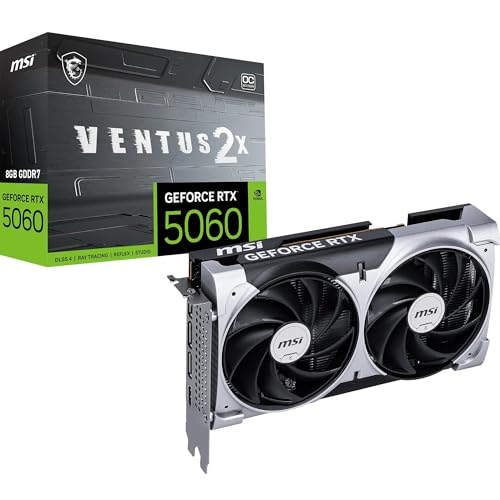
MSI GeForce RTX 5060 Ventus 2X OC
Best for: compact PCIe 5.0 1080p gaming
- Interface
- PCIe 5.0 (what this guide is about)
- Graphics Processor
- GeForce RTX 5060
- Memory Size
- 8 GB
- Memory Type
- GDDR7
- Memory Bus Width
- 128-bit
- PCIe Interface
- PCIe 5.0
View on Amazon: MSI GeForce RTX 5060 Ventus 2X OC Affiliate link
The MSI RTX 5060 8GB VENTUS 2X OC uses the Blackwell architecture and PCIe 5.0 interface. It features 8GB of GDDR7 memory on a 128-bit bus. This 2-slot card measures 7.76 inches long. It targets 1080p gaming with DLSS 4.0 support. You get three DisplayPort 2.1b outputs and one HDMI 2.1b port. The card requires a 550W PSU and draws 145W.
Pros
- PCIe 5.0 interface for future bandwidth
- 8GB GDDR7 memory at 28 Gbps
- Compact 2-slot design at 7.76 inches
- DLSS 4.0 support for frame generation
Cons
- Narrow 128-bit memory bus width
- Only 8GB of video memory
- Limited to 2-slot physical size
Good fit if
- You need a compact 2-slot card
- You want PCIe 5.0 compatibility
- You play at 1080p resolution
Skip if
- You require 16GB or more VRAM
- You need a wider memory bus
- You build in a small form factor case with strict length limits
Verdict: MSI RTX 5060 8GB VENTUS 2X suits gamers who prioritize PCIe 5.0 readiness and a compact 2-slot build for 1080p titles. It avoids the larger footprint of high-end cards while offering modern memory speeds.
Specifications side by side
| Spec | EVGA GeForce RTX 3090 24GB | MSI GeForce RTX 5060 Ventus 2X OC |
|---|---|---|
| Graphics Processor | GeForce RTX 3090 | GeForce RTX 5060 |
| Memory Size | 24GB | 8 GB |
| Memory Type | GDDR6X | GDDR7 |
| Boost Clock | 1800MHz | not stated |
| Memory Bus Width | not stated | 128-bit |
| PCIe Interface | PCIe 4 | PCIe 5.0 |
| Recommended PSU | not stated | 550W |
| Slot Width | not stated | 2-slot |
| Memory | 24GB | 8GB |
| GPU | GeForce RTX 3090 | not stated |
| Interface | PCIe 4.0 | PCIe 5.0 |
| Use | Gaming | not stated |
| Dimensions | 11.8 × 5.38 × 0.1 inches | not stated |
| Weight | 2.5 pounds | 1.13 pounds |
| Length | not stated | 7.76 inches |
| Width | not stated | 4.72 inches |
| Color | not stated | Multicolour |
| Model | not stated | V537-002R |
Frequently asked questions
Does PCIe 5.0 offer better performance for gaming?
PCIe 5.0 provides higher bandwidth than PCIe 4.0, which can benefit future-proofing. The MSI RTX 5060 Ventus 2X OC uses this newer standard. It is designed for compact 1080p gaming builds. While current games may not show massive gains, the interface supports newer memory speeds. This makes it a solid choice for modern mid-range systems.
Is PCIe 4.0 still good for high-end graphics cards?
Yes, PCIe 4.0 remains a proven standard for high-performance tasks. The EVGA RTX 3090 utilizes this interface with 24GB of GDDR6X memory. It delivers ample bandwidth for demanding creative workloads and high-resolution gaming. Users prioritizing VRAM capacity over the newest interface generation will find this setup sufficient for their needs.
What is the main difference between PCIe 4.0 and 5.0 cards?
The primary difference is the connection standard and resulting bandwidth. PCIe 5.0 doubles the data transfer rate of PCIe 4.0. The MSI RTX 5060 features PCIe 5.0 for modern readiness. The EVGA RTX 3090 relies on PCIe 4.0. Both interfaces support their respective GPUs effectively, but the newer standard offers more headroom for future data demands.
Can I use a PCIe 5.0 card in a PCIe 4.0 slot?
Yes, PCIe standards are backward compatible. A PCIe 5.0 card like the MSI RTX 5060 will work in a PCIe 4.0 motherboard slot. It will operate at PCIe 4.0 speeds. This ensures you can upgrade your GPU without immediately replacing your entire system. The card will function normally, though at the lower interface speed.
Which card has more memory for creative work?
The EVGA GeForce RTX 3090 has significantly more memory. It includes 24GB of GDDR6X VRAM. This large buffer handles complex textures and heavy creative tasks efficiently. The MSI RTX 5060 has 8GB of memory. It is better suited for 1080p gaming rather than heavy creative workloads requiring large data buffers.
Is the EVGA RTX 3090 suitable for 4K gaming?
Yes, the EVGA RTX 3090 is well-suited for 4K gaming. Its 24GB of GDDR6X memory helps manage high-resolution textures without bottlenecking. The PCIe 4.0 interface provides sufficient bandwidth for these demands. It is an excellent choice for users who prioritize VRAM capacity and core counts for demanding gaming and content creation tasks.
Does the MSI RTX 5060 have a large physical size?
No, the MSI RTX 5060 Ventus 2X OC has a compact form factor. It measures 7.76 inches in length and 4.72 inches in width. It weighs only 1.13 pounds. This small footprint avoids the larger size of high-end cards. It is ideal for users who prioritize a compact 2-slot build for their PC case.