Pcie 4.0 vs Pcie 5.0 Computer Cables in 2026: Key Differences
As an Amazon Associate we earn from qualifying purchases. Links on this page are affiliate links.
When evaluating a pcie 40 vs pcie 50 computer cable, you are choosing between established bandwidth and next-generation speed. Both products are right-angle riser cables designed for vertical GPU mounts and standard mid-tower layouts. They share x16 slot configurations and backward compatibility with older generations. The primary difference lies in their interface standards and maximum data throughput. This comparison breaks down the specific specifications to help you decide which cable fits your build.
Key differences
| Aspect | GLOTRENDS 200mm Right-Angle PCIe 4.0 Riser Cable | LINKUP 25cm Right Angle PCIe 5.0 Riser Cable |
|---|---|---|
| Interface Standard | PCIe 4.0 | PCIe 5.0 |
| Maximum Bandwidth | 32GB/s | 128GB/s |
| Cable Length | 200mm | 25cm |
| Shielding Type | Individually foil-wrapped | Multilayer shielding |
Which one should you choose?
Choose GLOTRENDS 200mm Right-Angle PCIe 4.0 Riser Cable if
- You need a cable that fits standard mid-tower cases with a 200mm reach from the CPU slot.
- Your system uses Intel 11th Gen or Ryzen 5000 series CPUs with PCIe 4.0 slots.
- You prefer individually foil-wrapped shielding for stable 4K or 8K output on current-generation GPUs.
Choose LINKUP 25cm Right Angle PCIe 5.0 Riser Cable if
- You require full 128GB/s bandwidth for next-generation graphics cards like RTX 5090.
- Your motherboard supports PCIe 5.0 x16 slots, such as ASUS WRX80 or WRX90 series boards.
- You want multilayer shielding to suppress crosstalk and EMI for high-FPS gaming or AI workflows.
Verdict: Choose the GLOTRENDS cable if your current hardware is limited to PCIe 4.0 and you need a reliable 200mm extension. Choose the LINKUP cable if you have a PCIe 5.0 motherboard and GPU, as it delivers four times the bandwidth for future-proofing.
PCIe 4.0 vs PCIe 5.0 Cable Specs
Interface Bandwidth
The LINKUP PCIe 5.0 riser cable delivers up to 128GB/s of bandwidth on a PCIe 5.0 x16 connection. This higher throughput supports next-generation graphics cards and storage devices that demand more data transfer. The GLOTRENDS PCIe 4.0 cable provides up to 32GB/s on a PCIe 4.0 x16 slot. While sufficient for current high-end GPUs, it offers one-quarter of the bandwidth found in the PCIe 5.0 option. If you plan to upgrade to future hardware requiring maximum data rates, the PCIe 5.0 standard provides significantly more headroom for sustained performance under heavy loads.
Cable Length
Length differences affect your build layout and cable management. The GLOTRENDS cable measures 200mm, which equals approximately 7.87 inches. This length suits standard mid-tower cases with vertical GPU mounts, allowing routing from the motherboard to the card with extra slack. The LINKUP cable is 25cm long, which converts to roughly 9.84 inches. This additional length provides more flexibility for routing behind the motherboard tray or connecting to slots further away. Both lengths accommodate typical ATX and mid-tower chassis, but the LINKUP option offers slightly more reach for complex cable paths.
Shielding Type
Signal stability relies on effective shielding against electromagnetic interference. The GLOTRENDS cable uses individually foil-wrapped differential signal pairs. This design protects each pair from crosstalk and EMI, ensuring stable 4K or 8K output over the run. The LINKUP cable features multilayer shielding with tuned impedance and premium conductors. This approach targets clean eye margins under load and tight bends. While both options protect signal integrity, the LINKUP multilayer design specifically addresses crosstalk suppression for high-speed PCIe 5.0 data rates, whereas GLOTRENDS focuses on individual pair protection for PCIe 4.0 speeds.
Connector Angle
Both cables utilize a right-angle connector design to facilitate vertical GPU mounting. The GLOTRENDS model specifies a 90-degree right angle, which helps reduce strain on the slot and keeps the card parallel to the case floor. The LINKUP model also uses a right-angle connector, described as suitable for vertical mounts and standard layouts. Both angles serve the same primary function of improving airflow and aesthetics in vertical setups. Since both products offer the same connector orientation, neither holds an advantage in terms of physical connection geometry for standard builds.
Backward Compatibility
Both cables support older hardware through backward compatibility. The GLOTRENDS PCIe 4.0 cable works in PCIe 3.0 slots and with GPUs at Gen3 speed, though it requires a CPU-direct PCIe 4.0 x16 slot for full performance. The LINKUP PCIe 5.0 cable is fully backward-compatible with PCIe 4.0 and validated on specific motherboards. It also supports PCIe 3.0 devices, though at reduced speeds. Both options allow you to use older GPUs or slots without issues. The LINKUP cable explicitly validates compatibility with newer workstation boards, while GLOTRENDS notes support for Intel 11th Gen and Ryzen 5000 or newer CPUs.
Choose the Right PCIe Riser Cable
Future-proofing for next-gen GPUs
You need maximum bandwidth for upcoming hardware. This LINKUP cable offers 128GB/s on PCIe 5.0 x16. It features multilayer shielding to suppress crosstalk and EMI. The tuned impedance ensures clean signal integrity under heavy loads. This setup supports next-gen cards like RTX 5090 and preserves upgrade headroom for future high-speed storage and graphics devices.
Budget-conscious builders with current GPUs
You want reliable performance for existing hardware. This GLOTRENDS cable provides 32GB/s on PCIe 4.0 x16. It uses individually foil-wrapped pairs for stable signals. The 200mm length fits standard mid-towers well. It works with RTX 30/40 and RX 6000/7000 series. You get stable 4K output without needing drivers or external power, making it a practical choice for current setups.
Users needing specific length and angle
You require a precise 200mm right-angle connection. This GLOTRENDS model matches that exact specification. While LINKUP offers 25cm, GLOTRENDS provides a fixed 200mm option. The 90-degree right angle suits vertical mounts in tight spaces. The silver-plated copper conductors and Teflon insulation ensure durability. If your case layout demands this specific dimension, this cable fits your routing needs directly.
Quick picks
| # | Product | Best for | Price |
|---|---|---|---|
| 1 | GLOTRENDS 200mm Right-Angle PCIe 4.0 Riser Cable | Vertical GPU mounts in mid-tower cases | Check price of GLOTRENDS 200mm Right-Angle PCIe 4.0 Riser Cable on Amazon |
| 2 | LINKUP 25cm Right Angle PCIe 5.0 Riser Cable | Vertical GPU mounts requiring Gen5 speed | Check price of LINKUP 25cm Right Angle PCIe 5.0 Riser Cable on Amazon |
The products compared

GLOTRENDS 200mm Right-Angle PCIe 4.0 Riser Cable
Best for: Vertical GPU mounts in mid-tower cases
- Interface
- PCIe 4.0 (what this guide is about)
- Interface Standard
- PCIe 4.0
- Slot Configuration
- x16
- Cable Length
- 200mm
- Connector Angle
- 90 Degree Right Angle
- Maximum Bandwidth
- 32GB/s
View on Amazon: GLOTRENDS 200mm Right-Angle PCIe 4.0 Riser Cable Affiliate link
This GLOTRENDS cable extends your GPU connection with a 200mm length and a 90-degree right-angle connector. It supports PCIe 4.0 x16 bandwidth, delivering up to 32GB/s for stable 4K or 8K output. The shielded design protects signal integrity over the run. You should use this if you need extra slack for vertical mounts in mid-tower cases. It works with modern Intel and AMD hardware.
Pros
- 200mm length provides extra slack for routing behind motherboard trays.
- 90-degree right-angle connector simplifies vertical GPU installation.
- PCIe 4.0 x16 interface delivers up to 32GB/s bandwidth.
- Individually foil-wrapped shielding protects against EMI for stable signals.
Cons
- Limited to 200mm length, which may not reach all cases.
- Requires a direct CPU-connected PCIe 4.0 x16 slot for full speed.
- Hot swapping is not supported.
Good fit if
- You are mounting a GPU vertically in a standard mid-tower case.
- You need a 90-degree right-angle connector for tight spaces.
- You have a PCIe 4.0 x16 slot connected directly to your CPU.
Skip if
- You require a longer cable than 200mm for your build.
- You are using a PCIe 3.0 slot and need maximum bandwidth.
- You need to swap the GPU while the system is running.
Verdict: The GLOTRENDS 200mm PCIe 4.0 GPU Riser fits builders who need a short, right-angle extension for vertical mounts. It ensures stable signal delivery for modern GPUs in mid-tower cases.
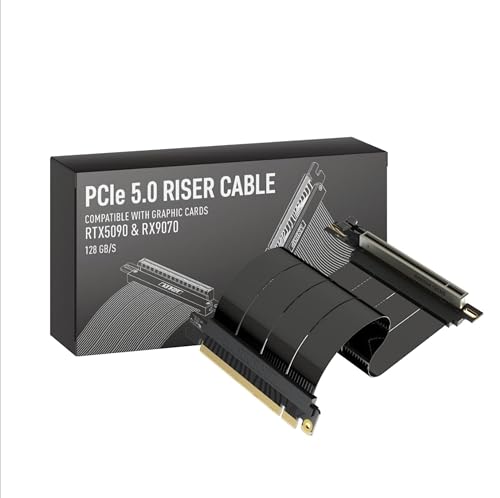
LINKUP 25cm Right Angle PCIe 5.0 Riser Cable
Best for: Vertical GPU mounts requiring Gen5 speed
- Interface
- PCIe 4.0 (what this guide is about)
- Interface Standard
- PCIe 5.0
- Slot Configuration
- x16
- Cable Length
- 25cm
- Connector Angle
- Right Angle
- Maximum Bandwidth
- 128GB/s
View on Amazon: LINKUP 25cm Right Angle PCIe 5.0 Riser Cable Affiliate link
This LINKUP riser cable supports PCIe 5.0 x16 interfaces with a maximum bandwidth of 128GB/s. It features a right-angle connector and multilayer shielding to reduce interference. The 25cm length suits vertical GPU mounts in various case layouts. You get stable signal integrity for next-gen cards. This option fits builders needing Gen5 headroom with a clean, angled connection path.
Pros
- Supports PCIe 5.0 x16 standard
- 128GB/s maximum bandwidth
- Right-angle connector design
- Multilayer EMI shielding
- Backward compatible with PCIe 4.0
Cons
- Right-angle connector only
- 5.29 ounces weight
- Requires specific case brackets
Good fit if
- You need PCIe 5.0 speed
- You use a vertical GPU mount
- You want right-angle routing
Skip if
- You require straight connectors
- You need PCIe 4.0 only
- You prefer lighter cables
Verdict: LINKUP 25cm PCIe 5.0 Right Angle Riser delivers full Gen5 bandwidth for vertical builds. It fits users who need angled routing and high-speed data transfer.
Specifications side by side
| Spec | GLOTRENDS 200mm Right-Angle PCIe 4.0 Riser Cable | LINKUP 25cm Right Angle PCIe 5.0 Riser Cable |
|---|---|---|
| Interface Standard | PCIe 4.0 | PCIe 5.0 |
| Slot Configuration | x16 | x16 |
| Cable Length | 200mm | 25cm |
| Connector Angle | 90 Degree Right Angle | Right Angle |
| Maximum Bandwidth | 32GB/s | 128GB/s |
| Shielding Type | foil-wrapped | multilayer shielding |
| GPU | GeForce RTX 4090 | not stated |
| Interface | PCIe 4.0 | PCIe 4.0 |
| Dimensions | 9.84 × 4.72 × 4.72 inches | not stated |
| Weight | 4.97 ounces | 5.29 ounces |
| Size | 200mm | 25cm - v4 |
| Color | Black | All Black |
| Model | PCIE40-X16-200MM-0090D | AG-P5-33SR-025BK |
Frequently asked questions
Can I use a PCIe 5.0 cable with a PCIe 4.0 graphics card?
Yes, the LINKUP PCIe 5.0 riser is backward compatible with older generations. You can connect a PCIe 4.0 GPU to this Gen5 cable without issues. The connection will operate at the speed of the slower component, which is your graphics card. This ensures stable performance while allowing you to use modern cabling for vertical mounts.
Does the GLOTRENDS riser support PCIe 5.0 speeds?
No, the GLOTRENDS 200mm cable is strictly designed for the PCIe 4.0 interface. It does not support the higher bandwidth of Gen5. If you require next-generation speed for future hardware, this cable will limit your potential. It is best suited for current PCIe 4.0 GPUs where stable signal delivery is the priority.
Which cable is better for vertical GPU mounting?
Both products are optimized for vertical GPU mounts in mid-tower cases. The GLOTRENDS 200mm model offers a right-angle design with a 200mm length. The LINKUP 25cm riser also features a right-angle configuration. Your choice depends on whether you prioritize established PCIe 4.0 stability or the higher bandwidth of PCIe 5.0 for vertical builds.
What is the length difference between these two risers?
The GLOTRENDS cable measures 200mm, which equals approximately 7.87 inches. The LINKUP cable is 25cm long, which is also roughly 9.84 inches. Both provide sufficient reach for typical mid-tower case layouts. The slight variation in exact measurements allows you to choose based on your specific case dimensions and cable routing needs.
Do these cables require external power connections?
The provided specifications do not list any external power requirements for either cable. Both the GLOTRENDS and LINKUP risers draw power directly through the PCIe slot. This design simplifies installation by eliminating the need for additional power cables. You only need to connect the cable to the motherboard and the graphics card.
Is the LINKUP cable suitable for high-end gaming builds?
Yes, the LINKUP PCIe 5.0 riser delivers up to 128GB/s of bandwidth. This high throughput supports next-generation graphics cards that demand significant data transfer. It is ideal for users who want to future-proof their vertical builds. The multilayer shielding helps maintain signal integrity under heavy loads typical in high-end gaming systems.
Can I use the GLOTRENDS cable for mining?
The GLOTRENDS PCIe 4.0 riser is designed for stable signal delivery in mid-tower cases. While it supports standard x16 configurations, its primary focus is on vertical GPU mounting for general computing. It does not specify specialized mining features. For standard vertical installations, it provides a reliable connection for compatible graphics cards.