6 Best Alternatives to the OwlTree PCIe 3.0 eGPU Dock (2026)
As an Amazon Associate we earn from qualifying purchases. Links on this page are affiliate links.
The OwlTree PCIe 3.0 eGPU Dock offers a practical way to add external graphics to compatible devices. If you are searching for owltree pcie 3 0 x16 22gbps alternatives, you may need a different form factor or interface standard. This dock provides 22Gbps bandwidth over a Thunderbolt connection. It also includes flexible power input options for various setups. However, some users prefer internal riser cables for better stability or higher bandwidth speeds. Others might need a specific cable length or a PCIe 5.0 connection for modern components. The alternatives listed here share overlapping specifications with the original product. They all support PCIe connections, though the generation and slot width vary. You can choose a solution that fits your case size or performance needs. Some options provide longer runs for test benches, while others suit compact ITX builds. Each product listed here addresses specific requirements that the original dock may not meet. You can compare the interface standards and physical dimensions to find the best match. The selection includes PCIe 3.0, 4.0, and 5.0 cables from different brands. This variety ensures you find a compatible extension for your graphics card.
Our top pick: OwlTree PCIe 3.0 eGPU Dock with Thunderbolt 4 Cable.
How these alternatives differ
GLOTRENDS 250mm PCIe 3.0 x16 90-Degree Riser Cable
The GLOTRENDS 250mm riser is a passive cable, not an active dock. It lacks the JHL6340 controller and Thunderbolt connectivity of the OwlTree. You get no 22Gbps external transfer speed. Instead, it provides a direct PCIe 3.0 x16 connection inside a case. This model suits users with full-tower cases who need signal stability for vertical mounting. It is ideal if you want to keep the GPU internal but need extra length. You sacrifice the external port flexibility for a simpler, passive extension. Choose this if your build requires a 90-degree angle and you do not need Thunderbolt features.
GLOTRENDS 600mm Straight PCIe 4.0 Riser Cable
The GLOTRENDS 600mm PCIe 4.0 riser offers higher bandwidth potential than the OwlTree's PCIe 3.0 interface. It delivers up to 32Gbps per lane, double the dock's 22Gbps total. This cable is straight and 600mm long, fitting test benches or long routing paths. It lacks the Thunderbolt port and power input options of the OwlTree. You cannot plug in a GPU externally via Thunderbolt. Instead, you use it for internal vertical mounting. This option is best for builders who need maximum internal bandwidth and a long, straight run. It is not suitable for external GPU docks.
10Gtek 10cm PCIe 3.0 x1 Riser
The 10Gtek 10cm PCIe 3.0 x1 riser uses a much smaller x1 slot configuration compared to the OwlTree's x16 slot. It provides only 4Gbps bandwidth, far below the dock's 22Gbps. This short cable is designed for compact builds where space is tight. It lacks the power inputs and Thunderbolt connectivity of the OwlTree. You cannot use it for external graphics cards. It is intended for internal x1 devices like network cards. Choose this if you need a short, 90-degree extension for non-GPU components. It is not a viable alternative for external graphics performance.
LINKUP 25cm Straight PCIe 5.0 Riser Cable
The LINKUP 25cm PCIe 5.0 riser provides 128Gbps bandwidth, vastly exceeding the OwlTree's 22Gbps. It is designed for internal vertical mounting in desktop cases. Unlike the dock, it has no Thunderbolt port or external power inputs. You must install it inside a case with a compatible motherboard. This cable suits builders who want uncompromised Gen5 speeds for internal GPUs. It is not an external dock solution. You give up portability and Thunderbolt connectivity for internal performance. Pick this if you are building a desktop with a vertical GPU mount and need the latest interface standard.
LINKUP 19cm ITX Double Reverse Riser Cable
The LINKUP ITX Double Reverse riser is designed for compact ITX sandwich cases. It offers PCIe 5.0 speed, which is much faster than the OwlTree's PCIe 3.0. It lacks the Thunderbolt port and external power options of the dock. You use it for internal vertical mounting in small form factor builds. This cable is ideal for users with ITX cases who need a double reverse angle. It does not support external GPU connections. You sacrifice external flexibility for internal space efficiency. Choose this if you are building a compact ITX system and need high-speed internal connectivity.
LINKUP 30cm Right-Angle PCIe 5.0 Riser Cable
The LINKUP 30cm Right-Angle PCIe 5.0 riser provides high-speed internal connectivity, surpassing the OwlTree's 22Gbps. It is a straight-to-right-angle cable for vertical GPU mounts. It lacks the Thunderbolt port and power inputs of the dock. You cannot use it for external graphics cards. This option suits builders who prioritize clean aesthetics and future-proof bandwidth in compatible cases. It is designed for internal installation only. You give up external portability for internal performance. Pick this if you need a vertical mount with PCIe 5.0 support and do not require Thunderbolt features.
Quick picks
Our 7 picks
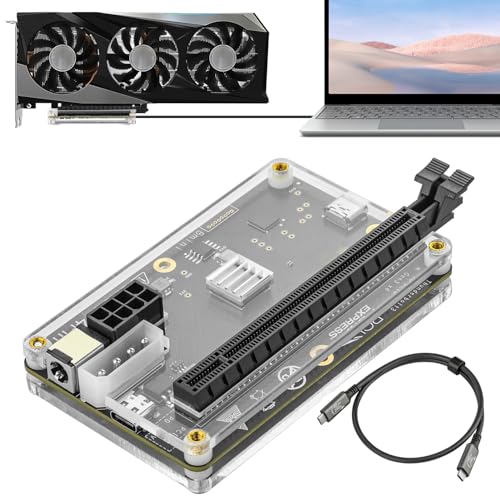
OwlTree PCIe 3.0 eGPU Dock with Thunderbolt 4 Cable
Best for: Thunderbolt laptops needing external GPU power
- Interface Standard
- PCIE 3.0
- Slot Configuration
- x16
- Maximum Bandwidth
- 22Gbps
View on Amazon: OwlTree PCIe 3.0 eGPU Dock with Thunderbolt 4 Cable Affiliate link
The OwlTree dock connects an external graphics card to your computer via a Thunderbolt 4 cable. It uses a PCIe 3.0 x16 interface with a maximum bandwidth of 22Gbps. You can power it using CPU, Molex, PD 3.0, or DC5521 inputs. It works with Windows 10/11, Linux, and USB4 ports. This setup suits users needing extra GPU power for gaming or editing on compatible laptops or desktops.
Pros
- Supports PCIe 3.0 x16 interface for standard GPU installation
- Includes a 23.6-inch Thunderbolt 4 cable for connection
- Offers four flexible power input options for various setups
- Compatible with NVIDIA and AMD graphics cards
Cons
- Limited to PCIe 3.0 bandwidth, which is slower than newer standards
- Maximum bandwidth is 22Gbps, potentially bottlenecking high-end cards
- Requires a compatible Thunderbolt or USB4 port on your device
Good fit if
- You have a laptop or desktop with a Thunderbolt 3, 4, or USB4 port
- You need to add an external GPU for gaming or creative work
- You want flexible power options for your eGPU setup
Skip if
- You require PCIe 4.0 or 5.0 speeds for maximum performance
- Your device lacks a Thunderbolt or USB4 port
- You prefer a plug-and-play solution without power configuration
Verdict: OwlTree PCIe 3.0 x16 eGPU Dock provides a reliable way to add external graphics to compatible devices. It is a solid choice for users with Thunderbolt ports who need flexible power options and do not require the highest bandwidth speeds.

GLOTRENDS 250mm PCIe 3.0 x16 90-Degree Riser Cable
Best for: Full-tower cases with PCIe 3.0 GPUs
- Interface Standard
- PCIe 3.0
- Slot Configuration
- x16
- Cable Length
- 250mm
- Connector Angle
- 90 Degree Right Angle
- Maximum Bandwidth
- 16GB/s
- Shielding Type
- EMI Shielded
View on Amazon: GLOTRENDS 250mm PCIe 3.0 x16 90-Degree Riser Cable Affiliate link
This GLOTRENDS riser cable offers a 250mm length with a 90-degree right-angle connector, designed for full-tower cases. It supports PCIe 3.0 x16 bandwidth up to 16GB/s and uses EMI-shielded ribbon design for stable signal integrity. It works with PCIe 2.0 and 1.0 slots without drivers. You should choose this if you need a compact riser for specific GPU generations or case layouts.
Pros
- 250mm length fits full-tower chassis layouts
- 90-degree right-angle connector for vertical mounting
- EMI-shielded ribbon design reduces interference
- No drivers or BIOS settings required for Gen3
Cons
- PCIe 3.0 limit restricts newer GPU speeds
- Hot swapping is not supported
- Requires BIOS adjustment for PCIe 4.0 GPUs
Good fit if
- You have a full-tower case with tight clearance
- You use PCIe 3.0 compatible graphics cards
- You need a right-angle connector for vertical mounts
Skip if
- You require PCIe 4.0 or 5.0 bandwidth
- You need to hot swap the GPU frequently
- You have a standard mid-tower case with ample space
Verdict: GLOTRENDS 250mm PCIe 3.0 x16 Riser suits users with full-tower cases who prioritize signal stability for older or Gen3 graphics cards. It is a practical solution for vertical mounting where space is limited.

GLOTRENDS 600mm Straight PCIe 4.0 Riser Cable
Best for: Long straight runs on test benches
- Interface Standard
- PCIe 4.0
- Slot Configuration
- x16
- Cable Length
- 600mm
- Connector Angle
- 180 Degree Straight
- Maximum Bandwidth
- 32GB/s
- Shielding Type
- individually foil-wrapped
View on Amazon: GLOTRENDS 600mm Straight PCIe 4.0 Riser Cable Affiliate link
This GLOTRENDS riser cable offers a 600mm length with a 180-degree straight connector, ideal for test benches or channel-routed cases. It supports PCIe 4.0 x16 bandwidth up to 32GB/s and uses individually foil-wrapped shielding for signal stability. You get backward compatibility with PCIe 3.0 slots, requiring no drivers or external power. It suits users needing long, direct-line runs for their GPU.
Pros
- 600mm length with 180-degree straight connector
- PCIe 4.0 x16 interface up to 32GB/s
- Individually foil-wrapped shielding for EMI protection
- Backward compatible with PCIe 3.0 slots
- No drivers or external power required
Cons
- 180-degree straight angle limits placement flexibility
- Requires direct CPU-connected PCIe 4.0 slot for full speed
- Hot swapping is not supported
Good fit if
- You need a long 600mm cable for test benches
- You require a straight connector aligned with the card
- You have a PCIe 4.0 CPU slot for maximum bandwidth
Skip if
- You need a 90-degree right-angle connector
- You only have a PCIe 3.0 motherboard slot
- You require hot-swapping capabilities
Verdict: GLOTRENDS 600mm PCIe 4.0 x16 Riser provides a long, straight run with full bandwidth for compatible systems. It fits users building test benches or routing cables through channels who need a direct connector alignment.

10Gtek 10cm PCIe 3.0 x1 Riser
Best for: Compact PCIe 3.0 x1 speed extensions
- Interface Standard
- PCIe 3.0
- Slot Configuration
- x1
- Cable Length
- 10 cm
- Connector Angle
- 90-degree
- Shielding Type
- EMI material
View on Amazon: 10Gtek 10cm PCIe 3.0 x1 Riser Affiliate link
This 10Gtek PCIe 3.0 riser connects x1 to x16 slots using a 10cm cable. It supports x1, x4, x8, and x16 boards but runs at PCIe 3.0 x1 speed. The 90-degree to 90-degree design helps with tight spaces. Gold-plated contacts improve durability. You should use this if you need a short, stable extension for specific graphics card setups.
Pros
- 10cm cable length for compact builds
- 90-degree to 90-degree connector angles
- 10u immersion gold contacts for durability
- Supports PCIe 3.0 x1, x4, x8, and x16
- EMI shielding material reduces interference
Cons
- Limited to PCIe 3.0 x1 speed
- Does not support hot swapping
- Short 10cm cable length restricts placement
Good fit if
- You need a very short extension for tight cases
- You require 90-degree connectors for specific routing
- You are using PCIe 3.0 x1 compatible devices
Skip if
- You need PCIe 4.0 or 5.0 speeds
- You require hot swapping capability
- You need a longer cable for distance
Verdict: The 10Gtek 10cm PCIe 3.0 Riser fits users needing a short, 90-degree extension for PCIe 3.0 x1 speed applications. It is ideal for compact builds where space is limited and hot swapping is not required.

LINKUP 25cm Straight PCIe 5.0 Riser Cable
Best for: internal Gen5 vertical GPU mounting
- Interface Standard
- PCIe 5.0
- Slot Configuration
- x16
- Cable Length
- 25cm
- Connector Angle
- Straight
- Maximum Bandwidth
- 128GB/s
- Shielding Type
- multilayer shielding
View on Amazon: LINKUP 25cm Straight PCIe 5.0 Riser Cable Affiliate link
This internal GPU riser cable connects your graphics card directly to a motherboard with a PCIe 5.0 x16 interface. It delivers up to 128GB/s bandwidth using multilayer shielding and measures 25cm with straight connectors. You get full throughput for high-bandwidth cards without external dock bottlenecks, making it suitable if your chassis supports vertical mounting.
Pros
- PCIe 5.0 x16 interface supporting up to 128GB/s bandwidth
- Multilayer shielding to suppress EMI and crosstalk
- Backward compatible with PCIe 4.0 motherboards and cards
- Flexible construction allows tight folds and bends
Cons
- Straight connector angle does not fit mounts requiring 90-degree plugs
- Fixed 25cm length is too short for distant chassis slots
- Does not include an external enclosure or Thunderbolt connectivity
Good fit if
- You need full PCIe 5.0 x16 throughput up to 128GB/s.
- You have a chassis bracket that accepts straight 180-degree connectors.
- You only need a 25cm span between slot and graphics card.
Skip if
- You need an external plug-and-play dock operating over Thunderbolt.
- You require a right-angle connector for tight vertical brackets.
- You need a cable run longer than 25cm.
Verdict: LINKUP 25cm PCIe 5.0 x16 Straight Riser Cable provides full 128GB/s bandwidth for builders vertically mounting modern graphics cards inside a desktop case. It serves users who want uncompromised Gen5 slot speeds rather than external Thunderbolt docks.

LINKUP 19cm ITX Double Reverse Riser Cable
Best for: ITX sandwich case vertical mounts
- Interface Standard
- PCIe 5.0
- Slot Configuration
- x16
- Cable Length
- 19cm
- Connector Angle
- Double Reverse
- Maximum Bandwidth
- 128GB/s
- Shielding Type
- multilayer shielding
View on Amazon: LINKUP 19cm ITX Double Reverse Riser Cable Affiliate link
This LINKUP PCIe 5.0 riser cable uses an ITX double reverse connector to fit compact sandwich cases. It supports x16 slots with a maximum bandwidth of 128GB/s. The 19cm length and multilayer shielding help manage tight routes. You can use it for vertical GPU mounts in small form factor builds. It works with standard layouts and open benches.
Pros
- PCIe 5.0 x16 interface with 128GB/s bandwidth
- ITX Double Reverse connector for compact cases
- 19cm length for tight routing
- Multilayer shielding for signal integrity
Cons
- 19cm length limits flexibility in larger cases
- ITX Double Reverse connector only fits specific layouts
- Requires separate standoffs and support brackets
Good fit if
- You use an ITX sandwich case
- You need a vertical GPU mount
- You want PCIe 5.0 bandwidth
Skip if
- You have a standard tower case
- You need a longer cable than 19cm
- You prefer straight connectors
Verdict: LINKUP ITX Double Reverse Riser fits ITX sandwich cases perfectly. It offers PCIe 5.0 speed for vertical mounts. Choose it for compact builds.

LINKUP 30cm Right-Angle PCIe 5.0 Riser Cable
Best for: Vertical GPU mounts with PCIe 5.0 support
- Interface Standard
- PCIe 5.0
- Slot Configuration
- x16
- Cable Length
- 30cm
- Connector Angle
- Right Angle
- Maximum Bandwidth
- 128GB/s
- Shielding Type
- multilayer shielding
View on Amazon: LINKUP 30cm Right-Angle PCIe 5.0 Riser Cable Affiliate link
This LINKUP PCIe 5.0 riser cable supports vertical GPU mounts with a right-angle connector. It delivers 128GB/s bandwidth over its x16 interface. The 30cm length fits standard tower and ITX layouts. You get multilayer shielding to reduce interference. It works with PCIe 4.0 and 5.0 boards. This cable helps you place graphics cards for better airflow and cleaner builds.
Pros
- PCIe 5.0 x16 interface for 128GB/s bandwidth
- Right-angle connector for vertical GPU mounting
- Multilayer shielding reduces crosstalk and EMI
- Backward compatible with PCIe 4.0 systems
Cons
- Shorter 30cm length limits case flexibility
- Right-angle design may not fit all tight spaces
- Requires separate standoffs for stability
Good fit if
- You need a vertical GPU mount for your build
- You want PCIe 5.0 bandwidth for future upgrades
- You have a case with enough depth for a 30cm cable
Skip if
- You require a longer cable for deep cases
- You need a straight connector for horizontal mounts
- You use a motherboard with no PCIe 5.0 support
Verdict: LINKUP PCIe 5.0 Vertical Riser provides high-speed connectivity for vertical GPU setups. It suits builders who prioritize clean aesthetics and future-proof bandwidth in compatible cases.
Specifications side by side
| Spec | OwlTree PCIe 3.0 eGPU Dock with Thunderbolt 4 Cable | GLOTRENDS 250mm PCIe 3.0 x16 90-Degree Riser Cable | GLOTRENDS 600mm Straight PCIe 4.0 Riser Cable | 10Gtek 10cm PCIe 3.0 x1 Riser | LINKUP 25cm Straight PCIe 5.0 Riser Cable | LINKUP 19cm ITX Double Reverse Riser Cable | LINKUP 30cm Right-Angle PCIe 5.0 Riser Cable |
|---|---|---|---|---|---|---|---|
| Interface Standard | PCIE 3.0 | PCIe 3.0 | PCIe 4.0 | PCIe 3.0 | PCIe 5.0 | PCIe 5.0 | PCIe 5.0 |
| Slot Configuration | x16 | x16 | x16 | x1 | x16 | x16 | x16 |
| Cable Length | not stated | 250mm | 600mm | 10 cm | 25cm | 19cm | 30cm |
| Connector Angle | not stated | 90 Degree Right Angle | 180 Degree Straight | 90-degree | Straight | Double Reverse | Right Angle |
| Maximum Bandwidth | 22Gbps | 16GB/s | 32GB/s | not stated | 128GB/s | 128GB/s | 128GB/s |
| Shielding Type | not stated | EMI Shielded | individually foil-wrapped | EMI material | multilayer shielding | multilayer shielding | multilayer shielding |
| GPU | not stated | not stated | GeForce RTX 4090 | not stated | not stated | not stated | not stated |
| Interface | PCIe 3.0 | PCIe 3.0 | PCIe 4.0 | PCIe 3.0 | PCIe 4.0 | PCIe 4.0 | PCIe 4.0 |
| Form Factor | not stated | not stated | not stated | not stated | not stated | ITX | not stated |
| Dimensions | not stated | not stated | 25.6 × 4.72 × 4.72 inches | not stated | not stated | not stated | not stated |
| Weight | not stated | not stated | 9.52 ounces | not stated | not stated | 3.84 ounces | not stated |
| Size | not stated | 250mm | 600mm | 10cm | 25cm - v2 | 19cm - v3 | 30cm - v4 |
| Color | not stated | Black | Black | black | Black | Black | Black |
| Model | not stated | PCIE30-X16-250MM-0090D | PCIE40-X16-600MM-0018D | P311MF5510 | AVA5 | AVA5 | AVA5 |
Readers of this guide also look at 10gtek pcie 3 0 x8 to alternatives.
Frequently asked questions
Can I use a PCIe riser cable instead of an eGPU dock?
Yes, you can use a riser cable if your graphics card fits inside your case. Unlike the OwlTree dock, these cables provide direct internal connections rather than external Thunderbolt links. You get full bandwidth for the specific PCIe generation, such as Gen3 or Gen5, without the need for an external enclosure.
What is the difference between PCIe 3.0 and 4.0 riser cables?
PCIe 3.0 cables offer 16GT/s transfer rates per lane, while PCIe 4.0 doubles that to 32GT/s. The GLOTRENDS 600mm option supports Gen4 for higher throughput. Choose Gen3 for older cards and Gen4 or Gen5 for modern hardware requiring maximum internal bandwidth and signal stability.
Do I need an active Thunderbolt controller for these alternatives?
No, internal riser cables do not require Thunderbolt controllers. The OwlTree dock uses a JHL6340 controller for external connectivity, but standard PCIe risers are passive or simple active extensions. They connect directly to your motherboard, eliminating the need for complex external docking hardware.
Which riser is best for vertical GPU mounting?
The LINKUP 25cm Straight PCIe 5.0 Riser is ideal for vertical mounts. It provides full 128GB/s bandwidth for modern cards. The 19cm ITX Double Reverse Riser also suits compact sandwich cases. Both options ensure your graphics card maintains its rated speeds while fitting vertically in your chassis.
Can I use a PCIe 3.0 riser with a PCIe 4.0 graphics card?
Yes, you can use a PCIe 3.0 riser with a PCIe 4.0 card. The connection will fall back to PCIe 3.0 speeds. This works for the GLOTRENDS 250mm or 10Gtek 10cm options. You will not achieve the full bandwidth of the newer card, but it will function correctly.
How does cable length affect signal integrity?
Longer cables can introduce signal degradation, especially at higher PCIe generations. The 600mm GLOTRENDS riser supports Gen4 for long runs, while the 250mm and 10cm options are shorter. Shorter cables like the 10cm model are best for compact builds where minimal distance reduces potential interference and ensures stable connections.
Is a 90-degree riser better than a straight one?
A 90-degree riser saves space in tight cases. The GLOTRENDS 250mm and 10Gtek 10cm models use right angles for compact layouts. Straight risers, like the LINKUP 25cm, offer cleaner cable routing for test benches or open cases. Choose based on your case interior layout and cable management needs.