GDDR6 vs DDR3 Graphics Cards in 2026: Key Differences
As an Amazon Associate we earn from qualifying purchases. Links on this page are affiliate links.
You are looking at a GDDR6 vs DDR3 graphics card comparison to understand the gap between modern gaming hardware and basic display solutions. Both cards provide video output for your monitor, but they serve very different roles. The ZOTAC RTX 3070 uses GDDR6 memory for high-speed gaming, while the MSI GeForce 210 relies on older DDR3 memory for simple tasks. This difference in memory technology defines their performance capabilities and intended use cases for you.
Key differences
| Aspect | ZOTAC GeForce RTX 3070 Twin Edge OC 8GB | MSI GeForce 210 1GB DDR3 Low Profile |
|---|---|---|
| Memory Type | GDDR6 | DDR3 |
| Memory Size | 8GB | 1GB |
| GPU Model | GeForce RTX 3070 | GeForce 210 |
| PCIe Interface | PCIe 4.0 | PCIe 2.0 |
| Form Factor | Standard | Low Profile |
Which one should you choose?
Choose ZOTAC GeForce RTX 3070 Twin Edge OC 8GB if
- You want to play modern games at high resolutions and settings.
- You need support for ray tracing and advanced display features like HDMI 2.1.
- You require a card with 8GB of video memory for large textures.
Choose MSI GeForce 210 1GB DDR3 Low Profile if
- You need a low-profile card for a small form factor PC.
- You only need to display video for office work or media playback.
- You want a passive or low-power solution for basic desktop use.
Verdict: The ZOTAC RTX 3070 is the clear choice for gaming and demanding graphics work due to its GDDR6 memory and powerful GPU. The MSI GeForce 210 is only suitable for users who need a basic display adapter for a compact case. Choose the RTX 3070 for performance and the GeForce 210 for minimal space and cost constraints.
Memory Type and Interface Comparison
Memory Type
The ZOTAC GeForce RTX 3070 Twin Edge OC uses GDDR6 memory, a modern standard designed for high-bandwidth tasks like gaming and content creation. This memory type operates at 14 Gbps, allowing for rapid data transfers between the GPU and video RAM. In contrast, the MSI GeForce 210 1GB DDR3 Low Profile relies on standard DDR3 memory. DDR3 is an older technology with significantly lower bandwidth capabilities. It is suitable for basic display output and light office work but cannot handle the data throughput required for modern 3D applications. The difference in memory technology highlights the vast performance gap between these two cards.
Memory Size
Memory capacity determines how much texture data and frame buffers the card can hold. The ZOTAC RTX 3070 comes with 8GB of video memory, providing ample space for high-resolution textures and complex scenes in modern games. The MSI GeForce 210 offers only 1GB of memory. This small amount is insufficient for modern gaming or heavy graphical tasks. While 1GB might suffice for displaying a desktop or playing very old titles, 8GB allows the RTX 3070 to maintain performance at higher resolutions. The larger memory size on the ZOTAC card is a clear advantage for demanding workloads.
Interface
The connection to the motherboard affects data transfer speeds. The ZOTAC RTX 3070 supports PCIe 4.0, which offers double the bandwidth of PCIe 3.0. This ensures that the GPU can receive data from the CPU without bottlenecks. The MSI GeForce 210 uses PCIe 2.0, an older standard with limited bandwidth. While PCIe 2.0 is adequate for low-power display adapters, it restricts the potential of high-performance cards. For the RTX 3070, PCIe 4.0 is essential to maximize its capabilities. The MSI card lacks this modern interface, making it less compatible with newer high-speed system architectures.
Form Factor
Physical dimensions determine which computer cases can accommodate the card. The MSI GeForce 210 features a low-profile design, measuring 3.3 inches in width and 0.7 inches in height. This compact form factor allows it to fit into slim or small form factor cases where space is limited. The ZOTAC RTX 3070 is a full-sized card with a metal backplate and advanced cooling system. It requires a standard expansion slot and more internal case space. If you have a small PC case, the MSI card is the only viable option. The ZOTAC card is better suited for standard mid-tower or full-tower cases.
Use Case
The intended use defines the practical value of each card. The ZOTAC RTX 3070 is built for gaming, featuring NVIDIA Ampere architecture with ray tracing and tensor cores. It supports 8K and 4K displays, making it ideal for high-end entertainment and professional graphics work. The MSI GeForce 210 is a basic display solution. It is designed for office tasks, web browsing, and video playback. It lacks the power for modern gaming or 3D rendering. If you need a card for gaming or creative work, the ZOTAC is the clear choice. The MSI card is only suitable for basic display extension or legacy systems.
Which Graphics Card Fits Your Needs
Modern gamers seeking high performance
The ZOTAC RTX 3070 uses GDDR6 memory running at 14 Gbps with a 256-bit bus. This configuration delivers the high bandwidth required for modern titles. Its PCIe 4.0 interface ensures fast data transfer, while the 8GB VRAM buffer handles complex textures. The boost clock of 1755 MHz provides the necessary speed for smooth gameplay at high resolutions.
Users needing basic display output
The MSI GeForce 210 features DDR3 memory and a PCIe 2.0 interface, suitable only for basic display tasks. Its low-profile design fits into slim systems where space is limited. This card lacks the memory bandwidth for gaming or heavy graphics work. It serves as a simple solution for extending desktop monitors or providing video output for office applications.
Creators requiring modern API support
This card supports DirectX 12 Ultimate and Vulkan RT API, enabling advanced rendering features. The NVIDIA Ampere architecture includes third-generation Tensor Cores for efficient AI processing. GDDR6 memory at 14 Gbps handles large datasets quickly. These specifications make it a viable choice for content creation workflows that rely on modern graphics APIs and high memory throughput.
Quick picks
| # | Product | Best for | Price |
|---|---|---|---|
| 1 | ZOTAC GeForce RTX 3070 Twin Edge OC 8GB | 4K gaming and modern display connectivity | Check price of ZOTAC GeForce RTX 3070 Twin Edge OC 8GB on Amazon |
| 2 | MSI GeForce 210 1GB DDR3 Low Profile | Compact PCs needing basic display output | Check price of MSI GeForce 210 1GB DDR3 Low Profile on Amazon |
The products compared

ZOTAC GeForce RTX 3070 Twin Edge OC 8GB
Best for: 4K gaming and modern display connectivity
- Memory Type
- GDDR6 (what this guide is about)
- Graphics Processor
- GeForce RTX 3070
- Memory Size
- 8GB
- Boost Clock
- 1755 MHz
- Memory Bus Width
- 256-bit
- PCIe Interface
- PCIE 4.0
View on Amazon: ZOTAC GeForce RTX 3070 Twin Edge OC 8GB Affiliate link
This ZOTAC card uses the NVIDIA Ampere architecture with 8GB of GDDR6 memory on a 256-bit bus. It connects via PCIe 4.0 and reaches a boost clock of 1755 MHz. The IceStorm 2.0 cooling system includes a metal backplate and fan stop technology. It supports 8K resolution and features HDMI 2.1. You get four display outputs for multi-monitor setups. This setup targets gamers who need high frame rates and modern API support.
Pros
- 8GB GDDR6 memory with 14 Gbps speed
- PCIe 4.0 interface for high bandwidth
- Boost clock of 1755 MHz
- HDMI 2.1 and DisplayPort 1.4a outputs
- IceStorm 2.0 cooling with fan stop
Cons
- Only 8GB memory limits future 4K textures
- Requires PCIe 4.0 slot for full speed
- No mention of external power connector details
Good fit if
- You want 4K gaming with high settings
- You need HDMI 2.1 for next-gen displays
- You prefer active cooling with fan stop
Skip if
- You only have a PCIe 2.0 motherboard
- You need more than 8GB of video memory
- You are building a silent low-power PC
Verdict: ZOTAC RTX 3070 8GB GDDR6 delivers strong 4K performance through its GDDR6 memory and PCIe 4.0 support. It fits gamers who prioritize high refresh rates and modern display connectivity over raw memory capacity.
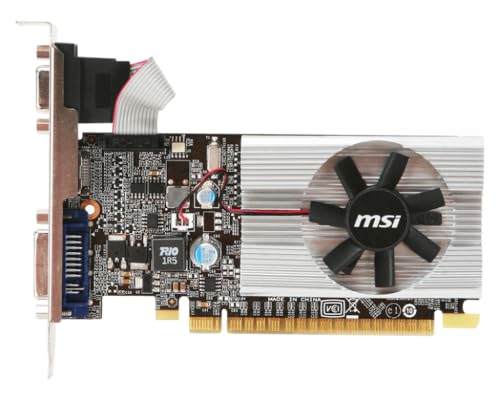
MSI GeForce 210 1GB DDR3 Low Profile
Best for: Compact PCs needing basic display output
- Memory Type
- DDR3 (what this guide is about)
- Graphics Processor
- GeForce 210
- Memory Size
- 1 GB
- PCIe Interface
- PCI Express 2.0
- Slot Width
- 1-slot
- Dimensions
- 5.7 × 3.3 × 0.7 inches
View on Amazon: MSI GeForce 210 1GB DDR3 Low Profile Affiliate link
The MSI GeForce 210 uses DDR3 memory, which places it in the entry-level category compared to modern GDDR6 cards. It features a low-profile design measuring 5.7 inches long, making it suitable for slim or small form factor systems. The card includes Military Class components for stability. It is best for users needing basic display output in compact builds rather than high-performance gaming.
Pros
- DDR3 memory configuration
- Low-profile design fits slim systems
- Compact dimensions at 5.7 inches long
- Military Class components for durability
Cons
- DDR3 memory is slower than GDDR6
- Limited performance for modern gaming
- Only 1GB of video memory
Good fit if
- You need a low-profile card for a small case
- You require basic display output for office tasks
- You are building a compact HTPC
Skip if
- You need high-resolution gaming performance
- You require GDDR6 memory speed
- You need more than 1GB of VRAM
Verdict: MSI GeForce 210 DDR3 Low Profile is a basic display solution for compact builds. It fits users who prioritize case compatibility over graphical power.
Specifications side by side
| Spec | ZOTAC GeForce RTX 3070 Twin Edge OC 8GB | MSI GeForce 210 1GB DDR3 Low Profile |
|---|---|---|
| Graphics Processor | GeForce RTX 3070 | GeForce 210 |
| Memory Size | 8GB | 1 GB |
| Memory Type | GDDR6 | DDR3 |
| Boost Clock | 1755 MHz | not stated |
| Memory Bus Width | 256-bit | not stated |
| PCIe Interface | PCIE 4.0 | PCI Express 2.0 |
| Slot Width | not stated | 1-slot |
| Memory | 8GB | not stated |
| Interface | PCIe 4.0 | not stated |
| Use | Gaming | not stated |
| Dimensions | 9.13 × 5.56 × 0.1 inches | 5.7 × 3.3 × 0.7 inches |
| Weight | not stated | 13.6 ounces |
| Model | not stated | N210-MD1G/D3 |
Frequently asked questions
Can a GDDR6 card play modern games at high settings?
Yes. The ZOTAC RTX 3070 uses GDDR6 memory and supports PCIe 4.0. This setup delivers strong performance for 4K gaming. It is designed for users who want high refresh rates and modern display connectivity. DDR3 cards lack this bandwidth and cannot handle these tasks.
Is DDR3 memory suitable for gaming?
No. DDR3 is a basic memory type found in entry-level cards like the MSI GeForce 210. It lacks the speed and bandwidth needed for gaming. This card is intended for compact PCs needing basic display output. It prioritizes case compatibility over graphical power.
What is the main difference between GDDR6 and DDR3?
GDDR6 offers much higher bandwidth than DDR3. It supports rapid data transfers for demanding tasks like gaming. DDR3 is slower and used for simple display solutions. The ZOTAC RTX 3070 uses GDDR6 for performance, while the MSI GeForce 210 uses DDR3 for basic output.
Do I need PCIe 4.0 for a GDDR6 card?
Not strictly, but it helps. The ZOTAC RTX 3070 uses a PCIe 4.0 interface. This ensures fast data transfer between the card and your system. It fits gamers who prioritize high refresh rates. DDR3 cards like the MSI GeForce 210 do not require this modern interface.
Which card is better for a small computer case?
The MSI GeForce 210 is better for small cases. It is a low-profile card measuring 5.7 inches in length. It fits users who prioritize case compatibility. The ZOTAC RTX 3070 is larger and designed for performance, not compact builds. It uses GDDR6 memory for gaming.
Can DDR3 graphics cards handle 4K video playback?
They can display video, but with limits. The MSI GeForce 210 is a basic display solution. It provides video output for your monitor. It is not designed for high-performance 4K gaming. The ZOTAC RTX 3070 with GDDR6 is built for 4K gaming performance.
Is GDDR6 memory faster than DDR3?
Yes, GDDR6 is significantly faster. It operates at high speeds to support gaming and content creation. The ZOTAC RTX 3070 uses GDDR6 for high bandwidth. DDR3, found in the MSI GeForce 210, is slower and intended for basic display tasks. It cannot match GDDR6 speeds.