ZOTAC GeForce RTX 3060 Twin vs ZOTAC Gaming GeForce RTX 4060 (2026): Key Differences
As an Amazon Associate we earn from qualifying purchases. Links on this page are affiliate links.
You are comparing the zotac gaming geforce rtx 3060 vs gaming geforce rtx 4060. Both cards use GDDR6 memory and a PCIe 4.0 interface for gaming. The main difference lies in memory capacity and architecture. The RTX 3060 offers 12GB of VRAM with a wider bus, while the RTX 4060 provides 8GB with a narrower bus but newer features. You need to decide which spec profile fits your resolution and texture needs.
Key differences
| Aspect | ZOTAC GeForce RTX 3060 Twin Edge 12GB | ZOTAC Gaming GeForce RTX 4060 Twin Edge OC |
|---|---|---|
| GPU | GeForce RTX 3060 | GeForce RTX 4060 |
| Memory Size | 12GB | 8GB |
| Memory Bus Width | 192-bit | 128-bit |
| Length | 8.8 inches | 8.7 inches |
Which one should you choose?
Choose ZOTAC GeForce RTX 3060 Twin Edge 12GB if
- You need more VRAM for high-resolution textures in modern titles.
- You prefer a wider memory bus for higher bandwidth potential.
Choose ZOTAC Gaming GeForce RTX 4060 Twin Edge OC if
- You want a slightly shorter card for smaller cases.
- You are interested in newer architecture features like DLSS 3.
Verdict: Choose the RTX 3060 if your games demand more than 8GB of VRAM at higher settings. Pick the RTX 4060 if you prioritize newer generation features and a compact form factor. Both cards share the same interface and memory type, so your choice depends on specific capacity needs.
RTX 3060 vs RTX 4060 Specs
memory capacity
The ZOTAC GeForce RTX 3060 Twin Edge 12GB provides 12GB of VRAM. This larger buffer helps you handle high-resolution textures and complex scenes in modern games without running out of space. In contrast, the ZOTAC Gaming GeForce RTX 4060 Twin Edge OC includes only 8GB of memory. While 8GB is sufficient for 1080p gaming, the RTX 3060 offers more headroom for future titles and higher settings. If you plan to play at 1440p or use heavy mod packs, the extra memory on the 3060 is a significant practical advantage.
gpu architecture
The key difference lies in the graphics processor. The RTX 3060 uses the older Ampere architecture, while the RTX 4060 features the newer Ada Lovelace architecture. Newer architectures typically bring improved ray tracing performance and better efficiency. The RTX 4060 also supports DLSS 3, which uses frame generation to boost framerates. This technology is not available on the RTX 3060. For gamers who prioritize ray tracing and the latest upscaling features, the RTX 4060 provides a clear technological edge.
memory bus width
Memory bus width affects how much data the GPU can process at once. The RTX 3060 has a 192-bit memory bus, which is wider than the 128-bit bus found on the RTX 4060. A wider bus generally allows for higher bandwidth potential, though actual performance depends on other factors like memory speed. The RTX 3060 uses 15 Gbps memory, while the RTX 4060 uses faster 17 Gbps memory. Despite the slower speed, the wider bus on the 3060 helps balance its overall memory throughput compared to the narrower RTX 4060.
physical dimensions
Both cards are compact, but their dimensions differ slightly. The RTX 3060 Twin Edge measures 8.8 inches in length, 4.6 inches in width, and 1.5 inches in height. The RTX 4060 Twin Edge OC is slightly shorter at 8.7 inches long, but it is wider at 4.8 inches and taller at 1.7 inches. The RTX 3060 is marginally more compact in length, which might matter for very small cases. However, the RTX 4060 is slightly wider, which could affect clearance in tight builds. Check your case specifications carefully for both models.
interface compatibility
Both graphics cards utilize the PCIe 4.0 interface. This means they are fully compatible with modern motherboards and offer the same bandwidth capabilities for data transfer. You will not see any difference in connectivity or bottleneck potential from the interface alone. Both cards are designed for gaming and perform well within the PCIe 4.0 standard. Since the interface is identical, this factor does not sway the decision between the two models. Your motherboard will support either card equally well.
Which graphics card suits your needs
High-resolution texture users
The RTX 3060 Twin Edge includes 12GB of VRAM. This larger buffer helps you handle high-resolution textures and complex scenes in modern games without running out of space. The 192-bit memory bus supports this capacity, making it a practical choice for 1080p gaming with detailed assets. You benefit from the extra memory headroom.
Compact build enthusiasts
The RTX 4060 Twin Edge OC is slightly shorter at 8.7 inches compared to the 3060's 8.8 inches. It also features a 128-bit memory bus and 8GB of VRAM. This card supports DLSS 3, which can boost frame rates in compatible titles. Its compact dimensions and efficient design make it ideal for smaller PC cases.
Budget-conscious gamers
The RTX 4060 offers a newer architecture with DLSS 3 support. This technology can improve performance in supported games by generating additional frames. While it has less VRAM than the 3060, the efficiency of the 4060 architecture often translates to better performance per watt. It is a solid option for modern gaming standards.
The products compared
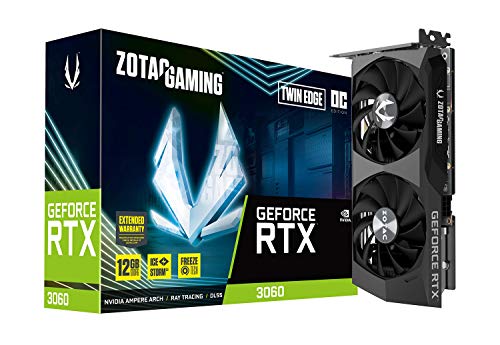
ZOTAC GeForce RTX 3060 Twin Edge 12GB
Best for: 1080p gaming with high texture settings
- Graphics Processor
- GeForce RTX 3060
- Memory Size
- 12GB
- Memory Type
- GDDR6
- Memory Bus Width
- 192-bit
- PCIe Interface
- PCIe 4.0
- Use
- Gaming
View on Amazon: ZOTAC GeForce RTX 3060 Twin Edge 12GB Affiliate link
This ZOTAC GeForce RTX 3060 Twin Edge OC features 12GB of GDDR6 memory on a 192-bit bus. It uses the PCIe 4.0 interface for data transfer. The card measures 8.8 inches in length and 1.5 inches in height. You get more video memory than the RTX 4060. This makes it suitable for gaming at 1080p with higher texture settings. It fits standard mid-size cases.
Pros
- 12GB GDDR6 memory capacity
- 192-bit memory bus width
- PCIe 4.0 interface support
- Compact 1.5-inch dual-slot height
Cons
- Older RTX 3060 architecture lacks DLSS 3 frame generation
- Narrower 192-bit memory bus compared to 128-bit high-bandwidth peers
- Longer 8.8-inch length may not fit small cases
Good fit if
- You need 12GB of VRAM for 1080p gaming
- You prefer a dual-slot card for airflow
- You are building on a PCIe 4.0 motherboard
Skip if
- You require DLSS 3 frame generation technology
- You have a small form factor case under 8.5 inches
- You want the latest Ada Lovelace architecture features
Verdict: ZOTAC RTX 3060 Twin Edge 12GB offers 12GB of VRAM for texture-heavy gaming. You should choose it if you prioritize memory capacity over newer generation features like frame generation.

ZOTAC Gaming GeForce RTX 4060 Twin Edge OC
Best for: Small form factor gaming builds
- Graphics Processor
- GeForce RTX 4060
- Memory Size
- 8GB
- Memory Type
- GDDR6
- Memory Bus Width
- 128-bit
- PCIe Interface
- PCIE 4.0
- Use
- Gaming
View on Amazon: ZOTAC Gaming GeForce RTX 4060 Twin Edge OC Affiliate link
The ZOTAC GeForce RTX 4060 Twin Edge OC delivers gaming performance with 8GB of GDDR6 memory on a 128-bit bus. It runs on the PCIe 4.0 interface and features a compact design measuring 8.7 inches in length. This card suits players who need a small form factor build. You get DLSS 3 support for enhanced frame generation. The Gun Metal finish keeps the look understated.
Pros
- 8GB GDDR6 memory capacity
- Compact 8.7-inch length
- Supports DLSS 3 technology
- PCIe 4.0 interface
Cons
- 8GB memory is less than the 12GB found on the RTX 3060
- 128-bit memory bus width is narrower than 192-bit options
- 17 Gbps memory speed is lower than some competitors
Good fit if
- You need a short graphics card for a small case
- You want DLSS 3 support for newer games
- You prefer a compact 1.7-inch dual-slot design
Skip if
- You require more than 8GB of video memory
- You need a wider 192-bit memory bus for higher resolution textures
- You are building with an older PCIe 3.0 motherboard and want maximum bandwidth
Verdict: ZOTAC RTX 4060 Twin Edge 8GB fits users who prioritize a compact build size and modern DLSS 3 features over raw memory capacity. It is a solid option for small form factor gaming PCs.
Specifications side by side
| Spec | ZOTAC GeForce RTX 3060 Twin Edge 12GB | ZOTAC Gaming GeForce RTX 4060 Twin Edge OC |
|---|---|---|
| Graphics Processor | GeForce RTX 3060 | GeForce RTX 4060 |
| Memory Size | 12GB | 8GB |
| Memory Type | GDDR6 | GDDR6 |
| Memory Bus Width | 192-bit | 128-bit |
| PCIe Interface | PCIe 4.0 | PCIE 4.0 |
| Memory | 12GB | 8GB |
| GPU | GeForce RTX 3060 | GeForce RTX 4060 |
| Interface | PCIe 4.0 | PCIe 4.0 |
| Use | Gaming | Gaming |
| Dimensions | 8.8 × 4.6 × 1.5 inches | 8.7 × 1.7 × 4.8 inches |
| Color | not stated | Gun Metal |
Frequently asked questions
Does the RTX 3060 Twin Edge have more VRAM than the RTX 4060?
Yes, the ZOTAC GeForce RTX 3060 Twin Edge includes 12GB of GDDR6 memory. The ZOTAC Gaming GeForce RTX 4060 Twin Edge OC provides 8GB of GDDR6 memory. The 3060 offers a larger buffer for texture-heavy gaming, while the 4060 prioritizes newer architectural features over raw memory capacity.
Which card is smaller for small form factor builds?
The ZOTAC Gaming GeForce RTX 4060 Twin Edge OC is slightly more compact in height. It measures 1.7 inches tall compared to the RTX 3060 Twin Edge’s 1.5-inch height, but the 4060 is wider at 4.8 inches versus the 3060’s 4.6 inches. Both fit standard cases, but check your specific chassis dimensions for width clearance.
Do both cards use PCIe 4.0?
Both graphics cards utilize a PCIe 4.0 interface for connectivity. This ensures they can communicate efficiently with your motherboard. The ZOTAC GeForce RTX 3060 Twin Edge and the ZOTAC Gaming GeForce RTX 4060 Twin Edge OC both support this standard for gaming workloads.
Is the RTX 4060 better for frame generation?
The ZOTAC Gaming GeForce RTX 4060 Twin Edge OC supports modern DLSS 3 features, including frame generation. The RTX 3060 Twin Edge lacks this specific capability. If you prioritize frame generation technology, the 4060 is the suitable choice, even though it has less VRAM.
What is the physical length of each card?
The ZOTAC GeForce RTX 3060 Twin Edge measures 8.8 inches in length. The ZOTAC Gaming GeForce RTX 4060 Twin Edge OC measures 8.7 inches in length. Both cards are similar in length, so they will fit in most mid-tower cases without requiring excessive space.
Which card is best for high texture settings?
The ZOTAC GeForce RTX 3060 Twin Edge is better for high texture settings due to its 12GB of VRAM. The larger memory buffer helps handle complex scenes and high-resolution textures without running out of space. The 4060’s 8GB limit may constrain texture quality in very demanding titles.