Yeston GTX 1050 ti 4GB vs Yeston Radeon RX 6500 XT: Spec Comparison
As an Amazon Associate we earn from qualifying purchases. Links on this page are affiliate links.
You are comparing the yeston gtx 1050 ti 4gb vs radeon rx 6500 xt for your next build. Both cards offer 4GB of video memory and fit into low-profile cases, making them suitable for compact systems. The main difference lies in their underlying technology. The GTX 1050 Ti uses older GDDR5 memory and a PCIe 3.0 interface. The RX 6500 XT features newer GDDR6 memory and supports PCIe 4.0. These specs change how each card handles modern tasks.
Key differences
| Aspect | Yeston GTX 1050 Ti 4GB Low Profile | Yeston Radeon RX 6500 XT 4GB |
|---|---|---|
| Memory Type | GDDR5 | GDDR6 |
| Memory Interface | 128-bit | 64-bit |
| PCIe Interface | PCI Express 3.0 x16 | PCI Express 4.0 x4 |
| CUDA Cores / Shaders | 768 | 1024 |
| Boost Clock | 1392 MHz | 2815 MHz |
Which one should you choose?
Choose Yeston GTX 1050 Ti 4GB Low Profile if
- You need a PCIe 3.0 x16 slot for maximum bandwidth compatibility
- You prefer a wider 128-bit memory bus for smoother multitasking
Choose Yeston Radeon RX 6500 XT 4GB if
- You want newer GDDR6 memory for higher data transfer speeds
- You need more shader cores for better parallel processing performance
Verdict: Choose the GTX 1050 Ti if you prioritize the wider memory bus and standard PCIe 3.0 x16 connectivity. Pick the RX 6500 XT if you want higher clock speeds and more shader cores. The decision depends on whether you value memory bandwidth or raw compute power.
GTX 1050 Ti vs RX 6500 XT Specs
Memory bandwidth
The Yeston GTX 1050 Ti 4GB Low Profile uses 4GB of GDDR5 memory on a 128-bit interface. This setup delivers 112 GB/s of bandwidth. The Yeston Radeon RX 6500 XT 4GB pairs 4GB of GDDR6 memory with a narrower 64-bit bus. Despite faster GDDR6 speeds, the narrow bus limits bandwidth to 104 GB/s. The GTX 1050 Ti offers higher memory bandwidth. This helps with texture loading in older titles. The RX 6500 XT relies on its 16MB Infinity Cache to compensate for the lower bandwidth. You get better raw memory throughput with the GTX 1050 Ti.
Shader performance
The Yeston GTX 1050 Ti 4GB Low Profile features 768 unified shaders on a GP107 core. The Yeston Radeon RX 6500 XT 4GB includes 1024 unified shaders on the Navi 24 core. The RX 6500 XT has more processing units. It also runs at higher core frequencies, reaching up to 2825 MHz. The GTX 1050 Ti boosts to 1392 MHz. The RX 6500 XT provides more raw compute power. This translates to better performance in modern games. The higher shader count and clock speeds give the RX 6500 XT a clear advantage in rendering tasks.
PCIe interface
The Yeston GTX 1050 Ti 4GB Low Profile connects via PCI-Express 3.0 x16. This provides a wide data path for older systems. The Yeston Radeon RX 6500 XT 4GB uses PCI Express 4.0 x4. The RX 6500 XT has fewer lanes. It may not fit in all motherboards that support x16 slots. The GTX 1050 Ti offers broader compatibility with older PCIe 3.0 systems. The RX 6500 XT requires a PCIe 4.0 slot for full performance. You should check your motherboard slots before choosing the RX 6500 XT.
Physical dimensions
Both cards are designed for small form factor builds. The Yeston GTX 1050 Ti 4GB Low Profile measures 7.01 inches in length. The Yeston Radeon RX 6500 XT 4GB is slightly shorter at 6.77 inches. Both cards share the same slim height of 0.1 inches. The RX 6500 XT is more compact in length. This makes it easier to fit into very tight cases. The GTX 1050 Ti is still low profile. You have a slight size advantage with the RX 6500 XT for minimal clearance builds.
Display outputs
The Yeston GTX 1050 Ti 4GB Low Profile includes HDMI and DisplayPort outputs. It supports resolutions up to 8K. The Yeston Radeon RX 6500 XT 4GB offers DP 1.4a and HDMI 2.1. The RX 6500 XT supports VRR and FRL on HDMI. This allows for variable refresh rates and frame rate control on compatible displays. The GTX 1050 Ti lacks these modern HDMI features. The RX 6500 XT provides better support for high refresh rate monitors. You get more advanced display features with the Radeon card.
Choose Your Yeston Graphics Card
Small form factor builders
The GTX 1050 Ti fits a 120mm height. It includes a half-height bracket. This makes installation easier in tight cases. The RX 6500 XT lacks this bracket. You need to check your case clearance carefully for the newer card. The older card offers a simpler fit for mini PCs.
Modern gaming performance seekers
The RX 6500 XT uses a 6nm process and GDDR6 memory. It runs at higher clock speeds up to 2825MHz. This provides better raw power for modern titles. The GTX 1050 Ti uses older 14nm tech and GDDR5. Its lower clock speeds and older architecture limit performance in new games compared to the RX 6500 XT.
Budget system upgraders
This card supports DirectX 12 and G-Sync. It has a 128-bit memory interface for smoother multitasking. It draws power from the slot alone. You do not need an external power connector. This simplifies builds for older or low-wattage power supplies. The RX 6500 XT requires a 6-pin connector and a 500W PSU.
The products compared
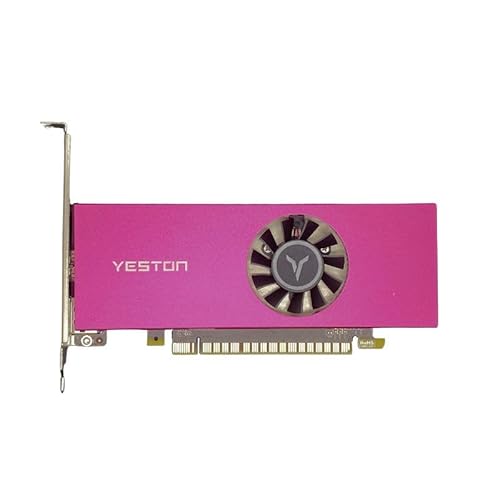
Yeston GTX 1050 Ti 4GB Low Profile
Best for: small form factor builds
- Graphics Processor
- GTX 1050 Ti
- Memory Size
- 4 GB
- Memory Type
- GDDR5
- Boost Clock
- 1392 MHz
- Memory Bus Width
- 128-bit
- PCIe Interface
- PCIe 3.0
View on Amazon: Yeston GTX 1050 Ti 4GB Low Profile Affiliate link
This Yeston card uses the GP107 core with 768 shaders and 4GB GDDR5 memory. It measures 178x120x22mm, making it a low-profile solution for small form factor builds. You get HDMI and DisplayPort outputs with support for DirectX 12. It suits users who need a compact card for basic gaming or office tasks in tight spaces.
Pros
- Compact 178x120x22mm low-profile design fits small cases
- 4GB GDDR5 memory with 128-bit interface
- Supports DirectX 12 and 8K resolution
- Includes half-height bracket shifter for versatility
Cons
- Older 14nm architecture limits performance
- PCI-Express 3.0 x16 interface is outdated
- No mention of external power connector requirements
Good fit if
- You need a low-profile card for a mini PC
- You want a compact solution for light gaming
- You require basic 4K or 8K display support
Skip if
- You need high-end gaming performance
- You require modern PCIe 4.0 support
- You want a full-size dual-slot card
Verdict: Yeston GTX 1050 Ti 4GB Low Profile fits users needing a small card for light tasks. It is not suitable for demanding modern games.

Yeston Radeon RX 6500 XT 4GB
Best for: Small form factor builds
- Graphics Processor
- Radeon RX 6500 XT
- Memory Size
- 4GB
- Memory Type
- GDDR6
- Memory Bus Width
- 64bit
- PCIe Interface
- PCI Express 4.0 x4
- Recommended PSU
- 500W
View on Amazon: Yeston Radeon RX 6500 XT 4GB Affiliate link
This Yeston graphics card uses the Radeon RX 6500 XT GPU with 4GB of GDDR6 memory on a 64-bit bus. It features a 6nm process and supports PCIe 4.0 x4. The card includes 16MB of Infinity Cache and a single-fan cooler. You get DisplayPort 1.4a and HDMI 2.1 outputs. It is a compact option for basic gaming and media tasks.
Pros
- GDDR6 memory for faster data transfer
- PCIe 4.0 x4 interface support
- 16MB Infinity Cache included
- Single fan with adjustable speed
Cons
- Only 4GB of video memory
- PCIe 4.0 x4 lane limit
- No half-height bracket included
Good fit if
- You need a low-profile card for a small case
- You want GDDR6 memory over GDDR5
- You use a 500W power supply
Skip if
- You require more than 4GB of VRAM
- You need a full-height bracket
- You want PCIe x16 connectivity
Verdict: Yeston RX 6500 XT 4GB GDDR6 fits users who need a small form factor card with modern memory. It works well in tight cases where space is limited.
Specifications side by side
| Spec | Yeston GTX 1050 Ti 4GB Low Profile | Yeston Radeon RX 6500 XT 4GB |
|---|---|---|
| Graphics Processor | GTX 1050 Ti | Radeon RX 6500 XT |
| Memory Size | 4 GB | 4GB |
| Memory Type | GDDR5 | GDDR6 |
| Boost Clock | 1392 MHz | not stated |
| Memory Bus Width | 128-bit | 64bit |
| PCIe Interface | PCIe 3.0 | PCI Express 4.0 x4 |
| Recommended PSU | not stated | 500W |
| Slot Width | Low Profile | not stated |
| Memory | 4GB | 4GB |
| Form Factor | Low Profile | not stated |
| Dimensions | 7.01 × 4.72 × 0.1 inches | 6.77 × 3.98 × 0.1 inches |
| Size | 178*120*22mm | not stated |
| Color | not stated | RX6500XT 4G D6 MA |
Frequently asked questions
Which card uses newer memory technology?
The Yeston Radeon RX 6500 XT uses GDDR6 memory. The GTX 1050 Ti uses older GDDR5. GDDR6 offers higher speeds and efficiency. This makes the RX 6500 XT more modern. You get better performance per watt with the newer standard.
Do both cards fit in low-profile cases?
Yes, both are designed for small form factors. The GTX 1050 Ti has a low profile form factor. It measures 7.01 inches in length. The RX 6500 XT is also compact at 6.77 inches. Both fit tight cases with limited space.
Is the GTX 1050 Ti suitable for modern gaming?
No, it is not suitable for demanding modern games. The card is designed for light tasks. You should expect limited performance in new titles. It works best for basic display output or older games. Do not rely on it for high settings.
Which card is better for tight spaces?
Both are excellent for tight spaces. The RX 6500 XT is slightly shorter at 6.77 inches. The GTX 1050 Ti is 7.01 inches long. Both share the same height of 0.1 inches. Choose based on your exact case dimensions.
Does the RX 6500 XT include a low profile bracket?
The data does not list a low profile bracket for the RX 6500 XT. You must check your case clearance carefully. The GTX 1050 Ti is explicitly noted for its low profile design. This makes installation easier in small builds without extra parts.
What is the difference in memory capacity?
There is no difference in capacity. Both cards provide 4GB of video memory. The type differs, with GDDR5 on the GTX and GDDR6 on the RX. The amount of memory remains the same for both options.
Which card has a smaller physical footprint?
The Radeon RX 6500 XT has a smaller footprint. It measures 6.77 inches in length. The GTX 1050 Ti is 7.01 inches long. Both are 0.1 inches high. The RX 6500 XT saves a small amount of space in your case.
Can I use these cards for office work?
Yes, both are suitable for office work. The GTX 1050 Ti is explicitly recommended for light tasks. The RX 6500 XT also fits small builds well. You get reliable performance for desktop use. Neither card is needed for heavy creative work.