SRhonyra GTX 1060 6GB Low vs SRhonyra RTX 3050 6GB Low Profile Graphics Card: Spec Comparison
As an Amazon Associate we earn from qualifying purchases. Links on this page are affiliate links.
You are comparing the srhonyra gtx 1060 6gb low profile graphics card vs rtx 3050 6gb low. Both cards offer 6GB of video memory and fit into small form factor cases. They share a single-slot design and require no external power connectors. The main difference lies in their architecture and memory speed. The GTX 1060 uses older GDDR5, while the RTX 3050 features modern GDDR6. This affects their performance capabilities and supported technologies.
Key differences
| Aspect | SRhonyra GTX 1060 6GB Low Profile | SRhonyra RTX 3050 6GB Low Profile |
|---|---|---|
| Graphics Processor | GTX 1060 (Pascal) | RTX 3050 (Ampere) |
| Memory Type | GDDR5 | GDDR6 |
| Memory Bus | not listed | 96-bit |
| Ray Tracing | not listed | Supported |
| DLSS | not listed | Supported |
| HDMI Version | 2.0 | 2.1 |
Which one should you choose?
Choose SRhonyra GTX 1060 6GB Low Profile if
- You need the lowest cost option for basic 1080p gaming.
- You prefer a card with a longer track record for stability.
- You only need 8K video playback support.
Choose SRhonyra RTX 3050 6GB Low Profile if
- You want modern features like Ray Tracing and DLSS.
- You need faster GDDR6 memory for better performance.
- You require HDMI 2.1 for newer display standards.
Verdict: The GTX 1060 is a practical choice for budget builds that do not require modern rendering features. The RTX 3050 offers superior performance and newer technology for users who can afford the higher tier. Your choice depends on whether you prioritize cost or modern capabilities.
Specs Show RTX 3050 Edge
Memory Type
The SRhonyra GTX 1060 6GB Low Profile uses GDDR5 memory, while the SRhonyra RTX 3050 6GB Low Profile upgrades to GDDR6. GDDR6 offers higher bandwidth and better efficiency than the older GDDR5 standard found in the GTX 1060. This difference matters for texture loading and data throughput in modern applications. The RTX 3050’s memory technology is a clear step forward, providing a more modern foundation for your graphics tasks. You get faster memory speeds with the newer card, which helps maintain performance in demanding scenarios.
GPU Architecture
Architecture differs significantly between these two cards. The GTX 1060 is built on the 16 nm Pascal architecture with 1280 shading units. The RTX 3050 uses the newer 8 nm Ampere architecture with a GA107 processor. The smaller 8 nm process allows for more transistors and better performance per watt. The RTX 3050 also supports Ray Tracing and DLSS, features completely absent in the Pascal-based GTX 1060. If you want modern rendering techniques and upscaling, the RTX 3050 is the only option that supports them.
Power Efficiency
Both cards are bus-powered and require no external PCIe power connectors, making them easy to install in any system. The GTX 1060 draws 75 Watts, while the RTX 3050 draws just 70 Watts. This 5-watt difference means the RTX 3050 is slightly more power-efficient. For builds where power consumption is a concern, such as home theater PCs or office workstations, the lower draw of the RTX 3050 is a minor but measurable advantage. Both fit within standard PCIe slot power limits.
Display Outputs
The GTX 1060 offers one HDMI 2.0 port and one DisplayPort 1.4a port. The RTX 3050 provides an HDMI 2.1 port and a DisplayPort 1.4a port. The HDMI 2.1 on the RTX 3050 supports higher bandwidth, enabling 4K at higher refresh rates compared to the GTX 1060’s HDMI 2.0. Both cards support 8K video playback via DisplayPort. For users connecting to modern 4K monitors, the HDMI 2.1 connection on the RTX 3050 offers better future-proofing and flexibility.
Physical Dimensions
Both cards are low-profile, single-slot designs with identical lengths of 6.61 inches. The GTX 1060 is 2.7 inches wide and 0.71 inches thick. The RTX 3050 is 2.71 inches wide and notably thinner at 0.63 inches. Both include full-height and half-height brackets for compatibility. The RTX 3050 is slightly lighter at 10.9 ounces compared to the GTX 1060’s 13.6 ounces. These physical differences are minor, but the RTX 3050 is marginally more compact in height and weight.
Which SRhonyra Low Profile Card Fits You
Users needing ray tracing and modern features
The RTX 3050 supports ray tracing and DLSS, features the GTX 1060 lacks. It uses GDDR6 memory for better bandwidth and efficiency. The 8 nm process and GA107 processor provide modern gaming capabilities. This card handles 4K video on HDMI 2.1, making it ideal for future-proofing your build with advanced graphical technologies.
Viewers wanting high-resolution display outputs
The GTX 1060 supports 8K video playback via DisplayPort 1.4a and HDMI 2.0. While the RTX 3050 also supports 8K, the GTX 1060 offers dual display outputs suitable for your setup. Its Pascal architecture delivers immersive experiences. This card is a solid choice if you prioritize high-resolution video playback compatibility in a compact form factor.
Small form factor builders prioritizing efficiency
The RTX 3050 draws just 70W with no external connectors, ensuring power efficiency. It weighs less at 10.9 ounces compared to the GTX 1060. The single-slot design fits mini-ITX cases easily. With GDDR6 memory and a 96-bit bus, it offers decent performance for daily use and light gaming while maintaining a low thermal profile.
The products compared

SRhonyra GTX 1060 6GB Low Profile
Best for: small form factor builds needing 6GB VRAM
- Graphics Processor
- GTX 1060
- Memory Size
- 6GB
- Memory Type
- GDDR5
- Memory Bus Width
- 192-Bit
- PCIe Interface
- PCIe 3.0 x16
- Slot Width
- single-slot
View on Amazon: SRhonyra GTX 1060 6GB Low Profile Affiliate link
This SRhonyra card uses the Pascal architecture with 6GB of GDDR5 memory. It measures 6.61 inches long and 0.71 inches thick, fitting single-slot SFF cases. The 75W TDP allows bus power without extra connectors. You get 1280 shading units and outputs for 8K playback. It suits small builds needing basic gaming or creative work within the 4-6GB VRAM range.
Pros
- 6GB GDDR5 memory for 3D and video tasks
- Single-slot low profile design fits small cases
- 75W power draw requires no extra connectors
- Supports 8K resolution output via HDMI and DP
Cons
- Older Pascal architecture limits modern performance
- Only one HDMI port available on this variant
- Heavier build at 13.6 ounces for its size
Good fit if
- You need a low profile card for a small form factor case
- You want to avoid extra power cables in your build
- You require 6GB VRAM for light creative work
Skip if
- You need high performance for modern AAA titles
- You require multiple HDMI ports for multi-monitor setups
- You prefer the latest GPU architecture for efficiency
Verdict: SRhonyra GTX 1060 6GB Low Profile fits users who need a compact, bus-powered card for light gaming and creative tasks in small cases.
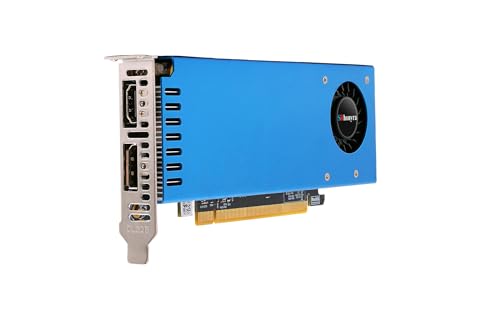
SRhonyra RTX 3050 6GB Low Profile
Best for: Small form factor builds needing modern graphics features
- Graphics Processor
- RTX 3050
- Memory Size
- 6GB
- Memory Type
- GDDR6
- Memory Bus Width
- 96-Bit
- PCIe Interface
- PCIe 4.0 x16
- Slot Width
- Single slot
View on Amazon: SRhonyra RTX 3050 6GB Low Profile Affiliate link
The SRhonyra RTX 3050 6GB is a low-profile graphics card built for small form factor systems. It features 6GB of GDDR6 memory on a 96-bit bus and a 70W TDP that requires no external power connectors. You get ray tracing and DLSS support for modern gaming. It includes HDMI 2.1 and DisplayPort 1.4a outputs for dual monitor setups. This card suits users needing a compact, power-efficient solution for light gaming or office work.
Pros
- Supports ray tracing and DLSS for modern graphics features
- 70W TDP allows bus-powered operation without external connectors
- Single-slot design fits small form factor cases
- Includes HDMI 2.1 and DisplayPort 1.4a for dual displays
Cons
- 96-bit memory bus limits performance compared to higher-end cards
- 6GB VRAM capacity is lower than the 6GB GTX 1060 competitor
- Single slot width restricts cooling potential
Good fit if
- You need a low-profile card for a mini-ITX build
- You want ray tracing and DLSS support in a compact form
- You require a power-efficient card without external power connectors
Skip if
- You need high VRAM for 4K gaming
- You require multiple external power connectors for stability
- You want a dual-slot card for better cooling
Verdict: SRhonyra RTX 3050 6GB Low Profile is a practical option for small builds needing modern features like ray tracing. It fits users prioritizing compact size and low power draw over raw gaming performance.
Specifications side by side
| Spec | SRhonyra GTX 1060 6GB Low Profile | SRhonyra RTX 3050 6GB Low Profile |
|---|---|---|
| Graphics Processor | GTX 1060 | RTX 3050 |
| Memory Size | 6GB | 6GB |
| Memory Type | GDDR5 | GDDR6 |
| Memory Bus Width | 192-Bit | 96-Bit |
| PCIe Interface | PCIe 3.0 x16 | PCIe 4.0 x16 |
| Slot Width | single-slot | Single slot |
| Memory | 6GB | 6GB |
| Interface | PCIe 3.0 | PCIe 4.0 |
| Form Factor | Low Profile | Low Profile |
| Length | 6.61 inches | not stated |
| Width | 2.71 inches | not stated |
| Weight | 13.6 ounces | 10.9 ounces |
| Dimensions | not stated | 6.61 × 2.7 × 0.1 inches |
| Size | low profile single slot | low profile single slot |
| Color | GTX 1060 HDMI DP | Blue |
| Model | SR106D5LP6G1 | SR305D6LP6G1 |
Frequently asked questions
Does the SRhonyra GTX 1060 6GB Low Profile need extra power cables?
No, it does not require external power connectors. You can run this card directly from your motherboard's PCIe slot. This makes installation simpler in small form factor cases where adding extra cables can be difficult. The design relies entirely on the bus for power delivery.
Is the RTX 3050 6GB Low Profile better for ray tracing?
Yes, the RTX 3050 supports ray tracing, while the GTX 1060 does not. If you want modern graphics features, the RTX 3050 is the practical choice. It uses a newer architecture that enables these advanced visual effects for compatible games and applications.
What is the weight difference between the two low profile cards?
The SRhonyra GTX 1060 6GB Low Profile weighs 13.6 ounces. The SRhonyra RTX 3050 6GB Low Profile is lighter at 10.9 ounces. This 2.7 ounce difference is minor but may matter if you are building a very lightweight or portable system.
Do both cards fit in single-slot expansion slots?
Yes, both graphics cards use a single-slot design. The GTX 1060 measures 2.71 inches in width. The RTX 3050 measures 2.7 inches in width. Both are low profile and suitable for compact cases that have limited space for expansion cards.
Which card has faster memory bandwidth due to its memory type?
The RTX 3050 uses GDDR6 memory, which offers higher bandwidth than the GTX 1060's GDDR5. GDDR6 is more efficient and supports faster data transfer rates. This makes the RTX 3050 better for tasks that benefit from modern memory standards.
Are the physical dimensions similar for both SRhonyra low profile cards?
Both cards share the same length of 6.61 inches. The GTX 1060 is 2.71 inches wide, while the RTX 3050 is 2.7 inches wide. They are nearly identical in footprint, ensuring they fit similarly in small form factor builds.