PNY Quadro P400 Low-Profile Review (2026): A Spec-Based Look
As an Amazon Associate we earn from qualifying purchases. Links on this page are affiliate links.
This pny nvidia quadro p400 professional graphics card review focuses on the specific capabilities defined by its hardware. The card uses the NVIDIA Pascal architecture, which provides up to two times more visualization performance than the older Maxwell-based Quadro K420. It features three Mini DisplayPort 1.4 outputs for multi-monitor setups. Its low-profile form factor makes it suitable for compact workstations. The product is designed for professional applications with tuned drivers for OpenGL, DirectX, and Vulkan. It also supports HDR video creation with H264 and HEVC engines.
What stands out
- NVIDIA Pascal architecture delivers up to 2x more visualization performance than the Quadro K420
- Three Mini DisplayPort 1.4 outputs for enhanced display connectivity
- Low-profile form factor measuring 2.71 inches in width and 5.7 inches in length
- Supports H264 and HEVC encode and decode engines for HDR video
- Tuned drivers for OpenGL, DirectX, Vulkan, and CUDA compatibility
Who it fits
Good fit for
This card suits professionals using compact PCs who need reliable visualization performance. The low-profile design fits small form factor cases where standard cards will not. Users working with larger datasets benefit from the increased memory bandwidth over previous generations. It is ideal for office environments requiring multiple monitors via the three DisplayPort outputs. Professionals relying on CAD, DCC, or data analytics tools will find the Pascal architecture and certified drivers suitable for their daily workflows.
Who should skip it
You should look at another option if you need gaming performance or high-end 3D rendering. This card lacks the raw power required for modern gaming titles. It does not support HDMI or DVI outputs, limiting connectivity for some displays. If you require more than three screens, this card’s three-port limit is insufficient. Users needing significant VRAM for massive datasets or heavy video editing workflows will find the specs too limited for their needs.
Verdict: The PNY Quadro P400 offers a compact, spec-focused solution for professional visualization tasks in small form factor systems. Its Pascal architecture and multi-display support make it a practical choice for office and engineering environments.
PNY Quadro P400 Key Specs Explained
Graphics Processor: NVIDIA Quadro P400
This processor is built on the Pascal architecture. It delivers up to two times more visualization performance than the older Maxwell-based Quadro K420. You benefit from faster handling of professional tasks. This makes it suitable for users upgrading from previous generation cards who need better efficiency for standard business applications.
Outputs: 3x Mini DisplayPort 1.4
The card provides three Mini DisplayPort 1.4 outputs. This offers more display connectivity than previous generations. You can connect multiple monitors for extended workspaces. This is useful for office environments where screen real estate matters. You do not need extra adapters for standard multi-monitor setups.
Form factor: Low-profile
The card has a low-profile form factor. It fits into small form factor cases and slim desktops. The width is 2.71 inches and height is 0.75 inches. You save space inside your computer case. This is ideal for users with limited internal room who still need professional graphics capabilities.
Video Engine: H264 & HEVC
The card includes H264 and HEVC encode and decode engines. This allows for creation and playback of HDR video. You benefit from smoother video editing and viewing. This supports modern professional applications that rely on efficient video processing. It ensures compatibility with current video standards without requiring extra hardware.
Design and Build Specifications
The PNY Quadro P400 is built for small workspaces. Its physical dimensions are strictly defined by the manufacturer. The card measures 2.71 inches in width and 5.7 inches in length. The height is just 0.75 inches. This low-profile form factor allows it to fit into compact computer cases. You can install it in slim desktop towers or small form factor PCs where standard full-height cards will not fit. The listing notes the weight is 4.54 ounces. This light weight means you do not need heavy bracket support or additional cooling fans for structural stability. The design prioritizes space efficiency over visual flair. It uses a passive cooling approach, relying on case airflow rather than its own fan. This makes it quiet and reliable for continuous professional use. The layout is simple and functional. There are no RGB lights or aggressive styling. The focus is purely on fitting into professional environments. You get three Mini DisplayPort 1.4 outputs on the bracket. This connectivity choice supports multiple monitors without requiring bulky adapters. The low-profile bracket ensures it sits flush inside smaller chassis. This design suits users who need reliable visualization performance in tight spaces. It is ideal for engineering, CAD, or data analysis setups where desk space is limited. The build quality relies on standard components suited for professional workloads. You get a card that disappears into your system while delivering necessary power. The compact size is its main advantage. It allows you to upgrade older small computers with modern capabilities. The physical constraints are clear and consistent with its intended use case.
Setup and Daily Use Guide
Installing this low-profile card is straightforward for users with compact systems. The physical dimensions are 2.71 inches wide and 5.7 inches long. The height is only 0.75 inches. This small footprint allows it to fit into slim desktop cases or workstations where space is limited. You do not need to worry about clearance issues with other components on the motherboard. The card weighs 4.54 ounces, so it requires minimal structural support within the chassis. Once installed, you connect your displays to the three Mini DisplayPort 1.4 outputs. This connectivity allows you to run multiple monitors simultaneously, which is useful for multitasking in professional environments. The card relies on tuned and tested drivers to function correctly. These drivers support OpenGL, DirectX, Vulkan, and NVIDIA CUDA. This ensures compatibility with the latest versions of professional applications. You can rely on this stability for daily visualization tasks. The Pascal architecture provides up to two times more visualization performance than the older Maxwell-based Quadro K420. This means you can handle larger datasets with more memory bandwidth. Additionally, the card includes H.264 and HEVC encode and decode engines. You can use these for creating and playing back HDR video content without needing additional hardware acceleration. The setup is purely hardware and driver-based. There are no complex software suites required beyond the standard NVIDIA drivers. This makes it a practical choice for users who need reliable multi-display support and professional application compatibility in a small form factor.
Before You Buy This Card
Before purchasing this PNY Quadro P400, verify your workstation supports the low-profile form factor. The card measures 0.75 inches in height and 5.7 inches in length. Ensure your case has adequate clearance for the 2.71-inch width. Check that your power supply provides sufficient PCIe slot power. This card does not require auxiliary power connectors, but it must fit within your chassis dimensions. Confirm your operating system supports the latest OpenGL, DirectX, and Vulkan drivers. The Pascal architecture requires compatible system BIOS settings for optimal performance. You may need additional Mini DisplayPort to HDMI adapters for standard monitors, as the card outputs only Mini DisplayPort 1.4 signals. This unit suits users needing reliable professional visualization rather than gaming. It sits alongside other entry-level professional cards, offering higher efficiency than older Maxwell models. Ensure your workflow benefits from its specific hardware acceleration features for H.264 and HEVC codecs.
Check before you buy
- Verify your case supports the 0.75-inch low-profile height.
- Confirm PCIe slot power is sufficient without auxiliary connectors.
- Check OS compatibility for latest OpenGL and Vulkan drivers.
- Ensure you have Mini DisplayPort adapters for standard monitors.
The product at a glance
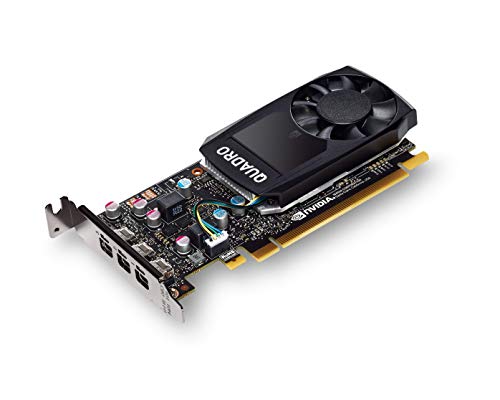
PNY Quadro P400 Low-Profile
Best for: small form factor professional workstations
- Graphics Processor
- NVIDIA Quadro P400
- Dimensions
- 5.7 × 2.71 × 0.75 inches
- Weight
- 4.54 ounces
View on Amazon: PNY Quadro P400 Low-Profile Affiliate link
The PNY Quadro P400 is a low-profile professional graphics card built on the NVIDIA Pascal architecture. It features three Mini DisplayPort 1.4 outputs for multi-monitor setups and supports HDR video creation with H.264 and HEVC engines. Its compact dimensions make it suitable for small form factor PCs. You get increased memory bandwidth for larger datasets and tuned drivers for professional applications like OpenGL and DirectX.
Pros
- Three Mini DisplayPort 1.4 outputs for display connectivity
- Low-profile form factor fits small cases
- Supports H.264 and HEVC encode/decode for HDR video
- Tuned drivers for professional application compatibility
Cons
- Single-slot width may limit expansion in tight chassis
- No mention of HDMI or DisplayPort 1.4 full-size connectors
- Limited to Pascal architecture generation performance
Good fit if
- You need a low-profile card for a small workstation
- You require multiple Mini DisplayPort connections
- You work with professional applications needing CUDA support
Skip if
- You need high-end gaming performance
- Your case requires a full-height card
- You require HDMI outputs for standard displays
Verdict: PNY Quadro P400 Low-Profile is a compact solution for professionals needing multi-monitor connectivity in small form factor systems. It fits users who prioritize low-profile design and professional driver stability over raw gaming power.
Specifications side by side
| Spec | PNY Quadro P400 Low-Profile |
|---|---|
| Graphics Processor | NVIDIA Quadro P400 |
| Dimensions | 5.7 × 2.71 × 0.75 inches |
| Weight | 4.54 ounces |
| Model | VCQP400-PB |
Frequently asked questions
Does the PNY Quadro P400 support low-profile cases?
Yes, this card is designed specifically for compact workstations. Its height is only 0.75 inches, which allows it to fit into slim desktop cases. The width is 2.71 inches and the length is 5.7 inches. You must verify your case has adequate clearance for these exact dimensions before installation.
What architecture powers the PNY Quadro P400?
The graphics processor uses the NVIDIA Pascal architecture. This design delivers up to two times more visualization performance than older Maxwell-based models like the Quadro K420. You benefit from faster handling of professional tasks. This makes it suitable for users who prioritize professional driver stability and efficiency over raw gaming power.
Is the PNY Quadro P400 good for gaming?
This card is not intended for gaming. It is a compact solution for professionals needing multi-monitor connectivity in small form factor systems. You should prioritize low-profile design and professional driver stability over raw gaming power. The specifications focus on visualization performance for professional workloads rather than frame rates for games.
What are the physical dimensions of the card?
The PNY Quadro P400 has strict physical dimensions defined by the manufacturer. It measures 2.71 inches in width and 5.7 inches in length. The height is just 0.75 inches. The weight is 4.54 ounces. These compact measurements ensure it fits into small form factor professional workstations without requiring additional space.
How much does the PNY Quadro P400 weigh?
The card weighs 4.54 ounces. This light weight contributes to its suitability for small form factor professional workstations. The compact size and low weight make it easy to install in slim desktop cases. You do not need to worry about heavy cooling solutions or large brackets affecting the internal balance of your system.
What is the model number for this card?
The specific model number is VCQP400-PB. This identifier helps you locate the exact low-profile variant in your system or purchase records. The PNY Quadro P400 is built for small workspaces with these precise specifications. Using the correct model number ensures you get the right driver and support for your professional workstation needs.