Pcie 5.0 vs Pcie 3.0 Graphics Cards: Which Should You Buy?
As an Amazon Associate we earn from qualifying purchases. Links on this page are affiliate links.
When you look at a pcie 50 vs pcie 30 graphics card comparison, the core difference is the connection standard. Both cards use NVIDIA GPUs and provide dedicated video memory for rendering. The MSI RTX 5060 connects via the newer PCIe 5.0 interface with GDDR7 memory. The HP Quadro RTX 5000 relies on the older PCIe 3.0 standard with GDDR6. You need to decide which interface and memory speed best match your system and workload needs.
Key differences
| Aspect | MSI GeForce RTX 5060 Ventus 2X OC | HP NVIDIA Quadro RTX 5000 16GB GDDR6 |
|---|---|---|
| Interface | PCIe 5.0 | PCIe 3.0 |
| Graphics Processor | GeForce RTX 5060 | Quadro RTX 5000 |
| Memory Size | 8GB | 16GB |
| Memory Type | GDDR7 | GDDR6 |
| Length | 7.76 inches | 16.3 inches |
Which one should you choose?
Choose MSI GeForce RTX 5060 Ventus 2X OC if
- You want the latest PCIe 5.0 bandwidth and faster GDDR7 memory speeds
- You need a compact card that fits in smaller cases due to its 7.76-inch length
- You are gaming at 1080p and prefer a consumer-grade GeForce architecture
Choose HP NVIDIA Quadro RTX 5000 16GB GDDR6 if
- You require 16GB of VRAM for professional applications or large datasets
- You are using a workstation that relies on the stable PCIe 3.0 interface
- You have a full-size tower case that can accommodate the 16.3-inch length
Verdict: The MSI RTX 5060 suits gamers who prioritize modern interface speeds and compact form factors. The HP Quadro RTX 5000 is better for professionals who need double the memory capacity and do not mind a larger physical footprint. Choose based on whether you value newer connectivity or higher video memory capacity.
PCIe 5.0 vs 3.0 Specs
Interface standard
The MSI GeForce RTX 5060 Ventus 2X OC utilizes the PCIe 5.0 interface. This newer standard offers higher bandwidth potential compared to older generations. The HP NVIDIA Quadro RTX 5000 uses the PCIe 3.0 interface. PCIe 3.0 is an established standard that remains widely supported. While PCIe 5.0 provides greater theoretical throughput, PCIe 3.0 is sufficient for many current workloads. You should consider your motherboard's capabilities when choosing between these two connection types. The MSI card is built for the latest platform, while the HP card fits into legacy systems.
Memory capacity
Memory size is a critical factor for handling large textures and complex scenes. The HP NVIDIA Quadro RTX 5000 provides 16GB of video memory. This larger buffer allows for more data to be stored locally on the card. The MSI GeForce RTX 5060 Ventus 2X OC offers 8GB of video memory. This is half the capacity of the Quadro card. For professional applications or high-resolution gaming, the additional memory on the HP card may prevent bottlenecks. The MSI card may require more frequent data swapping if you exceed its 8GB limit.
Memory type
The type of memory affects speed and efficiency. The MSI GeForce RTX 5060 Ventus 2X OC uses GDDR7 memory. This is the latest generation of graphics memory, offering higher bandwidth per pin. The HP NVIDIA Quadro RTX 5000 uses GDDR6 memory. GDDR6 is a mature and reliable technology but is older than GDDR7. GDDR7 typically supports faster data rates, which can improve performance in bandwidth-heavy tasks. However, the wider memory bus on the Quadro may offset some of this difference. The MSI card benefits from newer memory architecture.
Form factor
Physical dimensions determine compatibility with your case. The HP NVIDIA Quadro RTX 5000 is a large, full-height card measuring 16.3 inches in length and 10.7 inches in width. It requires a spacious case and likely a full-size tower. The MSI GeForce RTX 5060 Ventus 2X OC is much smaller at 7.76 inches long and 4.72 inches wide. It is a low-profile card that fits in compact builds. If you have a small form factor PC, the MSI card is the only viable option. The HP card is designed for large workstations.
Power requirements
Power consumption influences your system's energy needs and cooling. The MSI GeForce RTX 5060 Ventus 2X OC has a power consumption of 145W. It recommends a 550W power supply unit. This is relatively efficient for a modern card. The HP NVIDIA Quadro RTX 5000 does not list a specific power draw in the provided data. However, professional cards often have different power profiles. Without explicit wattage data for the HP card, you cannot directly compare efficiency. You must check the HP specifications separately to ensure your power supply meets its needs.
Which Graphics Card Fits Your Needs
Modern gamers seeking high frame rates
The MSI GeForce RTX 5060 features GDDR7 memory running at 28 Gbps. This newer memory type offers higher bandwidth than GDDR6, supporting DLSS 4.0 for improved performance. The PCIe 5.0 interface ensures fast data transfer, making it ideal for gaming at 1080p with ray tracing enabled.
Professionals needing large video memory
The HP NVIDIA Quadro RTX 5000 provides 16GB of GDDR6 memory. This double the capacity of the RTX 5060 is better for handling large datasets in professional applications. The PCIe 3.0 x16 interface offers stable connectivity for workstation tasks, prioritizing memory size over interface generation speed.
Users wanting efficient power usage
The MSI card has a 145W power consumption and requires a 550W PSU. This is more efficient than many high-end alternatives. The compact 2-slot design and 197mm length fit easily into smaller cases. You get modern features like DisplayPort 2.1b without needing a massive power supply.
Quick picks
| # | Product | Best for | Price |
|---|---|---|---|
| 1 | MSI GeForce RTX 5060 Ventus 2X OC | 1080p gaming on PCIe 5.0 systems | Check price of MSI GeForce RTX 5060 Ventus 2X OC on Amazon |
| 2 | HP NVIDIA Quadro RTX 5000 16GB GDDR6 | Professional workstations with PCIe 3.0 slots | Check price of HP NVIDIA Quadro RTX 5000 16GB GDDR6 on Amazon |
The products compared
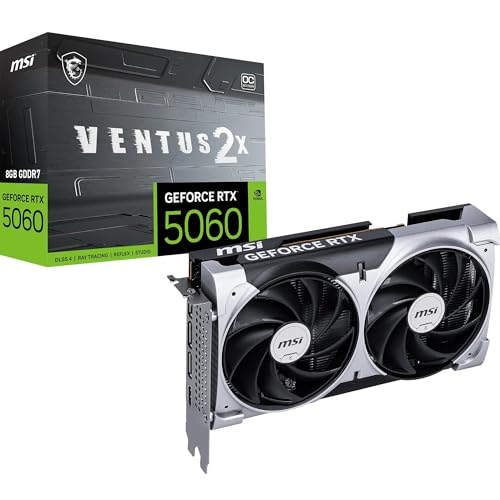
MSI GeForce RTX 5060 Ventus 2X OC
Best for: 1080p gaming on PCIe 5.0 systems
- Interface
- PCIe 5.0 (what this guide is about)
- Graphics Processor
- GeForce RTX 5060
- Memory Size
- 8 GB
- Memory Type
- GDDR7
- Memory Bus Width
- 128-bit
- PCIe Interface
- PCIe 5.0
View on Amazon: MSI GeForce RTX 5060 Ventus 2X OC Affiliate link
This MSI graphics card uses the GeForce RTX 5060 GPU with 8GB of GDDR7 memory on a 128-bit bus. It connects via a PCIe 5.0 x8 interface, offering high bandwidth for modern systems. The card features a 2-slot design measuring 7.76 inches long. It includes DisplayPort 2.1b and HDMI 2.1b outputs. You will find this card suitable for 1080p gaming with ray tracing and DLSS 4.0 support.
Pros
- PCIe 5.0 interface for high-speed data transfer
- 8GB GDDR7 memory with 28 Gbps speed
- DisplayPort 2.1b and HDMI 2.1b connectivity
- 2-slot width fits most standard cases
- Factory-overclocked for improved performance
Cons
- 128-bit memory bus limits high-resolution texture loading
- PCIe 5.0 x8 lane count may bottleneck in older PCIe 3.0 systems
- 145W power draw requires a 550W PSU
Good fit if
- You need a modern PCIe 5.0 compatible card
- You play games at 1080p resolution
- You want ray tracing and DLSS 4.0 support
Skip if
- You require a PCIe 3.0 interface
- You need more than 8GB of video memory
- You prefer a wider 256-bit memory bus
Verdict: MSI RTX 5060 VENTUS 2X OC is a compact, high-bandwidth option for 1080p gamers who need the latest PCIe 5.0 connectivity and GDDR7 speed. It suits users building new platforms who do not require high-end 1440p or 4K performance.

HP NVIDIA Quadro RTX 5000 16GB GDDR6
Best for: Professional workstations with PCIe 3.0 slots
- Interface
- PCIe 3.0 (what this guide is about)
- Graphics Processor
- Quadro RTX 5000
- Memory Size
- 16GB
- Memory Type
- GDDR6
- PCIe Interface
- PCIe 3.0
- Dimensions
- 16.3 × 10.7 × 0.96 inches
View on Amazon: HP NVIDIA Quadro RTX 5000 16GB GDDR6 Affiliate link
This HP graphics card uses the Quadro RTX 5000 GPU with 16GB of GDDR6 memory. It connects via a PCIe 3.0 x16 interface. The card measures 16.3 inches in length and 10.7 inches in width. It is designed for professional workstations running Windows 10. You should choose this if you need stable performance for CAD or rendering tasks that rely on older motherboard slots.
Pros
- 16GB GDDR6 memory for large datasets
- PCIe 3.0 interface for broad compatibility
- Quadro RTX 5000 GPU for professional workloads
- 16.3-inch length fits most standard cases
Cons
- PCIe 3.0 interface is slower than PCIe 5.0
- 16.3-inch length may not fit small cases
- Designed for Windows 10 only
Good fit if
- You use a motherboard with PCIe 3.0 slots
- You run professional CAD or rendering software
- You need 16GB of video memory
Skip if
- You want the latest PCIe 5.0 speeds
- You have a small form factor PC
- You primarily play modern games
Verdict: HP Quadro RTX 5000 PCIe 3.0 16GB suits professionals who need reliable compute power on older systems. It is not ideal for gamers seeking maximum bandwidth.
Specifications side by side
| Spec | MSI GeForce RTX 5060 Ventus 2X OC | HP NVIDIA Quadro RTX 5000 16GB GDDR6 |
|---|---|---|
| Graphics Processor | GeForce RTX 5060 | Quadro RTX 5000 |
| Memory Size | 8 GB | 16GB |
| Memory Type | GDDR7 | GDDR6 |
| Memory Bus Width | 128-bit | not stated |
| PCIe Interface | PCIe 5.0 | PCIe 3.0 |
| Recommended PSU | 550W | not stated |
| Slot Width | 2-slot | not stated |
| Memory | 8GB | 16GB |
| Interface | PCIe 5.0 | PCIe 3.0 |
| Length | 7.76 inches | not stated |
| Width | 4.72 inches | not stated |
| Weight | 1.13 pounds | not stated |
| Dimensions | not stated | 16.3 × 10.7 × 0.96 inches |
| Color | Multicolour | not stated |
| Model | V537-002R | 5JH81AT |
Frequently asked questions
Can I use a PCIe 5.0 graphics card in a PCIe 3.0 slot?
Yes, you can use a PCIe 5.0 graphics card in a PCIe 3.0 slot. The interface is backward compatible, so the MSI GeForce RTX 5060 Ventus 2X OC will work in older systems. However, you will not benefit from the higher bandwidth of PCIe 5.0. The card will operate at the lower speed of the PCIe 3.0 standard.
Is PCIe 5.0 necessary for 1080p gaming?
For 1080p gaming, PCIe 5.0 is not strictly necessary but offers future-proofing. The MSI GeForce RTX 5060 Ventus 2X OC is designed for this resolution and includes GDDR7 memory. This combination provides high bandwidth for modern tasks. If you are building a new system, the newer interface ensures you are ready for upcoming software demands.
What is the main difference between PCIe 3.0 and 5.0 for graphics cards?
The main difference is the data transfer bandwidth. PCIe 5.0 doubles the bandwidth of PCIe 3.0. The MSI RTX 5060 uses PCIe 5.0 for faster data movement, while the HP Quadro RTX 5000 uses PCIe 3.0. Higher bandwidth helps when moving large amounts of texture data or running compute-heavy professional applications efficiently.
Does the HP Quadro RTX 5000 support PCIe 5.0?
No, the HP Quadro RTX 5000 does not support PCIe 5.0. It uses the PCIe 3.0 interface. This card is intended for professional workstations that may rely on older motherboard standards. It provides 16GB of GDDR6 memory for stable performance in professional tasks, but it lacks the latest connectivity standard found in newer consumer cards.
Which card is better for a new build in 2024?
The MSI GeForce RTX 5060 Ventus 2X OC is better for a new build. It features the latest PCIe 5.0 interface and GDDR7 memory. This setup maximizes bandwidth for modern gaming at 1080p. The HP Quadro RTX 5000 is limited to PCIe 3.0 and is aimed at professional users rather than general gamers seeking the newest technology.
Will I see a performance difference between PCIe 3.0 and 5.0?
You may not see a huge difference in current games, but PCIe 5.0 offers higher potential bandwidth. The MSI RTX 5060 leverages this for GDDR7 speeds. The HP Quadro RTX 5000 is sufficient for professional work but lacks the high-speed interface. The difference becomes more relevant as software and games demand more data throughput over time.