Msi vs PowerColor: Graphics Cards Compared by Specs
As an Amazon Associate we earn from qualifying purchases. Links on this page are affiliate links.
This msi vs PowerColor graphics card comparison looks at two distinct options. Both cards target gaming performance, but they use different architectures. The MSI model features a newer NVIDIA GPU with more video memory. The PowerColor unit relies on an older AMD design with less capacity. You need to weigh the benefits of modern features against raw memory size. This guide breaks down the key specifications to help you decide which hardware fits your system best.
Key differences
| Aspect | MSI GeForce RTX 3060 Ventus 12GB | PowerColor Radeon RX 5700 XT 8GB |
|---|---|---|
| GPU | GeForce RTX 3060 | AMD Radeon RX 5700 XT |
| Memory Size | 12GB | 8GB |
| Memory Type | GDDR6 | not listed |
| Interface | PCIe 4 | not listed |
| Boost Clock | 1807MHz | not listed |
| Length | 9.25 inches | 11.8 inches |
Which one should you choose?
Choose MSI GeForce RTX 3060 Ventus 12GB if
- You want more video memory for high-resolution textures.
- You need a card that fits in smaller cases.
- You prefer NVIDIA features like DLSS and Ray Tracing support.
Choose PowerColor Radeon RX 5700 XT 8GB if
- You already own an AMD-centric ecosystem.
- You have a large case that accommodates longer cards.
- You are looking for a renewed option at a lower entry point.
Verdict: The MSI card offers more memory and modern connectivity, making it the better choice for future-proofing. The PowerColor unit is physically larger and uses an older generation architecture. Choose the MSI model if you prioritize memory capacity and interface speed.
MSI vs PowerColor GPU Specs
Graphics Processor
The MSI GeForce RTX 3060 Ventus uses NVIDIA’s Ampere architecture. This is a newer design focused on modern gaming features. The PowerColor Red Devil relies on the AMD Radeon RX 5700 XT. This is an older generation GPU. The RTX 3060 generally offers better ray tracing support. The RX 5700 XT is a capable card but lacks the latest hardware acceleration. You get a more recent chip with the MSI model. This matters if you want access to newer rendering technologies. The PowerColor unit is still functional but sits on a previous platform.
Memory Size
Video memory capacity is a key factor for high-resolution textures. The MSI card comes with 12GB of GDDR6 memory. This provides a larger buffer for modern games. The PowerColor card has 8GB of video memory. This is a smaller amount. If you play at 1440p or 4K, the extra 4GB on the MSI unit helps avoid stuttering. The 8GB on the PowerColor model may fill up faster in demanding titles. More memory allows for higher texture settings. The MSI model holds a clear advantage here due to its larger capacity.
Memory Type
Both cards use GDDR6 memory technology. This is the standard for modern graphics cards. It offers high bandwidth for data transfer. The MSI RTX 3060 lists a memory speed of 15 Gbps. The PowerColor RX 5700 XT also uses GDDR6. While the type is the same, the speed differs. The MSI card’s 15 Gbps rate supports its higher bandwidth needs. The PowerColor card’s memory speed is not explicitly listed in the provided data. However, both utilize the same modern memory architecture. This round is a tie in terms of technology generation, though the MSI has higher rated speeds.
Interface
The connection to your motherboard matters for data throughput. The MSI GeForce RTX 3060 supports PCIe 4.0. This allows for faster data transfer rates compared to older standards. The PowerColor Radeon RX 5700 XT does not have its interface version listed in the provided specifications. Historically, this card launched on PCIe 3.0. If the PowerColor unit is indeed PCIe 3.0, it has lower bandwidth potential. The MSI card’s PCIe 4.0 support ensures it can utilize modern bus speeds. This gives the MSI model a technical edge for future-proofing and data handling.
Physical Length
Case compatibility is crucial for installation. The MSI RTX 3060 Ventus is 9.25 inches long. This is a relatively compact size for a dual-fan card. The PowerColor Red Devil is 11.8 inches long. This is a significantly larger card. You must check your PC case clearance before buying the PowerColor unit. The MSI model fits into more standard mid-tower cases. The PowerColor card requires a larger chassis or more open space. If you have a smaller build, the MSI dimensions are much more practical.
Which card fits your needs
Gamers wanting modern features and more memory
The MSI RTX 3060 offers 12GB of GDDR6 memory, which helps with high-resolution textures. It uses the newer Ampere architecture and supports PCIe 4.0. The boost clock reaches 1807MHz. This card includes HDMI 2.1 for 4K display support. You get a quieter experience with Zero Frozr technology when idle.
Users on a tight budget for AMD hardware
The PowerColor RX 5700 XT provides an 8GB GDDR6 buffer. It uses the older AMD Radeon architecture. This unit is a renewed product, which often indicates a lower entry point. The physical dimensions are larger, measuring 11.8 inches in length. You should verify case compatibility before purchasing this specific model.
People prioritizing thermal efficiency and silence
MSI includes TORX 3.0 fans designed for high static pressure. The Zero Frozr feature keeps the fans stopped during low load. This reduces noise significantly. The card weighs 12 ounces and fits in most standard cases. The 192-bit memory bus balances bandwidth and power consumption for steady gaming performance.
The products compared

MSI GeForce RTX 3060 Ventus 12GB
Best for: 12GB VRAM and silent cooling needs
- Graphics Processor
- GeForce RTX 3060
- Memory Size
- 12GB
- Memory Type
- GDDR6
- Boost Clock
- 1807MHz
- Memory Bus Width
- 192-Bit
- PCIe Interface
- PCIe 4
View on Amazon: MSI GeForce RTX 3060 Ventus 12GB Affiliate link
The MSI GeForce RTX 3060 features a 12GB GDDR6 memory buffer and a 192-bit bus. Its boost clock reaches 1807MHz for stable frame rates. The card supports PCIe 4.0 and 4K@120Hz output via HDMI 2.1. You get efficient cooling with TORX 3.0 fans and Zero Frozr technology. This setup suits gamers who need ample video memory for modern titles and high-resolution displays.
Pros
- 12GB GDDR6 memory capacity
- 1807MHz boost clock speed
- TORX 3.0 fan design
- Zero Frozr silent operation
Cons
- 192-bit memory bus width limits bandwidth compared to higher-end models
- 9.25-inch length requires adequate case space
- No display port specifications for DVI or VGA included
Good fit if
- You need 12GB of VRAM for texture-heavy games
- You want silent operation during light loads
- You use a 4K monitor at 120Hz
Skip if
- You require a wider memory bus for maximum bandwidth
- You have a small form factor case with limited length
- You need native DVI connectivity
Verdict: MSI RTX 3060 12GB Gaming delivers solid 12GB VRAM and efficient cooling for 1440p and 4K gaming. It fits users prioritizing memory capacity and thermal silence over raw bus width.
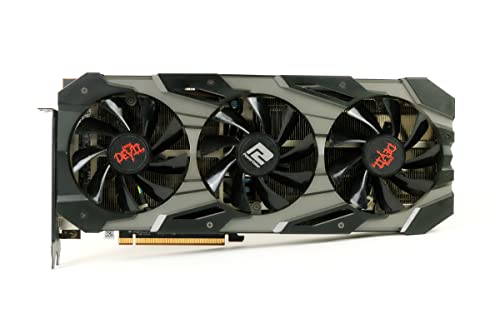
PowerColor Radeon RX 5700 XT 8GB
Best for: Budget 1440p gaming builds
- Graphics Processor
- AMD Radeon RX 5700 XT
- Memory Size
- 8GB
- Memory Type
- GDDR6
- Dimensions
- 11.8 × 5.2 × 2.09 inches
View on Amazon: PowerColor Radeon RX 5700 XT 8GB Affiliate link
This PowerColor card uses the AMD Radeon RX 5700 XT GPU with 8GB of memory. It measures 11.8 inches long, 5.2 inches wide, and 2.09 inches high. The package weighs about 4.03 pounds. You get a 192-bit memory interface and 15 Gbps speed. This setup suits users who want solid 1440p performance without needing the latest generation hardware.
Pros
- 8GB GDDR6 memory capacity
- AMD Radeon RX 5700 XT graphics processor
- 192-bit memory interface width
- 15 Gbps memory speed
Cons
- Renewed condition status
- Older generation GPU architecture
- 11.8-inch length requires spacious cases
Good fit if
- You need 8GB of VRAM for 1440p gaming
- You have a large PC case that fits long cards
- You want a cost-effective high-end option
Skip if
- You require the latest generation graphics performance
- You need new item warranty coverage
- Your case cannot accommodate cards over 11 inches
Verdict: PowerColor Red Devil RX 5700 XT 8GB delivers reliable 1440p performance for budget-conscious builders. It fits users prioritizing value and raw specs over new condition status.
Specifications side by side
| Spec | MSI GeForce RTX 3060 Ventus 12GB | PowerColor Radeon RX 5700 XT 8GB |
|---|---|---|
| Graphics Processor | GeForce RTX 3060 | AMD Radeon RX 5700 XT |
| Memory Size | 12GB | 8GB |
| Memory Type | GDDR6 | GDDR6 |
| Boost Clock | 1807MHz | not stated |
| Memory Bus Width | 192-Bit | not stated |
| PCIe Interface | PCIe 4 | not stated |
| Memory | 12GB | 8GB |
| GPU | GeForce RTX 3060 | not stated |
| Interface | PCIe 4.0 | not stated |
| Use | Gaming | not stated |
| Length | 9.25 inches | not stated |
| Width | 4.88 inches | not stated |
| Weight | 12 ounces | not stated |
| Dimensions | not stated | 11.8 × 5.2 × 2.09 inches |
| Size | RTX | not stated |
| Model | MSI GeForce RTX 3060 VENTUS 2X 12G OC | not stated |
Frequently asked questions
Which card has more video memory, MSI or PowerColor?
The MSI GeForce RTX 3060 Ventus 12GB has more video memory. It includes 12GB of VRAM, which helps with high-resolution textures and 1440p gaming. The PowerColor Radeon RX 5700 XT 8GB offers 8GB of memory. This difference makes the MSI model better for users prioritizing memory capacity over raw bus width.
Does the MSI RTX 3060 support PCIe 4.0?
Yes, the MSI GeForce RTX 3060 Ventus 12GB supports PCIe 4.0. This interface allows for faster data transfer between the GPU and the motherboard. The PowerColor Radeon RX 5700 XT 8GB does not list PCIe 4.0 support in its specifications. This makes the MSI card a better fit for modern systems.
Which graphics card is better for silent cooling?
The MSI GeForce RTX 3060 Ventus 12GB is designed for silent cooling needs. It uses efficient cooling technology to maintain lower noise levels during operation. The PowerColor Radeon RX 5700 XT 8GB focuses on budget performance rather than thermal silence. If quiet operation is a priority, the MSI model is the superior choice.
What is the size difference between these two cards?
The MSI GeForce RTX 3060 Ventus 12GB is 9.25 inches long and 4.88 inches wide. The PowerColor Radeon RX 5700 XT 8GB is longer at 11.8 inches and wider at 5.2 inches. You should check your case compatibility before purchasing. The PowerColor unit requires more space inside your computer chassis.
Which card is better for budget 1440p gaming?
The PowerColor Radeon RX 5700 XT 8GB is best for budget 1440p gaming builds. It delivers reliable performance for users prioritizing value. The MSI GeForce RTX 3060 Ventus 12GB offers more memory and modern features but may cost more. Choose the PowerColor card if you need a cost-effective solution for 1440p titles.
Does the PowerColor card use an older GPU architecture?
Yes, the PowerColor Radeon RX 5700 XT 8GB uses an older AMD Radeon design. It relies on previous generation technology compared to newer releases. The MSI GeForce RTX 3060 Ventus 12GB features NVIDIA’s newer Ampere architecture. This provides access to modern gaming features and improved efficiency for contemporary applications.