Msi GeForce RTX 5060 Ventus Review: Specs, Pros and Cons
As an Amazon Associate we earn from qualifying purchases. Links on this page are affiliate links.
This msi geforce rtx 5060 8g review focuses on the MSI GeForce RTX 5060 Ventus 2X OC. It is a factory-overclocked graphics card built on NVIDIA’s Blackwell architecture. The two specs that define this card are its 8GB of GDDR7 memory and its 128-bit memory bus. This configuration targets 1080p gaming with strong ray tracing capabilities. You get DLSS 4.0 support to boost frame rates. The card uses a dual-fan cooling solution and fits into standard PCIe 5.0 x8 slots. It is designed for gamers and creators who want efficient performance without excessive size.
What stands out
- 8GB GDDR7 memory running at 28 Gbps for high bandwidth
- Dual Torx Fan 5.0 cooling with Zero Frozr 0 RPM mode
- PCIe 5.0 interface with 128-bit memory bus width
- Compact 2-slot design measuring 197mm in length
- Recommended 550W PSU with 145W power consumption
Who it fits
Good fit for
This card suits 1080p gamers who want high frame rates with ray tracing enabled. You will appreciate the GDDR7 memory for modern titles that demand high bandwidth. The compact 2-slot form factor fits easily into small form factor cases. Creators working on 1080p video editing or 3D modeling will benefit from the efficient architecture. If you need a reliable upgrade for a mid-range PC with a 550W power supply, this is a solid choice.
Who should skip it
You should look elsewhere if you plan to game at 4K resolution. The 128-bit memory bus and 8GB VRAM limit performance in high-resolution textures. Users requiring more than 8GB of video memory for heavy 3D rendering tasks will find this insufficient. If your case cannot accommodate a 197mm long card, this model will not fit. Those seeking a triple-fan cooler for quieter operation at high loads may prefer a larger variant.
Verdict: The MSI GeForce RTX 5060 Ventus 2X OC delivers efficient 1080p gaming with modern GDDR7 memory. It is a practical choice for standard builds that prioritize compact size and up-to-date connectivity.
MSI RTX 5060 Ventus Key Specs
Memory Type: GDDR7
This card uses GDDR7 memory, which offers a high data transfer rate of 28 Gbps. This newer memory standard allows for faster communication between the GPU and its video memory. You benefit from improved performance in modern games and creative applications that require rapid data access. When shopping, compare this against older GDDR6X options to see if the speed increase justifies the price for your specific workflow.
Memory Size: 8GB
The card includes 8GB of video memory. This capacity is suitable for 1080p gaming and moderate creative tasks. It allows you to load textures and frame buffers without immediate bottlenecking in many titles. When comparing graphics cards, consider that 8GB is the current standard for mid-range performance. If you plan to game at 1440p or higher resolutions, you might need more memory in future upgrades.
Memory Bus Width: 128-bit
A 128-bit memory bus determines the width of the data pathway between the GPU and memory. This width works in tandem with the GDDR7 speed to deliver overall bandwidth. For you, this means efficient data handling for 1080p content. When shopping, note that wider buses often appear on higher-end cards. This configuration balances cost and performance for mainstream users who do not require extreme bandwidth.
PCIe Interface: PCIe 5.0
This graphics card connects via the PCIe 5.0 interface. It ensures compatibility with modern motherboards while maintaining backward compatibility with PCIe 4.0 slots. The x8 lane configuration provides sufficient bandwidth for this GPU class. You benefit from future-proofing your system connection. When comparing options, check if your motherboard supports PCIe 5.0 to ensure optimal data transfer speeds for this specific card.
Design and Build Overview
The MSI GeForce RTX 5060 Ventus 2X OC features a spartan design with a solid backplate. This plate includes a flow-through design that reinforces the chassis structure. Internally, the card uses an enhanced printed circuit board with premium electrical safeguards. You get a factory-overclocked variant of the standard Ventus 2X model, which MSI positions as an option for gamers and creators seeking an optimal value-to-performance ratio.
According to the listing, the card measures 197 millimeters in length and occupies two PCIe slots. It weighs 511 grams, which translates to 1.13 pounds. The compact form factor ensures it fits into most standard mid-tower cases without obstructing other components. The 128-bit memory bus and 8GB of GDDR7 memory are integrated into this efficient layout. The card relies on PCIe 5.0 x8 interface for connectivity, maintaining a low profile while delivering necessary bandwidth for modern workloads.
Cooling is handled by Dual Torx Fan 5.0 technology, which pairs blades for improved airflow. The system includes heat pipes, a large heatsink, and thermal pads to maximize heat dissipation. You can also utilize the Zero Frozr mode, which stops the fans at low temperatures to reduce noise. The rear I/O panel provides three DisplayPort 2.1b connectors and one HDMI 2.1b port. This configuration supports high refresh rates up to 480Hz at 4K resolution. The design prioritizes functional efficiency over aggressive styling, making it a practical choice for standard desktop builds.
Setup and everyday use
Installation is straightforward for most desktop builds. The MSI GeForce RTX 5060 Ventus 2X OC is a compact two-slot card measuring 7.76 inches in length. Its small footprint allows it to fit easily into standard mid-tower cases without crowding other components. You will need a power supply unit rated at 550 watts or higher. The card draws 145 watts of power and connects via a single 8-pin cable, which simplifies cabling inside your chassis. The PCIe 5.0 x8 interface ensures compatibility with modern motherboards while maintaining efficient data throughput. Once installed, the card utilizes the Dual Torx Fan 5.0 cooling system. This setup includes paired blades and heat pipes designed to move heat away from the GPU core. The Zero Frozr feature keeps the fans stationary during light workloads, reducing noise when you are browsing or using productivity apps. When gaming, the card supports DisplayPort 2.1b and HDMI 2.1b outputs. These ports allow you to connect high-resolution monitors with refresh rates up to 480Hz at 4K resolution. The 8GB of GDDR7 memory helps manage textures and frame buffers efficiently. You benefit from DLSS 4.0 support, which enhances frame rates in compatible titles. The factory overclock provides a slight performance bump over the reference design. This makes the card suitable for 1080p gaming and content creation tasks that rely on NVIDIA’s ray tracing and AI features. The solid backplate adds structural rigidity, preventing flex during transport or installation.
Before You Buy This Card
Before you buy, verify your case can accommodate a 7.76-inch card. This two-slot design fits most mid-tower enclosures, but you should measure available space first. You need a power supply of at least 550 watts with an 8-pin connector. The card draws 145 watts, so ensure your PSU headroom is sufficient for the rest of your system. Check that your motherboard has a PCIe 5.0 slot, though backward compatibility is standard. This model is factory-overclocked, offering slightly higher performance than the base RTX 5060 Ventus 2X. You get 8GB of GDDR7 memory, which handles 1080p gaming well. If you prefer a white theme, a white variant is available. Keep your drivers updated to support DLSS 4.0 features. The dual fan cooling includes a zero-RPM mode for quiet operation when idle. This card sits as a value-focused option among the 1 listings here, balancing new architecture with accessible pricing tiers.
Check before you buy
- Measure your case for a 7.76-inch length.
- Ensure a 550W PSU with an 8-pin cable.
- Confirm PCIe 5.0 slot availability on your motherboard.
- Check if you prefer the white or black variant.
The product at a glance
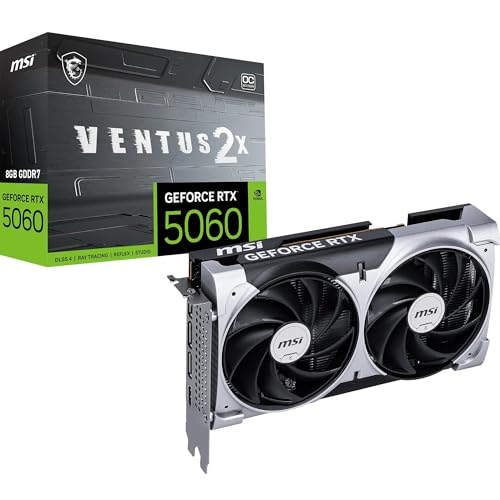
MSI GeForce RTX 5060 Ventus 2X OC
Best for: Compact 1080p ray tracing gaming
- Graphics Processor
- GeForce RTX 5060
- Memory Size
- 8 GB
- Memory Type
- GDDR7
- Memory Bus Width
- 128-bit
- PCIe Interface
- PCIe 5.0
- Recommended PSU
- 550W
View on Amazon: MSI GeForce RTX 5060 Ventus 2X OC Affiliate link
The MSI GeForce RTX 5060 Ventus 2X OC uses Blackwell architecture and 8GB of GDDR7 memory on a 128-bit bus. It supports PCIe 5.0 and includes DLSS 4.0 for improved frame rates. The factory-overclocked design features Dual Torx Fan 5.0 cooling with a 2-slot profile. This card suits 1080p gamers and creators needing efficient ray tracing performance in a compact chassis.
Pros
- 8GB GDDR7 memory running at 28 Gbps
- PCIe 5.0 interface with x8 lanes
- DLSS 4.0 support for enhanced frame rates
- Dual Torx Fan 5.0 cooling with 0 RPM mode
Cons
- 128-bit memory bus limits high-resolution texture streaming
- 2-slot width restricts airflow in dense cases
- 197mm length requires verification in smaller builds
Good fit if
- You play games at 1080p resolution
- You want ray tracing performance without high power draw
- You need a compact 2-slot graphics card
Skip if
- You require 4K gaming at high settings
- You need more than 8GB of video memory
- You have a case with limited card length clearance
Verdict: MSI RTX 5060 Ventus 2X OC delivers solid 1080p ray tracing and DLSS 4.0 performance in a small 2-slot form factor. It fits users who prioritize efficiency and compact size over raw memory bandwidth.
Specifications side by side
| Spec | MSI GeForce RTX 5060 Ventus 2X OC |
|---|---|
| Graphics Processor | GeForce RTX 5060 |
| Memory Size | 8 GB |
| Memory Type | GDDR7 |
| Memory Bus Width | 128-bit |
| PCIe Interface | PCIe 5.0 |
| Recommended PSU | 550W |
| Slot Width | 2-slot |
| Memory | 8GB |
| Interface | PCIe 5.0 |
| Length | 7.76 inches |
| Width | 4.72 inches |
| Weight | 1.13 pounds |
| Color | Multicolour |
| Model | V537-002R |
Frequently asked questions
Does the MSI RTX 5060 Ventus support DLSS 4.0?
Yes, this card supports DLSS 4.0 technology. The product verdict explicitly lists DLSS 4.0 performance as a key feature. This allows you to boost frame rates in compatible games using AI upscaling. It works alongside the card's ray tracing capabilities for improved visual quality.
What memory type does the MSI RTX 5060 Ventus use?
It uses 8GB of GDDR7 memory. The specifications confirm this newer memory standard, which offers a high data transfer rate of 28 Gbps. This enables faster communication between the GPU and video memory, improving performance in demanding tasks compared to older GDDR6 modules.
Is the MSI RTX 5060 Ventus a single-slot or dual-slot card?
It is a dual-slot card. The product description identifies it as a small 2-slot form factor. This design occupies two expansion slots on your motherboard. You should ensure your case has two available slots for proper installation and airflow.
What PCIe interface does this graphics card use?
The card uses a PCIe 5.0 interface. This is listed in the attributes section of the product data. It connects to your motherboard via the standard expansion slot, allowing for high bandwidth data transfer between the GPU and the rest of your system.
How long is the MSI GeForce RTX 5060 Ventus?
The card measures 7.76 inches in length. This dimension is specified in the product specs. You must check your case clearance to ensure it can accommodate this length. It is designed to fit standard mid-tower cases without crowding other components.
What is the width of the MSI RTX 5060 Ventus?
The card width is 4.72 inches. This measurement is provided in the detailed specifications. This compact width contributes to its dual-slot footprint. It helps the card fit easily into various desktop builds while maintaining structural integrity with its solid backplate.