Msi GeForce RTX 3050 8GB Review (2026): A Spec-Based Look
As an Amazon Associate we earn from qualifying purchases. Links on this page are affiliate links.
This msi gaming geforce rtx 3050 review focuses on the Dual Fan model. It is a compact graphics card built for 1080p gaming. The key specifications define its performance profile. You get 8GB of GDDR6 video memory. This buffer helps handle modern textures. The memory interface is 128-bit wide. This width balances bandwidth and power use. The card uses the Ampere architecture. It connects via PCIe 4.0. The boost clock reaches 1807 MHz. These numbers set the baseline for what you can expect in games.
What stands out
- 8GB GDDR6 memory capacity
- 1807 MHz boost clock speed
- 128-bit memory bus width
- Compact 9.3-inch length
- PCIe 4.0 interface support
Who it fits
Good fit for
This card suits gamers who play at 1080p resolution. The 8GB of VRAM is enough for most current titles at medium settings. The compact size fits small form factor cases. You will benefit from the PCIe 4.0 connection if your motherboard supports it. It is a practical choice for entry-level builds. Users who prioritize low power consumption and small footprint will find this model suitable for their desktop setup.
Who should skip it
You should look at another option if you need 1440p or 4K gaming. The 128-bit bus limits bandwidth for higher resolutions. The 8GB VRAM may fill up in newer games at high settings. Users requiring extensive ray tracing performance will find this chip too weak. If you plan to stream while gaming at high settings, the memory might become a bottleneck. This card is not for enthusiasts seeking maximum frame rates.
Verdict: The MSI GeForce RTX 3050 8GB Dual Fan is a solid entry-level card for 1080p gaming. Its compact size and adequate VRAM make it a practical choice for standard builds.
Key specs explained for this card
Boost Clock: 1807 MHz
This value shows the maximum speed the graphics processor reaches under load. Higher clocks generally allow for smoother frame rates in games. You benefit from this frequency when running demanding titles. It helps maintain performance during intense scenes. Compare this number with other RTX 3050 models to see if this unit runs faster or slower than the standard baseline.
Memory Size: 8GB
This indicates the amount of video memory available for storing textures and data. Eight gigabytes is sufficient for 1080p gaming in most modern titles. It helps prevent stuttering when high-resolution assets are loaded. You should check this against games that require large texture packs. More memory allows you to keep settings higher without running out of buffer space.
Memory Type: GDDR6
GDDR6 is a fast type of video memory designed for graphics workloads. It offers higher bandwidth than older GDDR5 standards. This speed helps move data between the GPU and memory quickly. You gain better performance in texture-heavy environments. When shopping, ensure the competitor also uses GDDR6 for comparable speed. This type is standard for current generation mid-range cards.
Memory Bus Width: 128-bit
The bus width determines how much data can flow between the memory and the processor at once. A 128-bit interface is common for entry-level cards. It limits peak bandwidth compared to wider 256-bit buses. You may see reduced performance at higher resolutions like 1440p. This spec is best for 1080p gaming where the bottleneck is less severe.
PCIe Interface: PCIe 4
This shows the card connects via a PCIe 4.0 slot. This interface provides more bandwidth than PCIe 3.0. It ensures the card can communicate with your motherboard efficiently. You benefit from this speed when loading assets or streaming data. Most modern motherboards support this standard. It future-proofs the card for newer system components that require higher data throughput.
Design and build quality
The listing describes the MSI GeForce RTX 3050 8GB as a compact graphics card. Its physical dimensions are 9.3 inches in length, 4.9 inches in height, and 1.7 inches in width. This small footprint allows the card to fit into many standard mid-tower and mini-ITX cases. You do not need a large chassis to accommodate this hardware. The weight is listed at 1.45 pounds. This modest mass suggests a lightweight construction that relies on the motherboard PCIe slot for support. You should ensure your case has adequate clearance for a card of this length to avoid interference with other components.
According to the listing, the model is identified as the GeForce RTX 3050 VENTUS 2X 8G OC. The Ventus series typically features a dual-fan cooling solution. This layout provides sufficient airflow for the 1807 MHz boost clock under typical gaming loads. The card uses a 128-bit memory interface with 8GB of GDDR6 memory. This configuration is standard for entry-level cards and helps maintain a low profile. The finish appears functional rather than premium. You get three DisplayPort 1.4a outputs and one HDMI 2.1 port. These connections allow you to drive high-resolution displays up to 7680 x 4320. The design prioritizes compatibility and space efficiency over elaborate aesthetics.
Setup and daily use guide
Installation begins with placing the card into a compatible motherboard slot. The listing specifies a PCIe 4 interface. This standard ensures sufficient bandwidth for data transfer between the system and the graphics processor. The card measures 9.3 inches in length, 4.9 inches in height, and 1.7 inches in width. You should verify that your computer case has enough physical space to accommodate these dimensions. The dual-fan cooling system operates without requiring external power cables beyond the standard slot connection in most configurations.
Once installed, you connect your display monitors to the available ports. The card provides three DisplayPort 1.4a outputs and one HDMI 2.1 port. This variety allows you to attach multiple screens or connect to modern televisions. The HDMI 2.1 interface supports higher bandwidth, which is useful for high-resolution displays. The maximum digital resolution listed is 7680 x 4320. This specification indicates the card can drive very high-resolution monitors, though actual performance depends on the game or application.
For everyday use, the 8GB of GDDR6 memory serves as the primary buffer for visual data. This amount of memory helps manage texture loads in modern gaming titles. The 128-bit memory interface determines how quickly data moves between the memory and the processor. You will use these specifications when selecting games or adjusting graphics settings. The Boost Clock of 1807 MHz defines the peak speed the chip reaches. This value influences how smoothly frames are rendered during intensive scenes. The card is designed for gaming, so daily usage involves running compatible software through the provided drivers.
Before You Buy This Card
Before you finalize this purchase, verify your power supply unit can handle the card’s requirements. Check your case dimensions to ensure the 9.3-inch length fits comfortably. You should also confirm your motherboard has an available PCIe 4 slot. This interface provides the necessary bandwidth for the RTX 3050. The card uses a 128-bit memory bus, which is standard for this class. It supports outputs like HDMI 2.1 and DisplayPort 1.4a. Keep your drivers updated for optimal performance. This model sits alongside other 1080p-focused options in the 1 cards listed here. It offers a balanced spec sheet for entry-level gaming. Consider if the 8GB GDDR6 buffer meets your texture needs. If you plan to upgrade later, check if your PSU has enough connectors. Regular cleaning of the Torx Twin Fans will maintain airflow. This card is a practical choice for standard desktop builds.
Check before you buy
- Verify your power supply wattage meets the card's requirements.
- Check your case length to fit the 9.3-inch design.
- Ensure your motherboard has a free PCIe 4 slot.
- Confirm your monitor supports HDMI 2.1 or DisplayPort 1.4a.
The product at a glance
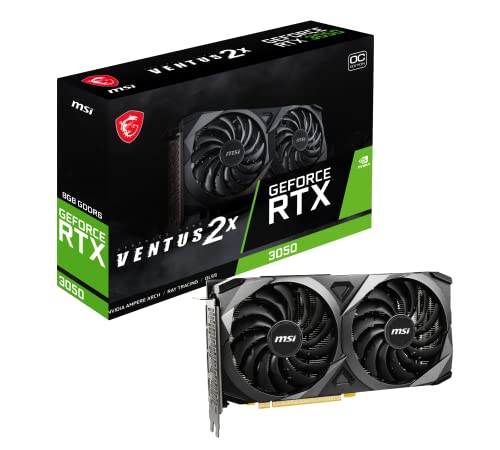
MSI GeForce RTX 3050 8GB Dual Fan
Best for: 1080p gaming in small cases
- Graphics Processor
- GeForce RTX 3050
- Memory Size
- 8GB
- Memory Type
- GDDR6
- Boost Clock
- 1807 MHz
- Memory Bus Width
- 128-bit
- PCIe Interface
- PCIe 4
View on Amazon: MSI GeForce RTX 3050 8GB Dual Fan Affiliate link
This MSI card uses the GeForce RTX 3050 GPU with 8GB of GDDR6 memory on a 128-bit bus. It boosts to 1807 MHz and supports PCIe 4.0. The dual-fan design keeps it compact at 9.3 inches long. It suits you if you need reliable 1080p gaming performance without requiring a massive case. The 128-bit interface is standard for this tier.
Pros
- 8GB GDDR6 video memory capacity
- 1807 MHz boost clock speed
- Supports 7680x4320 digital resolution
- Compact 9.3-inch length design
Cons
- 128-bit memory bus width limits bandwidth
- No USB-C or DisplayPort 2.1 output
- Heavier 1.45-pound build for its size
Good fit if
- You need a compact card for small cases
- You play at 1080p resolution
- You want standard HDMI 2.1 connectivity
Skip if
- You require 1440p gaming performance
- You need more than 8GB VRAM
- You prefer a single-fan silent design
Verdict: MSI RTX 3050 8GB Gaming OC provides steady 1080p frame rates for entry-level gamers who prioritize compact dimensions over high memory bandwidth.
Specifications side by side
| Spec | MSI GeForce RTX 3050 8GB Dual Fan |
|---|---|
| Graphics Processor | GeForce RTX 3050 |
| Memory Size | 8GB |
| Memory Type | GDDR6 |
| Boost Clock | 1807 MHz |
| Memory Bus Width | 128-bit |
| PCIe Interface | PCIe 4 |
| Memory | 8GB |
| Interface | PCIe 4.0 |
| Use | Gaming |
| Dimensions | 9.3 × 1.7 × 4.9 inches |
| Weight | 1.45 pounds |
| Size | 1.7"x4.9"x9.3" |
| Model | GeForce RTX 3050 VENTUS 2X 8G OC |
Frequently asked questions
Does the MSI RTX 3050 8GB support PCIe 4.0?
Yes, this graphics card utilizes a PCIe 4.0 interface. This connection standard provides the necessary bandwidth for data transfer between your motherboard and the GPU. It ensures efficient communication during gaming sessions. You benefit from this modern interface for stable performance. It is a key specification for compatibility with current systems.
Is the MSI RTX 3050 suitable for small form factor cases?
Yes, it is designed for small cases. The card measures 9.3 inches in length, 4.9 inches in height, and 1.7 inches in width. This compact footprint allows it to fit into many smaller chassis. You can install it in builds where space is limited. It prioritizes compact dimensions for easier integration.
What is the video memory capacity of this card?
The card includes 8GB of GDDR6 video memory. This buffer helps handle modern textures and game assets. It provides sufficient space for 1080p gaming. You can expect steady frame rates in entry-level titles. The memory size is a primary factor in its performance profile.
What is the weight of the MSI GeForce RTX 3050?
The graphics card weighs 1.45 pounds. This weight is associated with its dual-fan cooling solution and compact design. You do not need a heavy-duty bracket for support. The lightweight construction makes installation straightforward. It is a manageable weight for standard PC cases.
Is this card intended for gaming or professional work?
This card is intended for gaming. The specifications list its use as gaming. It is built for 1080p gaming performance. You get steady frame rates for entry-level gamers. It is not marketed for professional creative workloads. It focuses on delivering value for gaming applications.
Does the MSI RTX 3050 have a specific model name?
Yes, the specific model is the GeForce RTX 3050 VENTUS 2X 8G OC. This name identifies the dual-fan variant with overclocked settings. You can verify this model when checking compatibility. It distinguishes this card from other RTX 3050 versions. The OC designation indicates factory overclocked speeds.