Maxsun or VisionTek? Graphics Cards Compared in 2026
As an Amazon Associate we earn from qualifying purchases. Links on this page are affiliate links.
Choosing between a maxsun vs VisionTek graphics card depends on your specific hardware needs. Both options offer compact designs suitable for small form factor builds. The main difference lies in performance and connectivity. Maxsun provides a low-profile NVIDIA solution with mixed output ports. VisionTek offers a single-slot AMD card with four DisplayPort outputs for multi-monitor setups.
Key differences
| Aspect | Maxsun GeForce GT 710 2GB Low Profile Card | VisionTek Radeon RX 550 4GB Quad DisplayPort |
|---|---|---|
| GPU | NVIDIA GeForce GT 710 | AMD Radeon RX 550 |
| Memory Size | 2GB | 4GB |
| Memory Type | Not listed | GDDR5 |
| Form Factor | Low Profile | Single Slot |
| Ports | HDMI, VGA, DVI-D | 4x DisplayPort |
| Power | Not listed | Bus-powered (50W) |
Which one should you choose?
Choose Maxsun GeForce GT 710 2GB Low Profile Card if
- You need a card that fits into very slim chassis with strict height limits.
- You require legacy connectivity options like VGA or DVI for older monitors.
- You are building a basic PC for light multimedia tasks and office work.
Choose VisionTek Radeon RX 550 4GB Quad DisplayPort if
- You plan to connect four monitors simultaneously for productivity or trading.
- You want more video memory to handle larger spreadsheets and data feeds.
- You prefer a card that draws power directly from the motherboard without extra cables.
Verdict: The Maxsun card is better for ultra-compact cases needing legacy ports. The VisionTek card suits users who need four displays and more memory for business tasks. Pick the one that matches your monitor count and case size.
Maxsun vs VisionTek GPU Specs
GPU Performance
VisionTek uses the AMD Radeon RX 550, which is a significantly more powerful chip than the Maxsun’s NVIDIA GeForce GT 710. The GT 710 is an entry-level card designed for basic display output and light multimedia tasks. The RX 550 offers much higher computational power, making it suitable for light gaming and faster video processing. If you need actual graphical performance beyond simple display extension, the VisionTek card is the clear choice. The Maxsun solution is limited to older architecture standards.
Memory Capacity
VisionTek provides 4GB of video memory, while Maxsun offers only 2GB. This difference matters when running multiple displays or handling larger textures. The 4GB buffer on the RX 550 allows for smoother operation in productivity applications like financial trading setups or digital signage. The 2GB on the GT 710 is sufficient for single high-resolution monitors but may struggle with multi-screen environments. More memory generally translates to better stability in demanding visual tasks.
Memory Type
VisionTek utilizes GDDR5 memory, which is faster and more efficient than the DDR3 typically found in the GT 710, though the exact type for Maxsun is not listed in the provided data. GDDR5 offers higher bandwidth, improving data transfer rates between the GPU and memory. This results in quicker rendering and smoother performance in applications that rely heavily on memory throughput. The Maxsun card’s memory speed is likely lower, affecting its ability to handle complex visual data efficiently.
Form Factor
Maxsun is explicitly designed as a low-profile card, measuring 2.72 inches in width and 0.91 inches in height. This makes it ideal for very tight Small Form Factor cases or ITX builds. VisionTek is a single-slot, full-height card. While it fits standard towers, it will not fit into low-profile chassis. If your computer case has strict height limitations, the Maxsun design is the only compatible option. Otherwise, both fit standard desktop enclosures.
Display Outputs
VisionTek features four DisplayPort outputs, enabling robust multi-monitor setups for productivity or digital signage. Maxsun provides a mixed interface with HDMI, VGA, and DVI-D ports. This variety is useful for connecting older monitors or projectors without adapters. However, VisionTek’s quad DisplayPort configuration supports four 4K displays simultaneously, offering greater scalability for professional environments. Maxsun’s outputs are limited to fewer screens and older connection standards.
Power Requirements
VisionTek is a bus-powered card requiring no external power cables, drawing all necessary energy from the motherboard slot. It recommends a 350W power supply for the system. Maxsun does not list specific power requirements in the provided data, but GT 710 cards typically also run without extra cables. The VisionTek card is noted for energy efficiency at 50W. This makes it a safe upgrade for office PCs without needing to modify existing power delivery systems.
Which graphics card suits your needs?
Users needing four 4K monitors for work
The VisionTek Radeon RX 550 supports four simultaneous 4K displays via DisplayPort. This quad-monitor capability is ideal for financial trading or digital signage. The 4GB GDDR5 memory ensures smooth performance with large spreadsheets and live data feeds across all screens without bottlenecking your workflow.
Owners of small ITX or SFF cases
The Maxsun GeForce GT 710 features a low-profile design measuring just 0.91 inches in height. It fits easily into slim or smaller computer cases. The passive cooling system keeps temperatures low and noise minimal. This compact form factor makes it a practical choice for DIY builds with limited space.
Budget upgraders wanting simple connectivity
This card includes HDMI, VGA, and DVI-D ports for versatile display connections. It supports DirectX 12 and OpenGL, handling basic multimedia tasks and light gaming. The NVIDIA GeForce GT 710 chipset provides a straightforward upgrade path for older systems needing reliable display output without complex power requirements.
The products compared
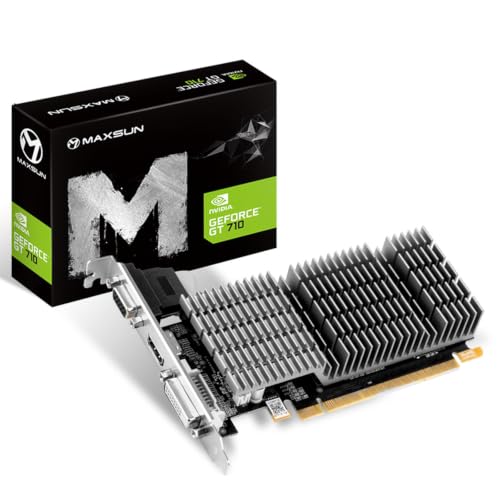
Maxsun GeForce GT 710 2GB Low Profile Card
Best for: Small form factor builds needing basic display output
- Graphics Processor
- GeForce GT 710
- Memory Size
- 2GB
- Form Factor
- Low Profile
- Dimensions
- 5.71 × 2.72 × 0.91 inches
- Weight
- 5.11 ounces
View on Amazon: Maxsun GeForce GT 710 2GB Low Profile Card Affiliate link
The Maxsun GT 710 is a low-profile graphics card designed for small form factor builds. It features 2GB of GDDR5 memory and an NVIDIA GeForce GT 710 chipset. The card includes passive cooling with a large heat sink to keep temperatures low. It supports DirectX 12 and offers HDMI, VGA, and DVI-D ports for multi-screen setups. This GPU suits users needing basic display output for compact systems.
Pros
- Low profile design fits ITX and SFF cases
- Passive 0dB cooling with large heat sink
- HDMI, VGA, and DVI-D output ports
- Supports DirectX 12 and PureVideo HD 4K decode
Cons
- Only 2GB of video memory limits modern gaming
- Passive cooling relies on case airflow
- GT 710 chipset is entry-level performance
Good fit if
- You need a low profile card for a small case
- You require basic display output for office tasks
- You want silent operation with passive cooling
Skip if
- You need high performance for modern gaming
- You require more than 2GB of VRAM
- You need active cooling for better thermal headroom
Verdict: Maxsun GT 710 2GB Low Profile is a suitable option for small form factor builds requiring basic display functionality. It fits users who prioritize compact size and silent operation over graphical performance.

VisionTek Radeon RX 550 4GB Quad DisplayPort
Best for: multi-monitor office productivity setups
- Graphics Processor
- AMD Radeon RX 550
- Memory Size
- 4GB
- Memory Type
- GDDR5
- Recommended PSU
- 350W
- Slot Width
- Single Slot
- Dimensions
- 6.9 × 9.4 × 2.3 inches
View on Amazon: VisionTek Radeon RX 550 4GB Quad DisplayPort Affiliate link
This VisionTek card uses the AMD Radeon RX 550 GPU with 4GB of GDDR5 memory. It supports four 4K displays via DisplayPort, making it useful for multi-screen office setups. The single-slot, bus-powered design draws 50W directly from the motherboard. You do not need extra power cables. It fits standard PC towers and leaves room for airflow. This is a practical option for productivity tasks.
Pros
- Supports four 4K displays simultaneously
- Single-slot width saves space
- Bus-powered with no extra cables
- 4GB GDDR5 memory for multitasking
Cons
- RX 550 is not for gaming
- Only includes DisplayPort outputs
- Low memory bandwidth for heavy loads
Good fit if
- You need four monitors for office work
- You have a small form factor PC
- You want a low power draw card
Skip if
- You want to play modern games
- You need HDMI or DVI ports
- You require high 3D performance
Verdict: VisionTek Radeon RX 550 4GB suits users who need multiple screens for productivity. It fits small cases and requires no extra power. It does not handle gaming well.
Specifications side by side
| Spec | Maxsun GeForce GT 710 2GB Low Profile Card | VisionTek Radeon RX 550 4GB Quad DisplayPort |
|---|---|---|
| Graphics Processor | GeForce GT 710 | AMD Radeon RX 550 |
| Memory Size | 2GB | 4GB |
| Memory Type | not stated | GDDR5 |
| Recommended PSU | not stated | 350W |
| Slot Width | not stated | Single Slot |
| Memory | not stated | 4GB |
| GPU | not stated | Radeon RX 550 |
| Form Factor | Low Profile | not stated |
| Dimensions | 5.71 × 2.72 × 0.91 inches | 6.9 × 9.4 × 2.3 inches |
| Weight | 5.11 ounces | 5.6 ounces |
| Size | 2GB | not stated |
| Model | GT 710 2GB | 901458 |
| Color | not stated | Black |
Frequently asked questions
Which card fits in a tiny PC case?
The Maxsun GeForce GT 710 is the better choice for tight spaces. It measures just 5.71 inches long and 0.91 inches high. This low-profile design allows it to slide into small form factor builds easily. The VisionTek RX 550 is significantly larger at 9.4 inches wide, making it unsuitable for compact chassis.
Does the VisionTek card need extra power cables?
No, the VisionTek Radeon RX 550 does not require extra power connectors. It draws sufficient power directly from the motherboard slot. This simplifies installation for users who want a plug-and-play solution without adding cables to their power supply unit.
How many monitors can the VisionTek card support?
The VisionTek Radeon RX 550 supports four simultaneous displays. It uses Quad DisplayPort outputs to connect multiple screens. This setup is ideal for office productivity or financial trading environments where you need extensive screen real estate for multitasking.
Is the Maxsun card good for gaming?
The Maxsun GeForce GT 710 is not designed for gaming. It is an entry-level card meant for basic display output and light multimedia tasks. If you need to play modern games, this card will not provide the necessary graphical performance for a smooth experience.
What memory does the VisionTek card have?
The VisionTek Radeon RX 550 comes with 4GB of GDDR5 memory. This memory type helps handle multiple monitors and productivity applications efficiently. The Maxsun GT 710 only has 2GB of memory, which limits its ability to run complex visual tasks.
Which card is lighter?
The Maxsun GeForce GT 710 is slightly lighter. It weighs 5.11 ounces compared to the VisionTek RX 550, which weighs 5.6 ounces. While the difference is minimal, the Maxsun card is marginally less dense, which may matter for very light cases.
Can the VisionTek card drive 4K displays?
Yes, the VisionTek Radeon RX 550 supports four simultaneous 4K monitors. This capability makes it suitable for digital signage or professional workstations. The Maxsun GT 710 lacks this multi-display power and is intended for simpler, single-screen basic output needs.