ASUS Phoenix GeForce RTX 3060 vs ASUS Dual GeForce RTX 4060: Spec Comparison
As an Amazon Associate we earn from qualifying purchases. Links on this page are affiliate links.
You are comparing the asus dual geforce rtx 4060 vs phoenix nvidia geforce rtx. Both cards use the same GDDR6 memory type and PCIe 4.0 interface for gaming. The main difference lies in the GPU architecture and video memory capacity. The older RTX 3060 offers more raw memory, while the newer RTX 4060 features a more modern processor. You need to decide if extra memory or newer generation performance matters more for your specific build.
Key differences
| Aspect | ASUS Phoenix GeForce RTX 3060 12GB | ASUS Dual GeForce RTX 4060 8GB |
|---|---|---|
| GPU | GeForce RTX 3060 | GeForce RTX 4060 |
| Memory Size | 12GB | 8GB |
| Memory Type | GDDR6 | GDDR6 |
| Interface | PCIe 4.0 | PCIe 4.0 |
| Width | 5 inches | 4.73 inches |
| Length | 7 inches | 7.96 inches |
Which one should you choose?
Choose ASUS Phoenix GeForce RTX 3060 12GB if
- You need 12GB of VRAM for high-resolution textures or creative workloads.
- You have a smaller case where a shorter card fits better.
- You prefer the established performance profile of the RTX 30 series.
Choose ASUS Dual GeForce RTX 4060 8GB if
- You want the latest GPU architecture with newer feature sets.
- You prefer a slightly narrower card for dual-slot compatibility.
- You prioritize efficiency and modern display output standards.
Verdict: Choose the Phoenix RTX 3060 if you require more video memory for specific applications or need a shorter card. Choose the Dual RTX 4060 if you want a newer GPU architecture and a narrower form factor. Both cards share the same memory type and interface speed.
Specs: RTX 3060 vs RTX 4060
GPU generation
You are choosing between two different NVIDIA architectures. The ASUS Phoenix GeForce RTX 3060 12GB uses the older GeForce RTX 3060 GPU. The ASUS Dual GeForce RTX 4060 8GB features the newer GeForce RTX 4060 GPU. Newer architectures often bring efficiency gains and new features. The RTX 4060 supports DLSS 3, which the RTX 3060 does not. This means the 4060 can generate frames differently for smoother performance in supported games. The 3060 relies on previous-generation frame generation techniques if available. You should consider which feature set matters more for your specific titles.
Video memory capacity
Memory size is a key specification for texture quality and future-proofing. The ASUS Phoenix GeForce RTX 3060 12GB comes with 12GB of GDDR6 memory. The ASUS Dual GeForce RTX 4060 8GB is equipped with 8GB of GDDR6 memory. The 3060 offers 50% more video memory than the 4060. This extra capacity can help when playing games with high-resolution textures or running at higher resolutions. If you plan to use the card for creative workloads that benefit from larger buffers, the 3060 has an advantage. The 4060’s 8GB is sufficient for many modern games but may limit settings in more demanding scenarios.
Physical dimensions
Both cards are designed to fit in standard mid-tower cases, but their sizes differ slightly. The ASUS Phoenix GeForce RTX 3060 12GB measures 7 inches in length and 5 inches in width. The ASUS Dual GeForce RTX 4060 8GB is longer at 7.96 inches but narrower at 4.73 inches. The 4060 is also taller in profile relative to its slot width, though it remains a 2-slot design. If your case has limited length clearance, the 3060 is the shorter option. However, the 4060’s narrower width might offer slightly better airflow or cable management in tight builds. Check your case specifications before deciding.
Weight and build
The physical weight of the card can affect how it sits in your case. The ASUS Phoenix GeForce RTX 3060 12GB weighs 12 ounces. The ASUS Dual GeForce RTX 4060 8GB weighs 1.2 pounds. Converting 1.2 pounds gives approximately 19.2 ounces. The 4060 is significantly heavier than the 3060. This extra weight might require a stronger GPU support bracket to prevent sagging over time. The 3060 is lighter and may feel less substantial, but it puts less stress on the PCIe slot. Consider your case’s structural support if you choose the heavier 4060 model.
Interface and connectivity
Both graphics cards utilize the PCIe 4.0 interface for communication with your motherboard. This ensures compatibility with modern systems and provides sufficient bandwidth for these GPU tiers. The ASUS Phoenix GeForce RTX 3060 12GB includes HDMI and DisplayPort 1.4a outputs. The ASUS Dual GeForce RTX 4060 8GB also features HDMI and DisplayPort 1.4a, with the HDMI port specified as 2.1a. The 2.1a HDMI version on the 4060 supports higher bandwidth, which is beneficial for 4K displays at higher refresh rates. If you use a 4K TV or monitor, the 4060’s HDMI 2.1a offers a slight technical advantage for future-proofing your display connection.
Which graphics card fits your build
You need 12GB VRAM for creative work
The ASUS Phoenix GeForce RTX 3060 provides 12GB of GDDR6 memory. This larger buffer helps with heavy texturing and complex scenes in professional applications. If your software lists 12GB as a minimum requirement, this card meets that specific need better than the 8GB alternative. The 12GB capacity ensures you avoid memory bottlenecks during rendering tasks.
You want newer architecture and features
The ASUS Dual GeForce RTX 4060 uses the newer RTX 4060 GPU architecture. It supports DLSS 3, which uses frame generation to boost performance in compatible games. This feature is not available on the older RTX 3060. If you play modern titles that utilize these upscaling technologies, the 4060 offers a more efficient path to higher frame rates.
You have a small case with space limits
The ASUS Phoenix GeForce RTX 3060 measures 5 inches in width and 7 inches in length. It is slightly narrower than the 4.73-inch wide and 7.96-inch long ASUS Dual RTX 4060. If your PC case has strict width or length constraints, the Phoenix card may fit more easily into tight spaces without requiring modifications or clearance adjustments.
The products compared
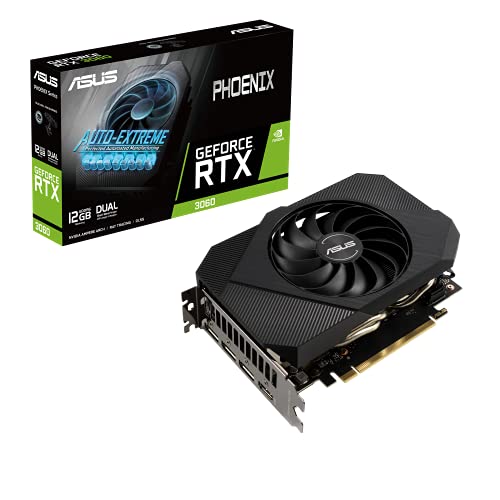
ASUS Phoenix GeForce RTX 3060 12GB
Best for: 1440p gaming with high texture settings
- Graphics Processor
- GeForce RTX 3060
- Memory Size
- 12GB
- Memory Type
- GDDR6
- PCIe Interface
- PCIe 4.0
- Use
- Gaming
- Length
- 7 inches
View on Amazon: ASUS Phoenix GeForce RTX 3060 12GB Affiliate link
The ASUS Phoenix GeForce RTX 3060 features 12GB of GDDR6 memory and a PCIe 4.0 interface. This extra VRAM distinguishes it from competitors with 8GB pools, making it suitable for high-resolution gaming and content creation. The card measures 7 inches long and weighs 12 ounces, fitting standard mid-tower cases. It targets users who need more texture memory for modern titles.
Pros
- 12GB GDDR6 memory capacity
- PCIe 4.0 interface support
- Compact 7-inch length
- Lightweight 12-ounce design
Cons
- Older RTX 30-series architecture lacks DLSS 3 frame generation
- No mention of dual-fan cooling efficiency compared to newer models
- Lower raw performance than RTX 4060 equivalents
Good fit if
- You need 12GB VRAM for 1440p gaming
- You prefer a compact card for smaller builds
- You want PCIe 4.0 compatibility
Skip if
- You require DLSS 3 frame generation
- You prioritize the highest possible frame rates
- You want the latest RTX 40-series features
Verdict: ASUS Phoenix RTX 3060 12GB offers ample VRAM for texture-heavy workloads but lacks the efficiency and new features of the RTX 4060. It suits builders who value memory capacity over raw speed.

ASUS Dual GeForce RTX 4060 8GB
Best for: Compact builds needing DLSS 3
- Graphics Processor
- GeForce RTX 4060
- Memory Size
- 8GB
- Memory Type
- GDDR6
- PCIe Interface
- PCIe 4.0
- Slot Width
- 2-slot
- Dimensions
- 7.96 × 4.74 × 0.1 inches
View on Amazon: ASUS Dual GeForce RTX 4060 8GB Affiliate link
This ASUS Dual GeForce RTX 4060 V2 OC Edition features an 8GB GDDR6 memory buffer and a PCIe 4.0 interface. The card measures 7.96 inches in length and occupies a 2-slot width. It supports HDMI 2.1a and DisplayPort 1.4a outputs. You will find this model suitable for gamers who need DLSS 3 technology and a compact form factor that fits standard mid-tower cases without requiring excessive space.
Pros
- 8GB GDDR6 memory capacity
- PCIe 4.0 interface support
- 2-slot width design
- HDMI 2.1a connectivity
Cons
- 8GB memory may limit high-resolution texture settings
- 7.96-inch length requires case compatibility check
- No mention of RGB lighting customization
Good fit if
- You need a compact 2-slot card for smaller builds
- You want DLSS 3 support for modern titles
- You require HDMI 2.1a for high-refresh monitors
Skip if
- You need more than 8GB of video memory
- Your case cannot accommodate cards over 7.96 inches
- You prefer PCIe 3.0 only systems without 4.0 support
Verdict: ASUS Dual RTX 4060 V2 OC provides solid 1080p performance with efficient specs. It fits users prioritizing compact size and modern display outputs over raw memory capacity.
Specifications side by side
| Spec | ASUS Phoenix GeForce RTX 3060 12GB | ASUS Dual GeForce RTX 4060 8GB |
|---|---|---|
| Graphics Processor | GeForce RTX 3060 | GeForce RTX 4060 |
| Memory Size | 12GB | 8GB |
| Memory Type | GDDR6 | GDDR6 |
| PCIe Interface | PCIe 4.0 | PCIe 4.0 |
| Slot Width | not stated | 2-slot |
| Memory | 12GB | 8GB |
| GPU | GeForce RTX 3060 | not stated |
| Interface | PCIe 4.0 | PCIe 4.0 |
| Use | Gaming | not stated |
| Length | 7 inches | not stated |
| Width | 5 inches | not stated |
| Weight | 12 ounces | 1.2 pounds |
| Dimensions | not stated | 7.96 × 4.74 × 0.1 inches |
| Size | 2"x5"x7" | RTX4060|V2|OC |
| Color | not stated | BLACK |
Frequently asked questions
Which card has more video memory?
The ASUS Phoenix GeForce RTX 3060 12GB offers 12GB of GDDR6 memory. The ASUS Dual GeForce RTX 4060 8GB provides 8GB of GDDR6. The RTX 3060 holds more memory for texture-heavy workloads. This extra capacity suits builders who value memory size over raw speed. You get four more gigabytes of buffer space on the older model.
Do both cards use the same memory type?
Yes, both graphics cards utilize GDDR6 memory. The ASUS Phoenix RTX 3060 and the ASUS Dual RTX 4060 share this specification. They also both connect via a PCIe 4.0 interface. This commonality ensures similar bandwidth characteristics for gaming. You do not need to worry about incompatible memory standards between these two specific models.
Which card is better for compact builds?
The ASUS Dual GeForce RTX 4060 is designed for compact builds. It fits users prioritizing size and modern features. The card supports DLSS 3 technology. This makes it ideal for 1080p gaming in smaller cases. You benefit from efficient specs and a form factor that saves space inside your chassis.
Is the RTX 3060 good for 1440p gaming?
The ASUS Phoenix GeForce RTX 3060 is best for 1440p gaming with high texture settings. Its 12GB VRAM helps manage complex scenes and heavy textures. This makes it suitable for creative workloads requiring ample memory. You get solid performance for high-resolution texturing even if raw speed is lower than newer cards.
What is the physical size difference between them?
The ASUS Dual RTX 4060 measures 7.96 inches in length. The ASUS Phoenix RTX 3060 is 7 inches long. The Dual model is slightly longer but narrower at 4.73 inches wide. The Phoenix is wider at 5 inches. You should check your case clearance for both dimensions before purchasing either card.
Which GPU generation is newer?
The ASUS Dual GeForce RTX 4060 features the newer GeForce RTX 4060 GPU. The ASUS Phoenix uses the older GeForce RTX 3060 GPU. Newer architectures often bring efficiency improvements and new features like DLSS 3. You get modern technology with the Dual model, while the Phoenix relies on its larger memory buffer for performance.
Do both cards support PCIe 4.0?
Yes, both the ASUS Phoenix RTX 3060 and the ASUS Dual RTX 4060 support PCIe 4.0. This interface standard ensures high-speed data transfer between your motherboard and the graphics card. You can use either card in a modern system without bottlenecking due to interface limitations. Both are optimized for current gaming platforms.