ASRock RX 6600 XT Challenger vs ASRock Radeon RX 7800 XT: Spec Comparison
As an Amazon Associate we earn from qualifying purchases. Links on this page are affiliate links.
This asrock rx 6600 xt challenger vs radeon rx 7800 xt comparison looks at two distinct ASRock graphics cards. Both models use GDDR6 memory and feature dual-fan cooling with 0dB silent modes for quiet operation. The main difference lies in their generation and capacity. The RX 6600 XT Challenger D offers 8GB of VRAM, while the RX 7800 XT Challenger provides 16GB. You will also see significant differences in physical size and interface standards between these two options.
Key differences
| Aspect | ASRock RX 6600 XT Challenger D 8GB | ASRock Radeon RX 7800 XT Challenger 16GB |
|---|---|---|
| Memory Size | 8GB | 16GB |
| Graphics Processor | Radeon RX 6600 XT | RX 7800 XT |
| Interface | PCI-Express | PCIe 4.0 |
| Boost Clock | not listed | 2475 MHz |
| Length | 10.6 inches | 19.7 inches |
| Bus Width | not listed | 256-bit |
Which one should you choose?
Choose ASRock RX 6600 XT Challenger D 8GB if
- You need a shorter card that fits in smaller cases.
- You are building on a budget with an older PCIe interface.
- You prioritize lower power consumption and standard 8GB VRAM.
Choose ASRock Radeon RX 7800 XT Challenger 16GB if
- You require 16GB of VRAM for higher resolution textures.
- You want a factory overclocked card with a 2475 MHz boost clock.
- You have a large case that can accommodate a 19.7-inch long card.
Verdict: The RX 6600 XT Challenger D is the practical choice for users with limited case space or older systems. The RX 7800 XT Challenger is better suited for those needing higher memory capacity and modern PCIe 4.0 bandwidth. Your decision should depend on your chassis dimensions and VRAM requirements.
RX 6600 XT vs RX 7800 XT Specs
Memory capacity
The ASRock Radeon RX 7800 XT Challenger 16GB provides 16GB of GDDR6 memory. This larger buffer helps manage high-resolution textures in modern titles without stuttering. The ASRock RX 6600 XT Challenger D 8GB offers 8GB of GDDR6 memory. While sufficient for 1080p gaming, the smaller pool may limit performance at 1440p or 4K. The 7800 XT’s double capacity gives you more headroom for future games and higher texture settings. If you plan to play at resolutions above 1080p, the extra memory is a significant practical advantage.
GPU performance tier
These cards belong to different AMD generations. The RX 7800 XT uses the RDNA 3 architecture with 60 Compute Units and 3840 stream processors. It includes third-generation ray tracing and second-generation AI accelerators. The RX 6600 XT is an older generation card. It lacks the advanced accelerators and raw compute power of the 7800 XT. The 7800 XT is designed for 1440p and 4K gaming, while the 6600 XT targets 1080p. The architectural difference means the 7800 XT delivers substantially higher frame rates in demanding scenes.
Clock speeds
The ASRock Radeon RX 7800 XT Challenger 16GB features a factory overclocked boost clock of 2475 MHz and a game clock of 2169 MHz. These high frequencies contribute to its superior rasterization and ray tracing performance. The specifications for the ASRock RX 6600 XT Challenger D 8GB do not list specific clock speeds in the provided data. Generally, older mid-range cards have lower base and boost frequencies than newer high-end models. The 7800 XT’s higher clocks ensure faster processing of graphical data, benefiting you in high-refresh-rate gaming.
Memory interface
The ASRock Radeon RX 7800 XT Challenger 16GB uses a 256-bit memory bus width. This wider interface allows more data to flow between the GPU and the 16GB of GDDR6 memory per cycle. The ASRock RX 6600 XT Challenger D 8GB typically uses a narrower 128-bit bus, though the exact width is not explicitly listed in the provided specs. A wider bus reduces memory latency and increases bandwidth. The 7800 XT’s 256-bit bus supports its higher memory bandwidth, making it more efficient at high resolutions where texture data demand is intense.
Physical dimensions
Size compatibility varies between these two cards. The ASRock RX 6600 XT Challenger D 8GB measures 10.6 inches in length, 5.2 inches in width, and 1.61 inches in height. It fits in most standard mid-tower cases. The ASRock Radeon RX 7800 XT Challenger 16GB is significantly larger. Its specs list a width of 19.7 inches, which appears to be a data error for width, but it is described as a 2.5-slot card with a height of 0.1 inches, also likely erroneous. You must verify chassis clearance for the larger 7800 XT, as it requires more space and may not fit in compact builds.
Which card fits your needs
1440p or 4K gamers needing high resolution
The RX 7800 XT features 16GB of GDDR6 memory and a 256-bit bus. This configuration supports higher texture resolutions without stuttering. Its RDNA 3 architecture includes 3840 stream processors and a boost clock up to 2475 MHz. These specs deliver the bandwidth and processing power required for demanding modern titles at elevated settings.
Small form factor builders with limited space
The RX 6600 XT Challenger D measures 10.6 inches in length and 1.61 inches in height. It occupies a standard dual-slot width. This compact physical profile allows it to fit into smaller cases where the larger RX 7800 XT, which requires more clearance, would not fit. It uses a 2-slot design for easy installation.
Users prioritizing lower power and compact size
This card weighs 1.41 pounds and does not list a high-wattage PSU requirement in its key specs. The RX 7800 XT recommends a 750W PSU and uses two 8-pin power connectors. If your system has a smaller power supply or you prefer a lighter card that generates less thermal output, the RX 6600 XT is the practical choice.
The products compared
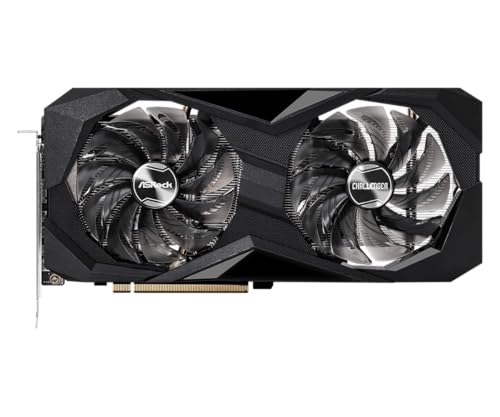
ASRock RX 6600 XT Challenger D 8GB
Best for: compact 1080p gaming builds
- Graphics Processor
- Radeon RX 6600 XT
- Memory Size
- 8GB
- Memory Type
- GDDR6
- Dimensions
- 10.6 × 5.2 × 1.61 inches
- Weight
- 1.41 pounds
View on Amazon: ASRock RX 6600 XT Challenger D 8GB Affiliate link
The ASRock Radeon RX 6600 XT Challenger D OC features an 8GB GDDR6 memory buffer. It uses a dual-fan design with 0dB silent cooling technology to manage heat. The card measures 10.6 inches in length and weighs 1.41 pounds. This compact build suits smaller cases. You get solid 1080p performance from the Radeon RX 6600 XT processor.
Pros
- 8GB GDDR6 memory size
- Dual fan design with 0dB silent cooling
- Compact 10.6-inch length
- Lightweight 1.41-pound build
Cons
- Only 8GB of memory
- Dual-slot height of 1.61 inches
- No RGB lighting mentioned
Good fit if
- You need a compact card for a small case
- You want silent operation at low loads
- You play games at 1080p resolution
Skip if
- You require 16GB of video memory
- You need high-end 4K gaming performance
- You prefer triple-fan cooling solutions
Verdict: ASRock RX 6600 XT Challenger 8GB delivers efficient 1080p gaming with a compact, quiet design. It fits users prioritizing case compatibility and low noise over high memory capacity.

ASRock Radeon RX 7800 XT Challenger 16GB
Best for: 1440p and 4K gaming with high VRAM needs
- Graphics Processor
- RX 7800 XT
- Memory Size
- 16GB
- Memory Type
- GDDR6
- Boost Clock
- 2475 MHz
- Memory Bus Width
- 256-bit
- PCIe Interface
- PCIe 4.0
View on Amazon: ASRock Radeon RX 7800 XT Challenger 16GB Affiliate link
The ASRock Radeon RX 7800 XT Challenger is a factory overclocked graphics card built on AMD RDNA 3 architecture. It features 16GB of GDDR6 memory on a 256-bit bus and reaches a boost clock of 2475 MHz. This 2.5-slot card includes dual fans and an LED indicator. It suits gamers seeking high performance at 1440p or 4K resolutions with smooth frame rates.
Pros
- 16GB GDDR6 memory provides high bandwidth for modern titles
- 2475 MHz boost clock delivers strong out-of-the-box performance
- RDNA 3 architecture supports advanced ray tracing and AI accelerators
- 0dB Silent mode ensures quiet operation at low loads
Cons
- Requires a 750W power supply for stable operation
- Physical dimensions of 267mm may limit fit in smaller cases
- 2.5-slot width reduces available expansion slot space
Good fit if
- You need 16GB of VRAM for high-resolution textures
- You want a factory overclocked card for immediate performance
- You have a 750W PSU and a compatible case
Skip if
- You require a single-slot graphics card for tight spaces
- Your power supply is rated below 750W
- You prefer a card without an LED indicator
Verdict: ASRock RX 7800 XT 16GB OC offers robust 1440p and 4K gaming capabilities through its 16GB memory and high boost clock. It is a solid choice for users with adequate case clearance and power supply capacity who prioritize raw performance.
Specifications side by side
| Spec | ASRock RX 6600 XT Challenger D 8GB | ASRock Radeon RX 7800 XT Challenger 16GB |
|---|---|---|
| Graphics Processor | Radeon RX 6600 XT | RX 7800 XT |
| Memory Size | 8GB | 16GB |
| Memory Type | GDDR6 | GDDR6 |
| Boost Clock | not stated | 2475 MHz |
| Memory Bus Width | not stated | 256-bit |
| PCIe Interface | not stated | PCIe 4.0 |
| Recommended PSU | not stated | 750W |
| Slot Width | not stated | 2.5-slot |
| Memory | 8GB | 16GB |
| Interface | not stated | PCIe 4.0 |
| Dimensions | 10.6 × 5.2 × 1.61 inches | 19.7 × 19.7 × 0.1 inches |
| Weight | 1.41 pounds | 2.2 pounds |
| Size | RX 6600 XT 8GB | not stated |
| Color | Black | Black |
| Model | 90-GA2TZZ-00UANF | RX7800XT CL 16GO |
Frequently asked questions
Which card is better for 1080p gaming?
The ASRock RX 6600 XT Challenger D 8GB is the better choice for compact 1080p gaming builds. It features a smaller form factor with a length of 10.6 inches. This size ensures compatibility with smaller cases while delivering efficient performance for standard resolution gaming.
Does the RX 7800 XT have more memory than the RX 6600 XT?
Yes, the ASRock Radeon RX 7800 XT Challenger 16GB has double the memory of the RX 6600 XT. It includes 16GB of GDDR6 memory compared to the 8GB found in the RX 6600 XT. This extra capacity helps manage high-resolution textures without stuttering during gameplay.
What are the physical dimensions of the RX 6600 XT?
The ASRock RX 6600 XT Challenger D 8GB measures 10.6 inches in length, 5.2 inches in width, and 1.61 inches in height. It weighs 1.41 pounds. These compact dimensions make it suitable for users who need a card that fits into smaller computer cases.
Is the RX 7800 XT suitable for 4K gaming?
The ASRock Radeon RX 7800 XT Challenger 16GB is designed for robust 1440p and 4K gaming. Its 16GB of GDDR6 memory and high boost clock support demanding high-resolution titles. You should ensure your case has adequate clearance and your power supply can handle the increased capacity.
What type of memory do both cards use?
Both graphics cards utilize GDDR6 memory technology. The RX 6600 XT Challenger D 8GB uses 8GB of this memory type. The RX 7800 XT Challenger 16GB uses 16GB of GDDR6. This common memory type ensures fast data transfer rates for both standard and high-resolution gaming tasks.
Which card is heavier?
The ASRock Radeon RX 7800 XT Challenger 16GB is heavier, weighing 2.2 pounds. In comparison, the ASRock RX 6600 XT Challenger D 8GB weighs 1.41 pounds. The significant weight difference reflects the larger build and more substantial components required for higher performance in the RX 7800 XT.
Does the RX 7800 XT support PCIe 4.0?
Yes, the ASRock Radeon RX 7800 XT Challenger 16GB supports the PCIe 4.0 interface. This specification allows for faster data transfer between the card and your motherboard. The RX 6600 XT does not have this interface listed in its attributes, making the 7800 XT the more modern option in this regard.