ASRock RX 6600 XT Challenger vs ASRock Radeon RX 7700 XT (2026): Key Differences
As an Amazon Associate we earn from qualifying purchases. Links on this page are affiliate links.
This asrock rx 6600 xt challenger vs radeon rx 7700 xt comparison highlights two distinct gaming cards from the same brand. Both feature ASRock's dual-fan cooling and 0dB silent mode for quiet operation. The primary difference lies in their core specifications. The RX 6600 XT Challenger D offers 8GB of VRAM, while the RX 7700 XT provides 12GB. You will also notice differences in physical dimensions and connectivity options between these two models.
Key differences
| Aspect | ASRock RX 6600 XT Challenger D 8GB | ASRock Radeon RX 7700 XT Challenger 12GB |
|---|---|---|
| Graphics Processor | Radeon RX 6600 XT | AMD Radeon RX 7700 XT |
| Memory Size | 8GB | 12GB |
| Boost Clock | not listed | 2584 MHz |
| PCIe Interface | not listed | PCIe 4.0 |
| Display Outputs | not listed | 3 x DisplayPort 2.1, 1 x HDMI 2.1 |
| Length | 10.6 inches | 10.5 inches |
Which one should you choose?
Choose ASRock RX 6600 XT Challenger D 8GB if
- You need a card with 8GB of GDDR6 memory for 1080p gaming.
- You prefer a slightly longer card that fits your case dimensions.
- You want a cooler that remains off during light workloads.
Choose ASRock Radeon RX 7700 XT Challenger 12GB if
- You require 12GB of VRAM for higher resolution textures.
- You need modern DisplayPort 2.1 and HDMI 2.1 outputs.
- You want a higher boost clock speed for faster performance.
Verdict: The RX 6600 XT Challenger D is suitable for users who prioritize compact form factors and sufficient memory for standard 1080p gaming. The RX 7700 XT is better for those who need more VRAM and modern display outputs for higher resolutions. Your choice depends on whether you value extra memory and newer connectivity over a slightly smaller footprint.
RX 6600 XT vs RX 7700 XT Specs
GPU architecture
The ASRock Radeon RX 7700 XT Challenger 12GB uses the newer AMD RDNA 3 architecture. It includes 54 Compute Units and dedicated RT and AI accelerators. This design targets higher performance in modern titles. The ASRock RX 6600 XT Challenger D 8GB relies on the previous generation RDNA 2 architecture. While still capable, it lacks the specific hardware updates found in the RDNA 3 chip. The newer architecture in the 7700 XT provides a clear generational advantage for future-proofing and advanced features.
memory capacity
Memory size is a key differentiator between these two cards. The ASRock Radeon RX 7700 XT Challenger 12GB comes with 12GB of GDDR6 memory. This larger pool helps handle high-resolution textures and complex scenes without running out of space. The ASRock RX 6600 XT Challenger D 8GB is limited to 8GB of GDDR6. For 1080p gaming, both may suffice, but the 12GB buffer on the 7700 XT offers more headroom for demanding games and higher resolution settings in the future.
boost clock speed
Clock speeds indicate how fast the GPU core can run. The ASRock Radeon RX 7700 XT Challenger 12GB features a boost clock of up to 2584 MHz and a game clock of 2226 MHz. The specifications for the ASRock RX 6600 XT Challenger D 8GB do not list specific clock speeds in the provided data. Generally, higher clock speeds contribute to better frame rates. The 7700 XT’s specified high frequency supports its position as the more powerful card in this comparison.
memory interface
The memory bus width affects how much data the GPU can process at once. The ASRock Radeon RX 7700 XT Challenger 12GB utilizes a 192-bit memory bus. This width, combined with its 12GB capacity and 48MB AMD Infinity Cache, helps reduce latency and improve performance at higher resolutions. The memory bus width for the ASRock RX 6600 XT Challenger D 8GB is not specified in the available data. The 192-bit interface on the 7700 XT is designed for efficient data throughput in demanding scenarios.
display outputs
Modern monitors benefit from the latest display standards. The ASRock Radeon RX 7700 XT Challenger 12GB includes three DisplayPort 2.1 outputs and one HDMI 2.1 port. These connectors support high-refresh-rate and high-resolution displays for an immersive experience. The ASRock RX 6600 XT Challenger D 8GB does not have its display outputs listed in the provided specifications. The 7700 XT’s inclusion of DisplayPort 2.1 ensures compatibility with the newest high-bandwidth monitors.
physical length
Case compatibility is important for installation. The ASRock RX 6600 XT Challenger D 8GB measures 10.6 inches in length. The ASRock Radeon RX 7700 XT Challenger 12GB is slightly shorter at 10.5 inches. Both cards are dual-fan designs that fit in most standard mid-tower cases. The 7700 XT is marginally more compact in length, which might be a small advantage for users with very tight case constraints, though the difference is minimal.
Which graphics card fits your needs
Budget 1080p gamers with small cases
The RX 6600 XT Challenger D measures 10.6 inches long and weighs 1.41 pounds. Its compact size fits smaller chassis easily. You get 8GB of GDDR6 memory for standard 1080p titles. The dual-fan design keeps noise low during gameplay. This card prioritizes physical compatibility and basic performance for entry-level systems.
High-resolution gamers wanting modern features
The RX 7700 XT Challenger offers 12GB of GDDR6 memory on a 192-bit bus. It includes 48MB of Infinity Cache to reduce latency. You gain DisplayPort 2.1 and HDMI 2.1 outputs for high-refresh monitors. The RDNA 3 architecture with 54 Compute Units handles demanding games better than older designs.
Users needing future-proof connectivity
This card supports PCIe 4.0 and features modern display outputs like DisplayPort 2.1. These specs ensure compatibility with latest monitors and motherboards. The 12GB VRAM buffer provides headroom for texture-heavy applications. You avoid potential bandwidth bottlenecks found in older interfaces, ensuring smoother performance as software demands increase over time.
The products compared
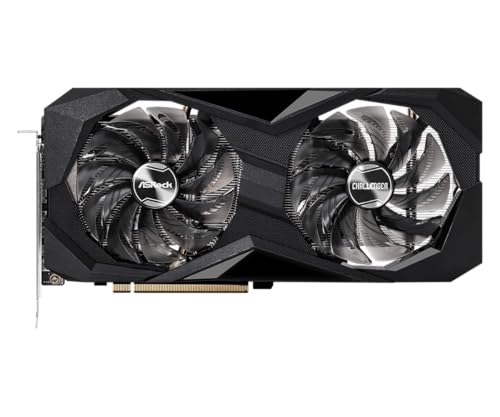
ASRock RX 6600 XT Challenger D 8GB
Best for: 1080p gaming in standard cases
- Graphics Processor
- Radeon RX 6600 XT
- Memory Size
- 8GB
- Memory Type
- GDDR6
- Dimensions
- 10.6 × 5.2 × 1.61 inches
- Weight
- 1.41 pounds
View on Amazon: ASRock RX 6600 XT Challenger D 8GB Affiliate link
This is the ASRock Radeon RX 6600 XT Challenger D OC graphics card. It features 8GB of GDDR6 memory and a dual-fan cooling system with 0dB silent operation. The card measures 10.6 inches in length and weighs 1.41 pounds. It suits gamers who need solid 1080p performance without taking up too much space in their case.
Pros
- 8GB GDDR6 memory capacity
- Dual fan design with striped axial fans
- 0dB silent cooling technology
- Compact 5.2-inch width
Cons
- 8GB memory is less than the 12GB found on the RX 7700 XT
- 10.6-inch length may not fit small cases
- Older RDNA 2 architecture lacks RDNA 3 features
Good fit if
- You need a reliable 1080p gaming card
- You have a mid-size PC case
- You want silent operation at low loads
Skip if
- You require 12GB of video memory
- You need the latest RDNA 3 architecture
- You are building a compact mini-ITX PC
Verdict: ASRock RX 6600 XT Challenger D 8GB delivers efficient 1080p gaming with its 8GB GDDR6 memory and quiet dual-fan design. It fits well in standard towers but lacks the memory headroom of newer cards.

ASRock Radeon RX 7700 XT Challenger 12GB
Best for: 1440p gaming with high VRAM needs
- Graphics Processor
- AMD Radeon RX 7700 XT
- Memory Size
- 12GB
- Memory Type
- GDDR6
- Boost Clock
- 2584 MHz
- Memory Bus Width
- 192-bit
- PCIe Interface
- PCIe 4.0
View on Amazon: ASRock Radeon RX 7700 XT Challenger 12GB Affiliate link
The ASRock Radeon RX 7700 XT Challenger 12GB OC offers 12GB of GDDR6 memory on a 192-bit bus. Its boost clock reaches 2584 MHz, providing strong performance for modern titles. The card features DisplayPort 2.1 and HDMI 2.1 outputs for high-resolution displays. It includes a dual-fan cooling system with 0dB silent operation. This GPU suits gamers seeking 1440p performance with ample video memory.
Pros
- 12GB GDDR6 memory with 48MB Infinity Cache
- Boost clock up to 2584 MHz
- DisplayPort 2.1 and HDMI 2.1 outputs
- 0dB silent cooling at low temperatures
Cons
- 192-bit memory bus width
- 10.5-inch length may not fit small cases
- Requires dual 8-pin power connectors
Good fit if
- You need 12GB of VRAM for high-resolution textures
- You want DisplayPort 2.1 support for future monitors
- You prefer silent operation during light workloads
Skip if
- You have a small form factor case under 10 inches
- Your power supply lacks dual 8-pin connectors
- You require more than 12GB of video memory
Verdict: ASRock RX 7700 XT 12GB OC delivers solid 1440p gaming with its 12GB GDDR6 buffer and 2584 MHz boost. It fits users who need ample VRAM and modern display outputs for high-refresh monitors.
Specifications side by side
| Spec | ASRock RX 6600 XT Challenger D 8GB | ASRock Radeon RX 7700 XT Challenger 12GB |
|---|---|---|
| Graphics Processor | Radeon RX 6600 XT | AMD Radeon RX 7700 XT |
| Memory Size | 8GB | 12GB |
| Memory Type | GDDR6 | GDDR6 |
| Boost Clock | not stated | 2584 MHz |
| Memory Bus Width | not stated | 192-bit |
| PCIe Interface | not stated | PCIe 4.0 |
| Memory | 8GB | 12GB |
| Dimensions | 10.6 × 5.2 × 1.61 inches | 10.5 × 5.1 × 0.1 inches |
| Weight | 1.41 pounds | 2.2 pounds |
| Size | RX 6600 XT 8GB | not stated |
| Color | Black | Black |
| Model | 90-GA2TZZ-00UANF | RX7700XT CL 12GO |
Frequently asked questions
Is the ASRock RX 7700 XT better for 1440p gaming than the RX 6600 XT?
Yes, the RX 7700 XT is designed for higher resolutions. It features 12GB of GDDR6 memory and a boost clock of 2584 MHz. The RX 6600 XT has only 8GB of memory and targets 1080p gaming. The extra VRAM and higher clock speeds on the 7700 XT provide more headroom for detailed textures at 1440p.
Does the RX 7700 XT have more VRAM than the RX 6600 XT?
Yes, the RX 7700 XT includes 12GB of GDDR6 memory. The RX 6600 XT Challenger D comes with 8GB of GDDR6. The additional 4GB on the 7700 XT helps manage high-resolution textures and modern game assets more effectively. This makes the 7700 XT more suitable for users who need ample video memory.
Which card is smaller and lighter?
The RX 6600 XT Challenger D is the more compact option. It measures 10.6 inches in length and weighs 1.41 pounds. The RX 7700 XT Challenger is 10.5 inches long but weighs 2.2 pounds. If you are installing the card in a small case, the lighter RX 6600 XT may be easier to fit.
What is the difference in GPU architecture between these two cards?
The RX 7700 XT uses the newer AMD RDNA 3 architecture. It includes 54 Compute Units and dedicated RT and AI accelerators. The RX 6600 XT uses an older architecture. The RDNA 3 design on the 7700 XT targets higher performance in modern titles compared to the older generation hardware found in the 6600 XT.
Can the RX 6600 XT handle 1440p gaming effectively?
The RX 6600 XT is primarily best for 1080p gaming. It has 8GB of GDDR6 memory, which limits its ability to handle high-resolution textures in demanding titles. While it can run some 1440p games, the RX 7700 XT with 12GB of memory is the better choice for that resolution. The 6600 XT lacks the memory headroom for consistent 1440p performance.
How do the physical dimensions compare between the two cards?
Both cards are similar in length, with the RX 6600 XT at 10.6 inches and the RX 7700 XT at 10.5 inches. The RX 6600 XT has a height of 1.61 inches, while the RX 7700 XT is significantly thinner at 0.1 inches. The RX 6600 XT is also lighter, weighing 1.41 pounds versus 2.2 pounds for the 7700 XT.