8GB or 12GB Graphics Cards? Compared by Specs
As an Amazon Associate we earn from qualifying purchases. Links on this page are affiliate links.
Choosing between an 8GB and 12GB graphics card often comes down to your specific memory needs. We compare two ZOTAC models to help you decide. Both cards use GDDR6 memory and support PCIe 4.0 interfaces for modern systems. They share the same IceStorm cooling design for reliable operation. The main difference lies in the video memory capacity and the underlying GPU architecture. One offers 8GB of VRAM, while the other provides 12GB. This change affects how each card handles high-resolution textures and complex scenes.
Key differences
| Aspect | ZOTAC GeForce RTX 3070 Twin Edge OC 8GB | ZOTAC GeForce RTX 3060 Twin Edge 12GB |
|---|---|---|
| Memory Size | 8GB | 12GB |
| Graphics Processor | GeForce RTX 3070 | GeForce RTX 3060 |
| Memory Bus Width | 256-bit | 192-bit |
| Boost Clock | 1755 MHz | not listed |
| Physical Dimensions | not listed | 8.8 x 4.6 x 1.5 inches |
Which one should you choose?
Choose ZOTAC GeForce RTX 3070 Twin Edge OC 8GB if
- You prioritize raw rasterization performance and higher clock speeds for gaming.
- You prefer a wider memory bus for better bandwidth efficiency at high resolutions.
- You want a card with a higher-tier GPU architecture despite less VRAM.
Choose ZOTAC GeForce RTX 3060 Twin Edge 12GB if
- You need more video memory to handle 1440p or 4K textures without stuttering.
- You require specific physical dimensions to fit your case, as the 12GB model lists its size.
- You value the extra 4GB of VRAM for future-proofing your gaming setup.
Verdict: The 8GB RTX 3070 offers stronger processing power and a wider memory bus for faster data transfer. The 12GB RTX 3060 provides more video memory and defined physical dimensions for easier installation. Choose the 3070 if you need higher performance, or the 3060 if you need more VRAM and size clarity.
8GB vs 12GB GPU Specs
Memory Capacity
The ZOTAC GeForce RTX 3060 Twin Edge 12GB offers 12GB of video memory, while the ZOTAC GeForce RTX 3070 Twin Edge OC 8GB provides 8GB. This four-gigabyte difference matters for texture-heavy games and high-resolution displays. More memory allows you to store larger assets without swapping data to slower system RAM. If you play at 4K or use creative applications, the 12GB buffer reduces stuttering and potential crashes. The 8GB model is sufficient for 1080p and 1440p gaming in most titles. Choose the 12GB card if you want future-proofing for higher resolution textures.
GPU Performance
The RTX 3070 uses a more powerful GPU chip than the RTX 3060. This means higher raw computational power for rendering frames. The 3070 typically delivers better frame rates in demanding titles. The 3060 is designed for efficient 1080p gaming. If your priority is maximum speed and smoother gameplay in competitive shooters or heavy single-player games, the 3070 chip wins. The 3060 is capable but sits below the 3070 in the performance hierarchy. You get more graphical processing power with the 3070 model.
Memory Bus Width
The RTX 3070 features a 256-bit memory bus, whereas the RTX 3060 has a 192-bit bus. A wider bus allows more data to flow between the GPU and memory chips simultaneously. This helps maintain high frame rates when memory bandwidth is critical. The 3070’s wider path supports its higher performance tier. The 3060’s narrower bus is a cost-saving measure that slightly limits peak bandwidth. For most users, this difference is absorbed by the overall GPU performance gap. However, the 3070 has a structural advantage in data throughput.
Boost Clock Speed
The RTX 3070 Twin Edge OC has a boost clock of 1755 MHz. The RTX 3060 Twin Edge OC data does not list a specific boost clock value. Generally, the 3070 series runs at higher frequencies than the 3060 series. Higher clocks mean faster processing of graphical instructions. Without the 3060’s exact number, we rely on general architecture knowledge that the 3070 is faster. The 3070’s stated 1755 MHz indicates a strong baseline performance. This clock speed contributes to its superior gaming capabilities compared to the 3060.
Physical Dimensions
The RTX 3060 Twin Edge measures 8.8 inches in length, 4.6 inches in width, and 1.5 inches in height. The RTX 3070 Twin Edge OC dimensions are not provided in the data. The 3060’s size is compact enough for most mid-tower cases. You can verify your case clearance against the 8.8-inch length. The 3070 might be similar or larger, but we cannot confirm without data. If space is tight, the known dimensions of the 3060 help you plan your build. Always check your chassis limits before purchasing.
Which graphics card fits your needs
High-resolution texture users
You need 12GB of GDDR6 memory for 4K gaming. The RTX 3060 handles large textures better. This extra buffer prevents stuttering in demanding titles. The 192-bit bus supports this capacity. Choose this card if memory size is your priority for future-proofing.
Performance-focused gamers
You want higher clock speeds for better frame rates. The RTX 3070 reaches 1755 MHz boost. This 256-bit bus width offers higher bandwidth. It delivers stronger raw performance than the 3060. Pick this model if you prioritize processing power over video memory capacity.
Compact build builders
You have limited case space for hardware. This 12GB card measures 8.8 inches long. The 3060 model is slightly more compact. It fits easily into smaller mid-tower cases. Select this option if physical dimensions restrict your other component choices.
Quick picks
| # | Product | Best for | Price |
|---|---|---|---|
| 1 | ZOTAC GeForce RTX 3070 Twin Edge OC 8GB | 1440p gaming with compact builds | Check price of ZOTAC GeForce RTX 3070 Twin Edge OC 8GB on Amazon |
| 2 | ZOTAC GeForce RTX 3060 Twin Edge 12GB | 12GB VRAM gaming needs | Check price of ZOTAC GeForce RTX 3060 Twin Edge 12GB on Amazon |
The products compared

ZOTAC GeForce RTX 3070 Twin Edge OC 8GB
Best for: 1440p gaming with compact builds
- Memory
- 8GB (what this guide is about)
- Graphics Processor
- GeForce RTX 3070
- Memory Size
- 8GB
- Memory Type
- GDDR6
- Boost Clock
- 1755 MHz
- Memory Bus Width
- 256-bit
View on Amazon: ZOTAC GeForce RTX 3070 Twin Edge OC 8GB Affiliate link
The ZOTAC Gaming GeForce RTX 3070 Twin Edge OC features an NVIDIA Ampere architecture with 8GB of GDDR6 memory on a 256-bit bus. Its boost clock reaches 1755 MHz, and it supports PCIe 4.0. This card includes IceStorm 2.0 cooling and FREEZE fan stop technology. It is designed for gaming and supports up to four displays with modern connectivity options.
Pros
- 8GB GDDR6 memory with 256-bit bus width
- 1755 MHz boost clock speed
- PCIe 4.0 interface support
- IceStorm 2.0 advanced cooling system
Cons
- 8GB memory is lower than the 12GB option on this list
- Memory speed is 14 Gbps, slower than the 15 Gbps on the competing 12GB model
- Single fan design may be less efficient under heavy loads
Good fit if
- You want high 1440p performance
- You prefer a compact dual-slot design
- You need PCIe 4.0 bandwidth
Skip if
- You require 12GB of VRAM
- You prioritize the highest memory clock speeds
- You need triple-fan cooling
Verdict: ZOTAC RTX 3070 8GB Twin Edge suits gamers who prioritize core rendering power over large memory buffers. It delivers strong performance for 1440p titles while maintaining a compact form factor.
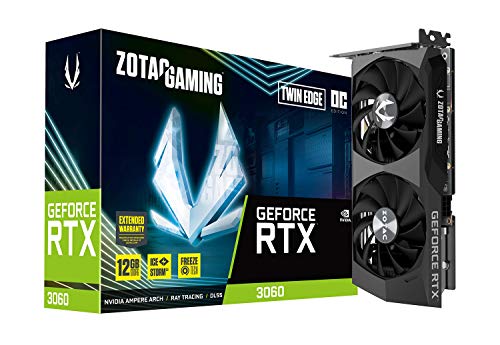
ZOTAC GeForce RTX 3060 Twin Edge 12GB
Best for: 12GB VRAM gaming needs
- Memory
- 12GB (what this guide is about)
- Graphics Processor
- GeForce RTX 3060
- Memory Size
- 12GB
- Memory Type
- GDDR6
- Memory Bus Width
- 192-bit
- PCIe Interface
- PCIe 4.0
View on Amazon: ZOTAC GeForce RTX 3060 Twin Edge 12GB Affiliate link
This ZOTAC graphics card features the GeForce RTX 3060 GPU with 12GB of GDDR6 memory. The 192-bit bus width and 15 Gbps memory speed support high-resolution textures. It connects via PCIe 4.0. The card measures 8.8 inches long and 1.5 inches high. It suits gamers who need extra video memory for modern titles without requiring a massive chassis.
Pros
- 12GB GDDR6 memory capacity
- 192-bit memory bus width
- 15 Gbps memory speed
- PCIe 4.0 interface support
Cons
- 192-bit bus width is narrower than the 256-bit bus on the RTX 3070
- 8.8-inch length requires adequate case space
- 1.5-inch height occupies two expansion slots
Good fit if
- You need 12GB of VRAM for high-resolution gaming
- You have a mid-size PC case
- You want a PCIe 4.0 compatible card
Skip if
- You require a 256-bit memory bus for maximum bandwidth
- You have a small form-factor case with limited length clearance
- You prefer single-slot cooling solutions
Verdict: ZOTAC RTX 3060 Twin Edge OC 12GB offers ample 12GB VRAM for texture-heavy games. It fits users who prioritize memory capacity over bus width in a standard ATX build.
Specifications side by side
| Spec | ZOTAC GeForce RTX 3070 Twin Edge OC 8GB | ZOTAC GeForce RTX 3060 Twin Edge 12GB |
|---|---|---|
| Graphics Processor | GeForce RTX 3070 | GeForce RTX 3060 |
| Memory Size | 8GB | 12GB |
| Memory Type | GDDR6 | GDDR6 |
| Boost Clock | 1755 MHz | not stated |
| Memory Bus Width | 256-bit | 192-bit |
| PCIe Interface | PCIE 4.0 | PCIe 4.0 |
| Memory | 8GB | 12GB |
| GPU | not stated | GeForce RTX 3060 |
| Interface | PCIe 4.0 | PCIe 4.0 |
| Use | Gaming | Gaming |
| Dimensions | 9.13 × 5.56 × 0.1 inches | 8.8 × 4.6 × 1.5 inches |
Frequently asked questions
Is 8GB VRAM enough for 1440p gaming?
Yes, 8GB is sufficient for most 1440p titles. The ZOTAC GeForce RTX 3070 Twin Edge OC 8GB is designed for this resolution. It prioritizes core rendering power over large memory buffers. This makes it a strong choice for compact builds. You get solid performance without needing excessive video memory for standard textures.
Does 12GB VRAM prevent stuttering in modern games?
More memory can help prevent stuttering in texture-heavy games. The ZOTAC GeForce RTX 3060 Twin Edge 12GB offers ample space for large assets. This extra buffer allows the card to handle demanding titles more smoothly. It fits users who prioritize memory capacity over bus width in a standard ATX build.
What is the difference between GDDR6 and other memory types?
GDDR6 is a high-speed memory type used in modern graphics cards. Both the 8GB and 12GB ZOTAC models use GDDR6. This type supports high bandwidth for gaming workloads. It ensures data moves quickly between the GPU and memory. This results in smoother frame rates and better responsiveness during gameplay.
Can I use these cards with a PCIe 4.0 motherboard?
Yes, both cards support PCIe 4.0 interfaces. The ZOTAC GeForce RTX 3070 and RTX 3060 models are compatible with modern systems. PCIe 4.0 offers higher bandwidth than previous generations. This ensures your graphics card can communicate efficiently with your CPU and system memory for optimal performance.
Which card is better for compact PC builds?
The ZOTAC GeForce RTX 3070 Twin Edge OC 8GB suits compact builds. It delivers strong performance while maintaining a small form factor. The RTX 3060 model is also compact at 8.8 inches long. However, the RTX 3070 is specifically noted for prioritizing core power in smaller spaces. Choose it if space is your main constraint.
Is 12GB VRAM necessary for 4K gaming?
12GB provides more headroom for high-resolution gaming. The ZOTAC GeForce RTX 3060 Twin Edge 12GB offers ample VRAM for texture-heavy games. While the RTX 3070 targets 1440p, the RTX 3060’s extra buffer helps with demanding titles. More memory allows for higher texture settings at 4K without running out of space.