Best Graphics Cards Under $300: 15 Spec-Based Picks
As an Amazon Associate we earn from qualifying purchases. Links on this page are affiliate links.
Finding the right graphics card under 300 depends on matching hardware capabilities to your system enclosure and workflow needs. The Sapphire NITRO+ Radeon RX 5700 XT 8GB takes the top spot because it combines 8GB of GDDR6 memory with PCIe 4.0 support and dual HDMI and DisplayPort outputs.
We evaluated 15 models based strictly on the specifications published on their listings. This guide helps you identify the ideal balance of physical card dimensions, memory capacity, and display connectivity for your PC build.
Our top pick: XFX Speedster SWFT210 Radeon RX 6600 XT 8GB.
Quick picks
The best fit for you
- You need multi-monitor gaming with high memory capacity XFX Speedster SWFT210 Radeon RX 6600 XT 8GB It offers 8GB GDDR6 memory and four display outputs for multi-panel desktop gaming.
- You have limited slot space in your workstation chassis PNY Quadro P4000 Single-Slot GPU Its 0.75-inch single-slot profile fits workstations with restricted physical expansion space.
- You need hardware ray tracing for professional 3D workloads PNY NVIDIA Quadro RTX 4000 Turing GPU It provides 36 dedicated RT cores and Turing architecture for ray-traced rendering.
- You want PCIe 4.0 connectivity for compact gaming enclosures MSI GeForce RTX 3050 8GB Dual Fan It pairs PCIe 4.0 connectivity with 8GB of GDDR6 memory in an 8.07-inch footprint.
Our 15 picks
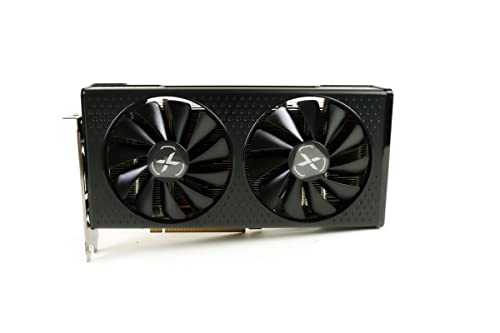
XFX Speedster SWFT210 Radeon RX 6600 XT 8GB
Best for: multi-monitor 8GB GDDR6 gaming setups
- Graphics Processor
- Radeon RX 6600 XT
- Memory Size
- 8GB
- Memory Type
- GDDR6
- Use
- Gaming
- Dimensions
- 9.49 × 5.16 × 1.61 inches
- Weight
- 2.2 pounds
View on Amazon: XFX Speedster SWFT210 Radeon RX 6600 XT 8GB (paid link)
The XFX Speedster SWFT210 Radeon RX 6600 XT 8GB is a dedicated gaming graphics card built on AMD RDNA 2 architecture. You get 8GB of GDDR6 memory and four total video outputs, comprising one HDMI port and three DisplayPorts. Measuring 9.49 inches long by 5.16 inches wide, it requires adequate chassis clearance. This card suits you if you prioritize multi-display connectivity and dedicated GDDR6 memory for gaming in 2026.
Pros
- 8GB of GDDR6 memory
- Four display outputs including one HDMI and three DisplayPorts
- AMD RDNA 2 architecture
- Compact length of 9.49 inches
Cons
- Width of 5.16 inches requires a wider case profile
- Offers only one HDMI port
Good fit if
- You need up to four monitor connections using three DisplayPorts and one HDMI port.
- You want 8GB of dedicated GDDR6 memory for desktop gaming.
- You have a computer case that accommodates a 9.49-inch card length.
Skip if
- You require multiple HDMI ports without using separate display adapters.
- You build in an ultra-compact chassis unable to fit a 5.16-inch card width.
Verdict: XFX Speedster SWFT210 Radeon RX 6600 XT 8GB delivers 8GB of GDDR6 memory and four display outputs for multi-panel gaming setups. Its RDNA 2 architecture provides dedicated graphical power within standard desktop enclosures.

PNY Quadro P4000 Single-Slot GPU
Best for: single-slot workstation and simulation builds
- Graphics Processor
- NVIDIA Quadro P4000
- PCIe Interface
- PCI Express 3.0 x16
- Slot Width
- single slot
- Dimensions
- 9.5 × 4.38 × 0.75 inches
- Weight
- 1.05 pounds
View on Amazon: PNY Quadro P4000 Single-Slot GPU (paid link)
The PNY Quadro P4000 is a workstation graphics card built on NVIDIA Pascal architecture. You get a single-slot design measuring 0.75 inches thick, 4.38 inches wide, and 9.5 inches long. It connects using a PCI Express 3.0 x16 interface and includes dedicated H.264 and HEVC decode and encode engines. It suits you if you need a slim card for CAD, 3D visualization, or simulation on Windows or Linux workstations.
Pros
- Single-slot form factor measuring 0.75 inches in height
- Hardware decoding and encoding for H.264 and HEVC video
- Support for OpenGL, DirectX, Vulkan, and NVIDIA CUDA
- Standard PCI Express 3.0 x16 interface
Cons
- Card length of 9.5 inches requires adequate case clearance
- Uses older PCI Express 3.0 bus standard
- Specific video output port types are not listed in specs
Good fit if
- You need a single-slot card that leaves adjacent expansion slots accessible.
- You work in professional CAD, simulation, or 3D visualization applications.
- You require driver support for Windows Server or Linux platforms.
Skip if
- You have a compact case with less than 9.5 inches of card clearance.
- You require modern PCI Express 4.0 interface transfer speeds.
Verdict: PNY Quadro P4000 Single-Slot GPU provides reliable professional workstation performance in a compact 0.75-inch single-slot design. It serves specialized CAD, visualization, and simulation workflows where physical expansion space is limited.

PNY NVIDIA Quadro RTX 4000 Turing GPU
Best for: professional ray tracing and VR workloads
- Graphics Processor
- Quadro RTX 4000
- Dimensions
- 2 × 4 × 8 inches
- Weight
- 2.97 pounds
View on Amazon: PNY NVIDIA Quadro RTX 4000 Turing GPU (paid link)
The PNY NVIDIA Quadro RTX 4000 Turing GPU is a professional graphics card built on NVIDIA Turing GPU architecture. It includes 36 RT cores designed to handle hardware-accelerated real-time ray tracing and advanced shading for VR tasks. Measuring 2 inches long, 4 inches wide, and 8 inches high, this 2.97-pound workstation card suits you if you need dedicated rendering hardware and professional application performance for design workflows.
Pros
- Built on NVIDIA Turing GPU architecture
- Equipped with 36 RT cores for photorealistic ray tracing
- Provides advanced rendering and shading features for VR
- Features ultra-fast graphics memory
Cons
- Published specifications omit exact video memory capacity
- Display output types and connector counts are not specified
Good fit if
- You need 36 dedicated RT cores for hardware-accelerated ray tracing
- You run professional applications requiring NVIDIA Turing architecture and VR shading
Skip if
- You need a card with a confirmed, specific video memory capacity in the published specifications
- You require detailed display output specifications like HDMI or DisplayPort counts
Verdict: PNY NVIDIA Quadro RTX 4000 Turing GPU provides 36 RT cores and Turing architecture for hardware ray-traced rendering in professional applications. It is a capable choice when you need dedicated professional-grade graphics hardware in your workstation.
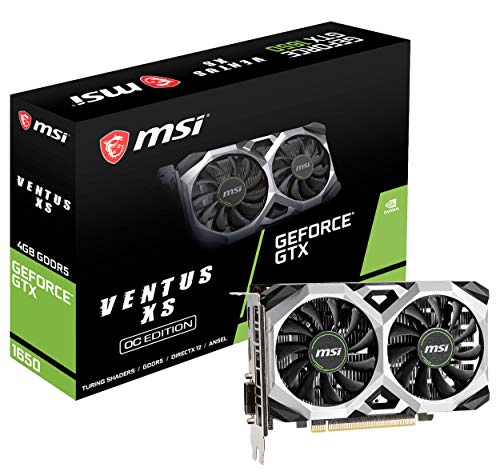
MSI GeForce GTX 1650 4GB
Best for: compact multi-display gaming setups
- Graphics Processor
- GeForce GTX 1650
- Memory Size
- 4GB
- Memory Type
- GDDR5
- Memory Bus Width
- 128-bit
- Use
- Gaming
- Dimensions
- 7 × 1.5 × 4.4 inches
View on Amazon: MSI GeForce GTX 1650 4GB (paid link)
This MSI graphics card features the NVIDIA GeForce GTX 1650 GPU paired with 4GB of GDDR5 memory across a 128-bit interface. Its compact frame measures 7 inches long and 1.5 inches wide, which helps you fit it into smaller enclosures. You can connect up to three displays using two DisplayPort 1.4 outputs and one HDMI 2.0b port. It suits you if you need a compact gaming card for a multi-monitor desktop setup.
Pros
- Compact 7-inch length fits smaller enclosures
- Supports up to 3 display monitors simultaneously
- Equipped with 2 DisplayPort 1.4 outputs and 1 HDMI 2.0b port
- 4GB GDDR5 memory on a 128-bit interface
Cons
- Memory is limited to 4GB capacity
- Uses GDDR5 memory instead of newer GDDR6
Good fit if
- You need a graphics card that is 7 inches long to fit tight cases.
- You plan to run up to three monitors using DisplayPort and HDMI.
Skip if
- You require more than 4GB of video memory for your applications.
- You need faster GDDR6 memory speeds.
Verdict: MSI GeForce GTX 1650 4GB provides a 7-inch physical profile and three display connections for space-constrained PCs. It gives you 4GB of dedicated GDDR5 memory on a 128-bit bus.
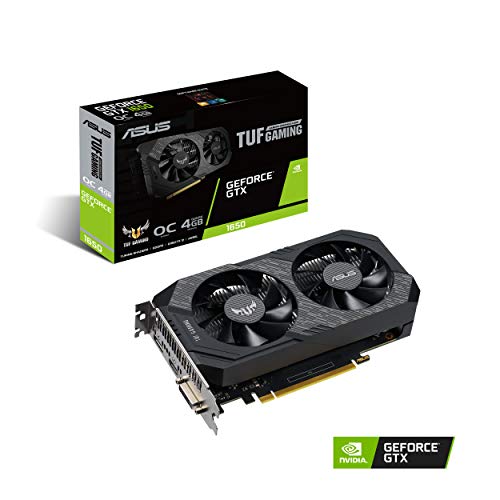
ASUS TUF Gaming GeForce GTX 1650 4GB
Best for: compact PCIe 3.0 desktop builds
- Graphics Processor
- GeForce GTX 1650
- Memory Size
- 4GB
- Memory Type
- GDDR6
- PCIe Interface
- PCIe 3.0
- Use
- Gaming
- Dimensions
- 8.11 × 4.92 × 1.81 inches
View on Amazon: ASUS TUF Gaming GeForce GTX 1650 4GB (paid link)
The ASUS TUF Gaming GeForce GTX 1650 4GB is a compact graphics card built on NVIDIA Turing architecture with a PCIe 3.0 interface. It pairs 4GB of GDDR6 memory with HDMI and DisplayPort outputs, supporting digital resolutions up to 7680 x 4320. At 8.11 inches long, it fits tight builds easily. This card suits you if you need a reliable PCIe 3.0 upgrade with a protective backplate for everyday gaming setups.
Pros
- PCIe 3.0 interface matches legacy motherboard setups
- 4GB of GDDR6 video memory
- Supports digital resolutions up to 7680 x 4320
- Protective backplate reinforces the physical card structure
Cons
- Limited to 4GB of memory capacity
- PCIe 3.0 interface offers less bandwidth than newer PCIe standards
Good fit if
- You need a dedicated card to fit a PCIe 3.0 motherboard.
- You have a compact case that requires an 8.11-inch card length.
- You run monitors requiring up to 7680 x 4320 digital output.
Skip if
- You require more than 4GB of video memory for your applications.
- You want a modern PCIe 4.0 interface.
Verdict: ASUS TUF Gaming GeForce GTX 1650 4GB delivers a dependable PCIe 3.0 solution with high-speed GDDR6 memory. Its 8.11-inch length and protective backplate make it a practical choice for compact enclosures.

PNY NVIDIA T1000 4GB GDDR6
Best for: lightweight systems needing dedicated GDDR6 memory
- Graphics Processor
- NVIDIA T1000
- Memory Size
- 4 GB
- Memory Type
- GDDR6
- Weight
- 7.05 ounces
View on Amazon: PNY NVIDIA T1000 4GB GDDR6 (paid link)
The PNY NVIDIA T1000 4GB GDDR6 is a lightweight workstation graphics card. You get 4GB of GDDR6 memory for visual computing workloads and display tasks. At roughly 0.44 pounds, it adds minimal physical weight to your desktop enclosure. This hardware suits you if you need an entry-tier dedicated GPU with modern memory technology without demanding large memory capacities.
Pros
- Features 4GB of GDDR6 memory
- Lightweight design at approximately 0.44 pounds
- Dedicated NVIDIA T1000 graphics processor
Cons
- 4GB memory capacity limits heavy graphical workloads
- Exact card dimensions are not listed in the product data
Good fit if
- You need a dedicated workstation card with GDDR6 memory.
- You want a light graphics card weighing under half a pound.
Skip if
- You require more than 4GB of video memory for larger projects.
- You need confirmed physical card dimensions before installing.
Verdict: PNY NVIDIA T1000 4GB GDDR6 provides 4GB of GDDR6 memory in a compact 0.44-pound package. It offers a straightforward option when basic dedicated graphics memory is all your system needs.

PNY Quadro T1000 4GB GDDR6
Best for: compact NVIDIA Quadro workstation builds
- Graphics Processor
- Quadro T1000
- Memory Size
- 4 GB
- Memory Type
- GDDR6
- Dimensions
- 11 × 6.3 × 2.6 inches
- Weight
- 1.3 pounds
View on Amazon: PNY Quadro T1000 4GB GDDR6 (paid link)
The PNY Quadro T1000 4GB GDDR6 is a professional workstation graphics card built on NVIDIA Quadro architecture. It provides 4 GB of GDDR6 memory for visual computing tasks. The card measures 11 inches long, 6.3 inches wide, and 2.6 inches high, weighing 1.3 pounds. This configuration suits you if you need dedicated workstation hardware in a slim profile, provided your PC case offers 11 inches of clearance for bulk installation.
Pros
- NVIDIA Quadro T1000 architecture
- 4 GB GDDR6 memory
- Weighs 1.3 pounds
Cons
- Comes in bulk packing without retail box
- 11-inch card length requires sufficient chassis depth
Good fit if
- You need an NVIDIA Quadro T1000 GPU with 4 GB GDDR6 memory.
- You have a PC case that fits an 11-inch card length.
Skip if
- You require more than 4 GB of graphics memory.
- You need standard retail packaging rather than bulk packing.
Verdict: PNY Quadro T1000 4GB GDDR6 delivers dedicated NVIDIA Quadro processing with 4 GB of GDDR6 memory in a 1.3-pound format. It serves basic workstation tasks if your chassis accommodates its 11-inch length.

PNY NVIDIA T1000 Workstation Card
Best for: multi-display professional workstations needing certified drivers
- Graphics Processor
- NVIDIA T1000
- Dimensions
- 12.1 × 7 × 3.5 inches
- Weight
- 10.5 ounces
View on Amazon: PNY NVIDIA T1000 Workstation Card (paid link)
The PNY NVIDIA T1000 Workstation Card is built on NVIDIA Turing GPU architecture for professional workflows. You get dedicated hardware engines for independent H.264 and HEVC video encode and decode tasks. DisplayPort 1.4 outputs support up to four 5K displays or two 8K displays simultaneously. It suits you if you need certified stability across professional design applications and multi-display productivity without standard consumer graphics card bulk.
Pros
- Drives up to four 5K displays or two 8K displays via DisplayPort 1.4
- Dedicated hardware decode and encode engines for H.264 and HEVC
- Certified for over 100 professional software applications
- Supports OpenGL, DirectX, Vulkan, and NVIDIA CUDA standards
Cons
- No native HDMI outputs listed in specifications
- Card package length of 12.05 inches requires adequate case clearance
Good fit if
- You run up to four 5K or two 8K monitors from a single graphics card
- You require ISV certification across professional CAD and design software
- You need dedicated hardware encoding and decoding for H.264 and HEVC video
Skip if
- You require native HDMI display connections without adapters
- You have a compact case unable to accommodate a 12.05-inch card length
Verdict: PNY NVIDIA T1000 Workstation Card provides multi-monitor capability and dedicated video processing on Turing architecture. It handles multi-screen setups with support for up to four high-resolution displays.
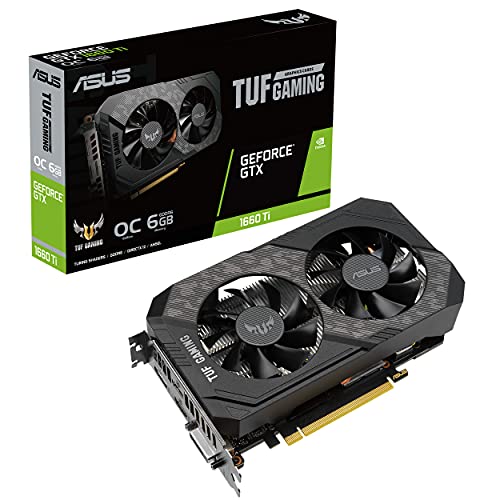
ASUS TUF Gaming GeForce GTX 1660 Ti 6GB
Best for: compact builds needing dedicated OBS hardware encoding
- Graphics Processor
- GeForce GTX 1660 Ti
- Memory Size
- 6GB
- Memory Type
- GDDR6
- Boost Clock
- 1845 MHz
- PCIe Interface
- PCIe 3.0
- Use
- Gaming
View on Amazon: ASUS TUF Gaming GeForce GTX 1660 Ti 6GB (paid link)
This graphics card provides 6GB of GDDR6 memory on a PCIe 3.0 interface for your gaming setup. It features an 1845 MHz boost clock in OC mode, 12 Gbps memory speed, and support for digital resolutions up to 7680 x 4320. Measuring 8.1 inches long and 1.8 inches high, it fits compact cases easily. It suits you if you need dedicated OBS streaming hardware and solid GDDR6 performance.
Pros
- Boost clock reaches up to 1845 MHz in OC mode
- 6GB GDDR6 memory with 12 Gbps memory speed
- Supports digital resolutions up to 7680 x 4320
- Dedicated hardware encoder optimized for OBS
- Compact 8.1-inch card length fits smaller cases
Cons
- Operates on older PCIe 3.0 interface
- Memory capacity is limited to 6GB
Good fit if
- You need a compact card measuring under 8.5 inches long.
- You use OBS and want dedicated hardware encoding.
- You have a motherboard using a PCIe 3.0 slot.
Skip if
- You require more than 6GB of video memory.
- You want native PCIe 4.0 connectivity.
Verdict: ASUS TUF Gaming GeForce GTX 1660 Ti 6GB delivers solid 12 Gbps GDDR6 memory performance and an 1845 MHz boost clock within a compact 8.1-inch frame. It is a capable pick if your system uses PCIe 3.0 and requires dedicated OBS hardware encoding.

PowerColor Fighter Radeon RX 6500 XT 4GB
Best for: compact builds needing high clock speeds
- Graphics Processor
- AMD Radeon RX 6500 XT
- Memory Size
- 4GB
- Memory Type
- GDDR6
- Boost Clock
- 2820Mhz
- Use
- Gaming
- Dimensions
- 7.52 × 4.96 × 1.57 inches
View on Amazon: PowerColor Fighter Radeon RX 6500 XT 4GB (paid link)
The PowerColor Fighter Radeon RX 6500 XT 4GB is a compact graphics card designed for gaming. It features 1024 stream processors, a 2650 MHz game clock, and a 2820 MHz boost clock. With 4GB of GDDR6 memory clocked at 18.0 Gbps, this unit handles resolutions up to 7680×4320. Measuring 7.52 inches long and 1.57 inches high, it fits setups where space is limited and you need entry-level display processing.
Pros
- High boost clock reaching up to 2820 MHz
- Fast 18.0 Gbps GDDR6 memory speed
- Compact 7.52-inch length and 1.43-pound weight
- Supports digital resolutions up to 7680×4320
Cons
- Limited to 4GB of VRAM
- 1024 stream processors
Good fit if
- You need a card under 8 inches long for a smaller chassis.
- You want high core clock rates reaching up to 2820 MHz.
- You connect to a high-resolution display supporting up to 7680×4320.
Skip if
- You require more than 4GB of video memory.
- You need more than 1024 stream processors for heavier tasks.
Verdict: PowerColor Fighter Radeon RX 6500 XT 4GB delivers high clock speeds up to 2820 MHz in a compact 7.52-inch form factor. It provides a solid option if your setup requires 8K output support and modest physical dimensions.

ASRock Radeon RX 6500 XT Phantom Gaming 4GB
Best for: entry-level 1080p setups with 400W power supplies
- Graphics Processor
- AMD Radeon RX 6500 XT
- Memory Size
- 4GB
- Memory Type
- GDDR6
- Boost Clock
- 2820 MHz
- PCIe Interface
- PCIe 4.0
- Recommended PSU
- 400W minimum
View on Amazon: ASRock Radeon RX 6500 XT Phantom Gaming 4GB (paid link)
The ASRock Radeon RX 6500 XT Phantom Gaming 4GB is a dedicated graphics card built on AMD RDNA 2 architecture. It features a 2820 MHz boost clock paired with 4GB of 18 Gbps GDDR6 memory. Cooling uses a dual-fan design with 0dB silent cooling and a metal backplate. This 9.45-inch card suits you if you need 1080p gaming performance that runs on a 400W power supply.
Pros
- High 2820 MHz boost clock
- Dual-fan cooling with 0dB silent mode
- Fast 18 Gbps GDDR6 memory speed
- Modest 400W minimum power supply requirement
Cons
- 4GB VRAM capacity limits heavier workloads
- Offers only two display outputs
Good fit if
- You want a card with a 2820 MHz boost clock and 18 Gbps GDDR6 memory.
- You have a 400W power supply with an available 8-pin connector.
Skip if
- You need more than 4GB of video memory for your software.
- You plan to connect more than two monitors simultaneously.
Verdict: ASRock Radeon RX 6500 XT Phantom Gaming 4GB delivers a 2820 MHz boost clock and dual-fan cooling in a 9.45-inch frame. Its 4GB memory capacity and two display outputs suit straightforward 1080p builds.

PNY Quadro T600 4GB Low Profile Card
Best for: compact workstations needing GDDR6 memory
- Graphics Processor
- Quadro T600
- Memory Size
- 4 GB
- Memory Type
- GDDR6
- Form Factor
- Low Profile
View on Amazon: PNY Quadro T600 4GB Low Profile Card (paid link)
The PNY Quadro T600 Low-Profile is a dedicated workstation graphics card designed for compact desktop enclosures. It features the NVIDIA Quadro T600 graphics processor paired with 4 GB of GDDR6 memory. This setup handles standard professional visualization tasks while maintaining a low-profile physical form factor. If you need a workstation GPU that fits inside small cases without demanding excessive internal space, this card gives you modern GDDR6 memory in a slim format.
Pros
- NVIDIA Quadro T600 graphics processor
- 4 GB of GDDR6 memory
- Space-saving low-profile form factor
Cons
- Limited to 4 GB total memory capacity
- Display output types and counts not specified in product data
Good fit if
- You build or upgrade a small-form-factor workstation desktop.
- You need dedicated GDDR6 memory on a slim expansion card.
Skip if
- You need more than 4 GB of video memory for larger workloads.
- You require a full-height graphics card configuration.
Verdict: PNY Quadro T600 Low-Profile provides 4 GB of GDDR6 memory in a compact workstation format. It gives you dedicated Quadro processing for space-constrained desktop builds.

PNY Quadro T400 4GB GDDR6
Best for: slim desktop builds needing GDDR6 memory
- Graphics Processor
- NVIDIA Quadro T400
- Memory Size
- 4GB
- Memory Type
- GDDR6
- Dimensions
- 9.45 × 27.2 × 0.98 inches
- Weight
- 12 ounces
View on Amazon: PNY Quadro T400 4GB GDDR6 (paid link)
The PNY NVIDIA Quadro T400 4GB is a dedicated graphics card built around the NVIDIA Quadro T400 processor. It features 4GB of GDDR6 memory to handle standard visual workloads. With a physical height of 0.98 inches and a weight of 12 ounces, it fits into compact desktop enclosures. If you need a slim black card with dedicated GDDR6 memory for your system, this hardware suits you.
Pros
- Equipped with 4GB GDDR6 memory
- Powered by NVIDIA Quadro T400 GPU
- Slim profile with 0.98-inch height
- Lightweight build at 12 ounces
Cons
- Memory capacity limited to 4GB
- Display output types not listed in specifications
Good fit if
- You need 4GB of GDDR6 memory in your system.
- You require a slim card measuring under one inch in height.
- You want an NVIDIA Quadro T400 processor for basic workstation tasks.
Skip if
- You need more than 4GB of video memory for heavy workloads.
- You require confirmed display port configurations before buying.
Verdict: PNY NVIDIA Quadro T400 4GB offers an entry-level workstation processor with 4GB of GDDR6 memory in a slim 0.98-inch tall profile. It gives you dedicated graphics processing while keeping weight down to 12 ounces.

PNY NVIDIA T400 4GB Low Profile
Best for: compact multi-monitor workstation setups
- Graphics Processor
- NVIDIA T400
- Memory Size
- 4 GB
- Memory Type
- GDDR6
- PCIe Interface
- PCI Express 3.0 x16
- Form Factor
- Low Profile
- Dimensions
- 13 × 7.09 × 1.97 inches
View on Amazon: PNY NVIDIA T400 4GB Low Profile (paid link)
The PNY NVIDIA T400 4GB Low-Profile is a dedicated compact workstation graphics card designed for slim enclosures. You get 4 GB of GDDR6 memory on a PCI Express 3.0 x16 interface and an active cooling fan. It supports up to four displays simultaneously alongside DirectCompute API acceleration. This card suits you if you need multi-monitor productivity and basic rendering without taking up standard expansion space in your desktop build.
Pros
- Low-profile form factor fits space-constrained desktop cases
- Supports up to 4 concurrent monitors
- Equipped with 4 GB of GDDR6 memory
- Active cooler provides dedicated thermal management
Cons
- PCI Express 3.0 interface rather than newer bus standards
- 4 GB memory capacity limits heavy rendering projects
Good fit if
- You need a low-profile card for a compact workstation setup
- You require display connectivity for up to 4 monitors
- You rely on DirectCompute API support for your applications
Skip if
- You need more than 4 GB of VRAM for intensive tasks
- You want a modern PCI Express 4.0 interface
Verdict: PNY NVIDIA T400 4GB Low-Profile delivers multi-display capabilities and GDDR6 memory in a slim format. It provides reliable output across four screens without demanding substantial chassis space.

MSI GeForce RTX 3050 8GB Dual Fan
Best for: PCIe 4.0 systems needing 8GB VRAM
- Graphics Processor
- GeForce RTX 3050
- Memory Size
- 8GB
- Memory Type
- GDDR6
- Boost Clock
- 1807 MHz
- Memory Bus Width
- 128-bit
- PCIe Interface
- PCIe 4
View on Amazon: MSI GeForce RTX 3050 8GB Dual Fan (paid link)
This MSI dual-fan card runs on the NVIDIA GeForce RTX 3050 processor. It features 8GB of GDDR6 memory on a 128-bit bus and uses a PCIe 4.0 interface. The GPU delivers an 1807 MHz boost clock. At 8.07 inches long, it fits standard compact cases. You get DisplayPort 1.4a, HDMI 2.1, and legacy DL-DVI-D connections. It suits you if you need modern PCIe 4.0 support with 8GB video memory for gaming.
Pros
- 8GB GDDR6 video memory
- PCIe 4.0 interface support
- 1807 MHz boost clock
- Compact 8.07-inch card length
Cons
- Single DisplayPort output limits modern multi-monitor setups
- Narrow 128-bit memory interface width
- Relies on legacy DL-DVI-D instead of modern second DisplayPort
Good fit if
- You need a PCIe 4.0 graphics card with 8GB GDDR6 memory.
- You require a compact dual-fan card under 8.5 inches long.
- You use display setups relying on HDMI 2.1 or DL-DVI-D.
Skip if
- You need multiple DisplayPort outputs for dual monitors.
- You require a memory bus wider than 128-bit.
Verdict: MSI GeForce RTX 3050 8GB Dual-Fan Card provides PCIe 4.0 connectivity, an 1807 MHz boost clock, and 8GB GDDR6 VRAM in a compact 8.07-inch footprint. It gives you stable entry-level bandwidth and dual-fan cooling for space-limited gaming enclosures.
Specifications side by side
| Spec | XFX Speedster SWFT210 Radeon RX 6600 XT 8GB | PNY Quadro P4000 Single-Slot GPU | PNY NVIDIA Quadro RTX 4000 Turing GPU | MSI GeForce GTX 1650 4GB | ASUS TUF Gaming GeForce GTX 1650 4GB | PNY NVIDIA T1000 4GB GDDR6 | PNY Quadro T1000 4GB GDDR6 | PNY NVIDIA T1000 Workstation Card | ASUS TUF Gaming GeForce GTX 1660 Ti 6GB | PowerColor Fighter Radeon RX 6500 XT 4GB | ASRock Radeon RX 6500 XT Phantom Gaming 4GB | PNY Quadro T600 4GB Low Profile Card | PNY Quadro T400 4GB GDDR6 | PNY NVIDIA T400 4GB Low Profile | MSI GeForce RTX 3050 8GB Dual Fan |
|---|---|---|---|---|---|---|---|---|---|---|---|---|---|---|---|
| Graphics Processor | Radeon RX 6600 XT | NVIDIA Quadro P4000 | Quadro RTX 4000 | GeForce GTX 1650 | GeForce GTX 1650 | NVIDIA T1000 | Quadro T1000 | NVIDIA T1000 | GeForce GTX 1660 Ti | AMD Radeon RX 6500 XT | AMD Radeon RX 6500 XT | Quadro T600 | NVIDIA Quadro T400 | NVIDIA T400 | GeForce RTX 3050 |
| Memory Size | 8GB | not specified | not specified | 4GB | 4GB | 4 GB | 4 GB | not specified | 6GB | 4GB | 4GB | 4 GB | 4GB | 4 GB | 8GB |
| Memory Type | GDDR6 | not specified | not specified | GDDR5 | GDDR6 | GDDR6 | GDDR6 | not specified | GDDR6 | GDDR6 | GDDR6 | GDDR6 | GDDR6 | GDDR6 | GDDR6 |
| Boost Clock | not specified | not specified | not specified | not specified | not specified | not specified | not specified | not specified | 1845 MHz | 2820Mhz | 2820 MHz | not specified | not specified | not specified | 1807 MHz |
| Memory Bus Width | not specified | not specified | not specified | 128-bit | not specified | not specified | not specified | not specified | not specified | not specified | not specified | not specified | not specified | not specified | 128-bit |
| PCIe Interface | not specified | PCI Express 3.0 x16 | not specified | not specified | PCIe 3.0 | not specified | not specified | not specified | PCIe 3.0 | not specified | PCIe 4.0 | not specified | not specified | PCI Express 3.0 x16 | PCIe 4 |
| Recommended PSU | not specified | not specified | not specified | not specified | not specified | not specified | not specified | not specified | not specified | not specified | 400W minimum | not specified | not specified | not specified | not specified |
| Slot Width | not specified | single slot | not specified | not specified | not specified | not specified | not specified | not specified | not specified | not specified | not specified | not specified | not specified | not specified | not specified |
| Memory | 8GB | not specified | not specified | not specified | 4GB | 4GB | 4GB | not specified | 6GB | 4GB | not specified | 4GB | 4GB | 4GB | 8GB |
| GPU | not specified | not specified | not specified | GeForce GTX 1650 | GeForce GTX 1650 | not specified | not specified | not specified | not specified | not specified | not specified | not specified | not specified | not specified | not specified |
| Interface | not specified | not specified | not specified | not specified | PCIe 3.0 | not specified | not specified | not specified | PCIe 3.0 | not specified | not specified | not specified | not specified | not specified | PCIe 4.0 |
| Form Factor | not specified | not specified | not specified | not specified | not specified | not specified | not specified | not specified | not specified | not specified | not specified | Low Profile | not specified | Low Profile | not specified |
| Use | Gaming | not specified | not specified | Gaming | Gaming | not specified | not specified | not specified | Gaming | Gaming | Gaming | not specified | not specified | not specified | Gaming |
| Dimensions | 9.49 × 5.16 × 1.61 inches | 9.5 × 4.38 × 0.75 inches | 2 × 4 × 8 inches | 7 × 1.5 × 4.4 inches | 8.11 × 4.92 × 1.81 inches | not specified | 11 × 6.3 × 2.6 inches | 12.1 × 7 × 3.5 inches | 8.1 × 4.9 × 1.8 inches | 7.52 × 4.96 × 1.57 inches | 9.45 × 5.08 × 1.65 inches | not specified | 9.45 × 27.2 × 0.98 inches | 13 × 7.09 × 1.97 inches | 8.07 × 1.77 × 4.41 inches |
| Weight | 2.2 pounds | 1.05 pounds | 2.97 pounds | 1.65 pounds | 1.39 pounds | 7.05 ounces | 1.3 pounds | 10.5 ounces | 1.41 pounds | 1.43 pounds | 1.1 pounds | not specified | 12 ounces | not specified | 1.75 pounds |
| Model | not specified | VCQP4000-PB | VCQRTX4000-PB | G1650VXS4C | TUF-GTX1650-O4GD6-P-GAMING | VCNT1000-PB | VCNT1000-SB | VCNT1000-PB | TUF-GTX1660TI-O6G-EVO-GAMING | AXRX 6500XT 4GBD6-DH/OC | RX6500XT PGD 4GO | not specified | VCNT400-4GB-SB | 120150 | RTX 3050 Ventus 2X XS 8G OC |
| Size | not specified | not specified | not specified | 1 | not specified | not specified | not specified | not specified | not specified | not specified | RX 6500 XT 4GB | not specified | not specified | 0 | 1.8" x 4.4" x 8.1" |
| Color | not specified | not specified | not specified | not specified | not specified | not specified | not specified | not specified | not specified | not specified | Black | not specified | Black | Information Not Available | Information Not Available |
Hardware Limitations Across These Graphics Cards
You encounter clear physical and technical ceilings among these 15 options. Dedicated memory maxes out at 8GB of GDDR6, while several compact options drop to 4GB of GDDR5 or GDDR6 memory. Form factor dictates capability. Choosing an 8GB model requires accommodating lengths up to 17 inches in your chassis. Shorter cards fit constrained builds but limit your display memory. Interfaces also vary across generations, with certain options operating on PCIe 3.0 rather than PCIe 4.0 bandwidth. Workstation and gaming choices prioritize specific display configurations over broad hardware expansion.
- Memory capacity caps at 8GB, with several options restricted to 4GB GDDR5 or GDDR6.
- Physical card length reaches up to 17 inches to accommodate higher memory configurations.
- Interface support splits between PCIe 4.0 and older PCIe 3.0 transfer standards.
If you want dedicated audio hardware for your desk setup, you can evaluate driver sizes and impedance ratings across headphones under 300 as well.
How We Chose These Cards
We select items for this guide from Amazon listings that match the qualifying category requirements. Only one size or variant of each product family is included on the page. You see the collection organized with products in stock first, then by Amazon sales rank (better-selling products first).
All reported details come directly from the published specifications and feature lists on each card's listing. We do not physically handle or test products. Stock and catalog details refresh at least daily to keep data current. Because listings change regularly, models move into or out of the guide automatically.
Spec Checklist for Choosing Your Graphics Card
-
Compare Memory Generations
Check the generation of video memory listed on the spec sheet. GDDR6 memory transfers data faster than older GDDR5 memory across identical bus widths. If you handle modern 3D rendering or high-refresh gaming, look for GDDR6 to avoid memory throughput bottlenecks. If your system runs basic office tasks or legacy software, GDDR5 remains adequate. The MSI GeForce GTX 1650 4GB uses GDDR5 on a 128-bit bus, whereas newer options upgrade to GDDR6 memory. Always match memory generation to the intensity of your visual processing tasks.
-
Check PCIe Interface Compatibility
Match the expansion bus version of the card to your motherboard slot. A PCIe 4.0 graphics card provides up to 64GB/s of potential bandwidth when paired with a compatible PCIe 4.0 slot and processor. Installing a PCIe 4.0 card into an older PCIe 3.0 motherboard functions normally, but operates at reduced transfer ceilings. If your system uses an older platform, selecting a dedicated PCIe 3.0 card like the ASUS TUF Gaming GeForce GTX 1650 4GB ensures you receive native bus performance without paying for interface bandwidth your motherboard cannot utilize.
-
Verify System Power Ceilings
Review the operational wattage of each card before mounting it inside your desktop enclosure. Standard high-performance graphics hardware frequently demands dedicated power cables and substantial power delivery units. Compact workstations with proprietary or low-output power supplies require low-draw hardware instead. The PNY NVIDIA T1000 4GB Graphics Card features a modest 50 W power ceiling, running entirely on the power provided through the motherboard slot. Checking your power supply capacity prevents system instability, unwanted thermal throttling, or the need to upgrade your existing power supply unit during setup.
-
Measure Slot Height Clearance
Check the vertical clearance and bracket profile of your desktop expansion bays. Many graphics cards occupy two or more physical expansion slots, which can obstruct adjacent PCIe slots, internal capture cards, or storage adapters. Workstation chassis with dense motherboard layouts often require slender hardware to fit alongside other expansion cards. The PNY Quadro P4000 Single-Slot GPU measures just 0.75 inches in height, leaving adjacent expansion slots accessible. Measure the vertical gap between your motherboard slots and neighboring components before choosing between single-slot and multi-slot cards.
-
Evaluate Dedicated Ray Tracing
Determine whether your daily workloads rely on hardware-accelerated ray tracing or standard rasterized graphics computation. Standard graphics processors compute lighting through software approximation, which slows down complex rendering jobs. Specialized professional GPUs include dedicated ray tracing cores that handle real-time lighting calculations directly in silicon. The PNY NVIDIA Quadro RTX 4000 Turing GPU includes 36 dedicated RT cores for hardware ray-traced rendering workflows. If your primary focus is computer-aided design, 3D simulation, or visualization software, prioritize graphics cards that specify dedicated hardware ray tracing cores over standard compute units.
-
Count Required Display Outputs
Calculate how many monitors you intend to connect before deciding on a card. Some entry-level graphics boards provide only two or three video ports, restricting your external display setup. If your workstation requires an expansive workspace across multiple screens, prioritize cards configured with four independent display connectors. The XFX Speedster SWFT 210 Radeon RX 6600 8GB includes four dedicated display outputs to support multi-monitor gaming or productivity setups simultaneously. Confirm that the card provides enough ports for your monitors without requiring active splitters or external adapter hubs.
Frequently asked questions
Which graphics card supports hardware ray tracing?
The PNY NVIDIA Quadro RTX 4000 Turing GPU includes dedicated hardware for ray tracing. It features 36 RT cores built on the Turing architecture to accelerate professional rendering and VR workloads. Measuring 8 inches high and 4 inches wide, this card provides hardware-level ray-traced rendering within a dedicated workstation environment.
Can you run four displays from a single graphics card?
Yes, several cards on this list run up to four displays simultaneously. The XFX Speedster SWFT210 Radeon RX 6600 XT 8GB provides four display outputs for multi-panel desktop setups. For compact workstations, the PNY NVIDIA T1000 Workstation Card and the low-profile PNY NVIDIA T400 4GB also support connections for up to four monitors.
What is the highest boost clock speed available among these cards?
The highest boost clock reaches 2820 MHz on specific Radeon RX 6500 XT models. Both the PowerColor Fighter Radeon RX 6500 XT 4GB and the ASRock Radeon RX 6500 XT Phantom Gaming 4GB achieve this 2820 MHz clock speed. The PowerColor measures 7.52 inches long, while the ASRock card utilizes a 9.45-inch frame with dual-fan cooling.
Which graphics card works best for dedicated OBS live streaming?
The ASUS TUF Gaming GeForce GTX 1660 Ti 6GB is configured for OBS streaming needs. It includes dedicated OBS hardware encoding alongside 6GB of GDDR6 memory running at 12 Gbps. Operating on a PCIe 3.0 interface with an 1845 MHz boost clock, its 8.1-inch card length fits easily into smaller desktop enclosures.
Which graphics cards support a PCIe 4.0 interface?
The MSI GeForce RTX 3050 8GB Dual Fan explicitly lists PCIe 4.0 connectivity. This model pairs PCIe 4.0 bandwidth with 8GB of GDDR6 video memory and an 1807 MHz boost clock. Measuring 8.07 inches in length, it uses a dual-fan cooling setup to maintain stable entry-level performance in compact gaming rigs.
What options fit into an extremely slim single-slot expansion bay?
The PNY Quadro P4000 Single-Slot GPU is built specifically for tight physical slots. It measures 0.75 inches in height, allowing it to occupy only one expansion bracket in your chassis. That slim profile makes it suitable for CAD, visualization, and simulation setups where adjacent motherboard slots must remain accessible for other hardware cards.
What is the shortest graphics card on this list for compact builds?
The MSI GeForce GTX 1650 4GB is the shortest card here at 7 inches long. Its compact dimensions include a height of 4.4 inches and a width of 1.5 inches. Despite the small physical profile, it provides three display connections and 4GB of dedicated memory running across a 128-bit bus for space-constrained cases.